
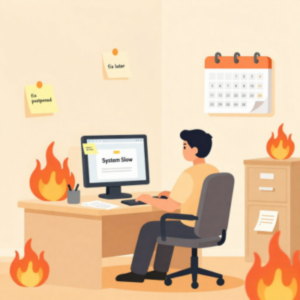
 I want to tell you something that every IT person knows, but most business owners only discover the hard way.
The thing that takes your business offline in July? It usually started quietly in April.
A system that was just a little slow. An update that kept getting pushed back one more week. A backup that was probably running fine, but nobody had actually checked in a while.
None of those felt like problems at the time. Everything was still working. There were more urgent things to deal with. So they went on the list — the mental one, the one that somehow never gets shorter — right next to “we’ll get to that eventually.”
And then eventually arrives. And it almost never arrives at a convenient time. 😬
Why Summer Makes Everything Harder
Here’s the thing about IT problems: they don’t care about your vacation schedule. But your ability to deal with them absolutely depends on it.
During the summer, key people are out. Schedules are less predictable. The person who knows where that file lives is in a cabin somewhere with spotty cell service. The vendor who handles your software license is also apparently “up north” at the lake.
So, when a deferred issue finally surfaces — and it will — it’s not just an inconvenience. It’s a disruption that hits a thinner team, takes longer to diagnose, and affects more people in the process.
What could have been handled quietly in the background — a 15-minute fix in February — turns into a half-day fire drill in July that everyone feels.
And you’re the one trying to fight it with half your crew out of office. </soapbox>
The Three Things That Keep Showing Up
I see versions of this play out constantly. Here are the three that come up most often:
1. The ‘It’s Just a Little Slow’ System
It starts with a system that’s slightly slower than it should be.
Nothing stops working, so nobody reports it. People adapt. They wait a few extra seconds, refresh the screen, try again. It becomes part of the routine.
Until one day — it doesn’t come back.
Now your team can’t access what they need. People start troubleshooting on their own: restarting devices, guessing at the cause, building workarounds.
If the person who usually handles this is out, it takes even longer.
What would have been a quick fix when the issue first appeared is now a half-day outage that takes down the whole team.
And the whole time, there were signs. They just never quite crossed the threshold of “urgent enough to deal with today.”
2. The Update That Keeps Getting Postponed
There’s always one. There’s a deadline to hit. A project in progress. Something more pressing that takes priority. The update gets bumped to next week, then bumped again.
Everything seems to be working, so it doesn’t feel like a risk. And technically, it isn’t — until it is.
A system becomes incompatible. A known vulnerability gets exploited because the patch has been sitting in the queue since March. A critical tool stops working the way it should — or stops working entirely.
Instead of a planned, controlled update during a slow Tuesday morning, your team is dealing with an unplanned disruption during one of the busiest stretch of summer projects.
The update that “could wait” waited one week too many.
3. The Backup Nobody Tested
Backups tend to run quietly in the background. Which means they’re easy to forget about — right up until the moment you desperately need one.
Maybe there was a warning at some point. A notification that didn’t seem urgent. Since nothing failed at the time, it was easy to assume everything was fine. That assumption holds until a file is lost, a system fails, or data needs to be restored.
And then you find out — right in that moment — whether your backup actually works.
If it hasn’t been running properly, is incomplete, or has never been tested… recovery gets complicated. And slow. And expensive.
What should have been a quick restore turns into a days-long effort while your team waits to get back to work. 😬
The Difference Isn’t Luck. It’s Approach.
The businesses that seem to glide through the summer without IT crises aren’t just lucky. They’re running a fundamentally different model.
Instead of waiting for something to break, they’re catching problems before they turn into disruptions. Performance issues get addressed when they first appear. Updates run on a consistent schedule — not when someone finally decides they can’t wait any longer. Backups get monitored and tested, not just assumed.
Does that eliminate every issue? No. Stuff still happens.
But it keeps small problems from turning into all-hands fire drills during the two weeks your team is already stretched thin.
That’s not a different level of tech. That’s just a different mindset about how to manage it. 💪
What’s Sitting on Your List Right Now?
I’m going to guess you already know what your version of this looks like.
There’s probably a system that’s been a little sluggish. An update that’s been on the list longer than you’d like to admit. A backup that you’re pretty sure is running fine, but haven’t actually verified recently. None of those feel urgent today. And they might be perfectly fine.
But if any of them surface in the middle of July — with three people on vacation and a client deadline looming — you’re going to wish you’d taken 30 minutes to look into it in June.
That’s where we can help.
We keep your systems monitored so small issues don’t quietly grow into big ones. We handle updates on a consistent schedule so nothing gets pushed to the point of crisis. We make sure your backups are actually working — not just running. And we give your team a clear, fast path to get help when something isn’t right.
Not so you can stop thinking about IT. It’s so that when you do have to think about it, it’s a five-minute conversation instead of a five-alarm fire. 🔥
No pressure. No long sales process. Just a practical look at what’s been sitting on your list — and what it would take to make sure it doesn’t turn into your next fire drill. 🎯
And if you know a business owner who’s been pushing the same three things back for the last six months, send this their way.
They’re probably closer to a fire drill than they think.