
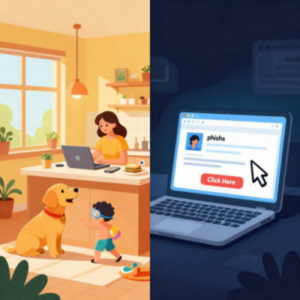
 School’s out.
And if you’re a business owner or manager with kids at home, you already know what that means for your workday.
You’re starting earlier to get ahead of the noise. Or working in stolen chunks between snack requests and “Moooom, he’s looking at me again!” Or logging back in after dinner to finish what the afternoon interrupted. The work is still getting done. It just looks… different.
And here’s the thing: cybercriminals know exactly what your summer workday looks like. And they plan around it. 😬
This Isn’t Your Normal Workday — And That’s the Whole Point
I’m not going to pretend the summer distraction thing is a secret. We all live it.
Brutus is barking. Johnny Jr. is crying. Your phone is buzzing with something that might be urgent. And an email just landed in your inbox that looks completely routine — an invoice, a shared file, a quick request — designed for exactly this moment.
Not when you’re focused. When you’re busy.
That’s the whole strategy. Cybercriminals aren’t betting on you being careless. They’re betting on you being human. And humans, when they’re juggling seventeen things and trying to keep the afternoon from completely derailing, make quick decisions.
Speed wins over scrutiny almost every time. Summer doesn’t create new security risks. It just makes the existing ones a lot easier to miss.
The Click Isn’t the Problem. It’s What the Click Has Access To.
Here’s where I want to slow down for a second, because this part really matters.
When someone clicks a phishing link or opens a malicious attachment, the immediate damage usually looks small. A weird redirect. An email that doesn’t load quite right. Easy to dismiss. Easy to forget about.
But that click just opened a door. And behind that door is everything that account can reach: email, files, shared drives, client records, financial systems, and every other account that shares the same login credentials. None of those operate in isolation. Once access is gained, it rarely stays contained.
The problem spreads quietly — moving through accounts, accessing data, sometimes sitting dormant for days or weeks before anything surfaces.
By the time someone notices something is off, the impact is already much bigger than one bad click.
That’s not a scare tactic. That’s just how it works. </soapbox>
Why ‘Just Be More Careful’ Isn’t a Strategy
I hear this one a lot, and I get the instinct.
“If everyone just paid more attention, this wouldn’t happen.”
But think about what that actually requires. It requires every person on your team to bring perfect focus and careful scrutiny to every single click, every single day — including the afternoon in late June when the AC is running, the kids are arguing about the TV remote, and there are twelve things left on the to-do list.
That’s not realistic. That’s not even fair to ask.
Work moves fast. Attention is split. People are doing their best in conditions that are genuinely challenging. The goal shouldn’t be perfect attention. It should be building systems that don’t require it. 💪
What Actually Works
Good security is designed for real workdays — not ideal ones. The kind where people get interrupted, move quickly, and don’t have time to second-guess every click.
In practical terms, that looks like a few specific things:
- Unique passwords for every login — so one compromised account doesn’t unlock everything else. A password manager makes this easy without asking your team to memorize anything.
- Multi-factor authentication turned on — so a stolen password is still just a password, not access.
- Email filtering that catches suspicious messages before they arrive — because the best click is the one that never had to happen.
- A culture where it’s safe to pause and ask “Does this look right?” — without feeling like you’re slowing things down or looking inexperienced.
None of this depends on perfect behavior. It’s designed for the workday where Brutus is barking, someone needs a snack, and the inbox is filling up anyway. That workday.
While Things Still Feel ‘Mostly Fine’
Here’s the question worth sitting with:
If someone on your team makes the wrong click this afternoon — not a catastrophic mistake, just a quick decision in a busy moment — is it a small, contained issue? Or is it something that quietly spreads through every system your business runs on?
Would you catch it right away? Or only after it’s already done its damage?
Summer doesn’t create these vulnerabilities. It just makes them easier to miss until they’re not. If your business is still relying on everyone catching everything perfectly, it’s worth taking a closer look — while things still feel mostly fine — before that changes.
No pressure. No jargon. Just a practical conversation about whether your current setup is built for the real workday — the one that actually happens in June. 🎯
And if you know another business owner trying to keep everything running while summer competes for their attention, send this their way.
Because “mostly fine” is a great time to check. It’s much better than the alternative.