
 You know that favorite sock you have? The one with the hole in it?
The one that’s clearly past its prime — but not quite bad enough to throw out. So, it stays in the drawer. You keep wearing it. You’ve adjusted. You barely notice the hole anymore.
Most businesses treat their outdated technology exactly the same way.
The system that takes forever to send a simple email. The machine that freezes when you hit save, like it briefly forgot what computers are supposed to do. The login that takes four attempts on a good day.
None of it is bad enough to stop everything and deal with. So, you adapt. You work around it. You wait the extra seconds. You restart when you have to. You move on.
And the whole time, the meter is running. The invoice just isn’t labeled. 😬
Keeping Old Tech Isn’t Frugal. It’s Just Expensive in a Different Way.
I hear this reasoning a lot: “If it’s still working, why replace it?”
And honestly? On the surface, it sounds practical. Even responsible. Why spend money when you don’t have to?
Here’s the problem with that logic: the old system isn’t free. It’s billing you every single month. You’re just not getting an itemized statement.
Let me show you what I mean.
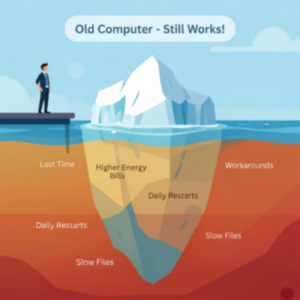
Energy costs. Older equipment doesn’t run efficiently — it works harder to keep up. It uses more power, generates more heat, and puts extra strain on everything around it. (During the summer, that last part is especially fun.) Newer systems are built to do more while consuming less. Over time, that difference shows up on your utility bill in ways that are easy to attribute to “just normal costs” — unless you’re looking for them.
Lost time. Tasks that should take 30 seconds take three minutes. Files are slow to open. The system lags between clicks. It’s not a dramatic outage — just a steady drip of small delays that add up faster than anyone tracks. Research from UC Irvine found that it takes an average of 23 minutes (and 15 seconds) to fully refocus after an interruption. Those “quick” restarts aren’t costing you two minutes. They’re costing you the better part of the next half hour.
Daily interruptions. Frozen screens. Dropped connections. The restart that’s become part of everyone’s morning routine. Each one is minor on its own. But they break focus, slow momentum, and quietly train your team to expect friction as the default.
Put those three together — higher bills, lost time, constant interruptions — and what looked like the frugal choice starts looking like the expensive one.
That sock with the hole in it? You’ve been paying for it this whole time. </soapbox>
What Changes When You Stop Paying for Problems
Here’s what I always hear from businesses once they’ve addressed the outdated systems:
“I didn’t realize how much time we were losing until we stopped losing it.”
When the right systems are in place, the day just… moves differently. Systems start when they’re supposed to — no delays, no second attempts. Restarts stop being part of the routine. Your team spends their time actually working instead of waiting, troubleshooting, or building workarounds for technology that’s supposed to be helping them.
Energy use comes down. Ongoing costs tied to inefficiency and downtime start to shrink. The friction that everyone had quietly accepted as normal disappears.
It’s not that everything suddenly becomes perfect. It’s that the baseline is finally where it should have been. 💪
Be Honest with Yourself for a Minute
Are your systems slow? Do issues keep surfacing on the same machines? Has your team quietly developed workarounds because “that’s just how it works here”?
If yes — you’re already covering the cost. You’re just paying it in ways that don’t show up on a single line item.
The question isn’t really whether you can afford to update your technology. It’s whether you can afford to keep not updating it.
This doesn’t fix itself. It just keeps running in the background, quietly charging you through lost time, higher bills, and daily interruptions that never quite go away.
That’s Where We Come In
We help businesses figure out exactly what they’re paying for — and stop paying for what isn’t worth it.
That means:
- Identifying which systems are quietly costing more than they’re delivering
- Helping you decide what should be replaced now vs. what can wait
- Recommending efficient, right-sized upgrades — not unnecessary ones
- Handling the transition so your team isn’t disrupted
- Maintaining everything going forward so you don’t end up back in the same position in two years
The goal isn’t to spend money on new technology for its own sake. It’s to stop spending money on old technology that’s already charging you in ways you can’t see.
No pressure. No lengthy audit process. Just a practical conversation about what’s been draining your time and energy — and what it would actually look like to fix it. 🎯
And if you know a business owner who’s been tolerating the same slow system and the same daily restarts for longer than they should — send this their way.
They’re paying for it too. They just might not know it yet.