
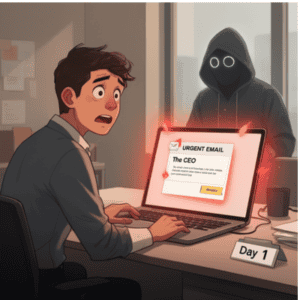
 The email shows up on a Tuesday morning. It looks like it’s from the CEO.
The name matches. The tone is right. Even the signature looks exactly right.
“Hey — can you help me with something quickly? I’m in back-to-back meetings. Need you to handle a vendor payment. I’ll explain later.”
The new employee pauses…
They’ve been with the company for four days. They’re still figuring out where the bathroom is. They don’t know what’s normal yet — and they definitely don’t want to be the person who questions the CEO in their first week.
So they go ahead and help.
And just like that, the damage is done. 😬
Why the First Week Is the Most Dangerous Week
Every spring, businesses bring in a fresh wave of employees — recent graduates, summer interns, new hires stepping into their first real roles. For companies, it’s onboarding season. For attackers? It’s something else entirely.
According to Keepnet Lab’s 2025 New Hires Phishing Susceptibility Report, CEO impersonation emails are 45% more likely to succeed with new hires than with experienced employees.
Forty-five percent. Let that sink in for a second.
Attackers don’t go after your most seasoned people. They go after the ones still learning the ropes — because there’s a window at the beginning where everything is unfamiliar and nothing feels certain.
A new employee doesn’t know what a typical request looks like. They don’t know how the CEO usually communicates. They haven’t had time to build instincts or confidence yet.
And cybercriminals take full advantage of that uncertainty.
But here’s the thing: The new employee isn’t the problem.
The most dangerous employee isn’t careless. It’s the one trying to be helpful.
If you run a business, you probably already know exactly who on your team would respond first. Sound familiar? Yeah… I thought so. 😅
The Real Gap Isn’t Training. It’s the System.
Now think back to your last new hire’s first day.
Their laptop wasn’t ready. Access hadn’t been fully set up. Their email account was still being created. They borrowed someone else’s login to check something quickly. They saved a file locally because they couldn’t get into the shared drive. They used their personal phone to look up a client number because it was just… faster.
None of that felt risky. It felt like being resourceful. Like doing what needed to get done on a hectic first day.
But here’s what was happening quietly in the background:
- Shared credentials created accounts nobody tracks
- Files ended up outside your backup systems
- A personal device touched your business data
- Nobody explained what to do if something feels off
The same Keepnet report found that new employees are 44% more susceptible to phishing than tenured staff. That gap doesn’t come from carelessness.
It comes from chaos.
When onboarding is chaotic, security becomes optional by default. And that’s the exact environment a phishing email walks into.
The attack didn’t create the vulnerability. The first day did. </soapbox>
What a Prepared First Day Actually Looks Like
The good news: fixing this doesn’t require a lengthy security presentation on day one. It doesn’t require a new tool or a compliance program. It just requires three things to be ready before the person walks in the door.
- Their access is configured — not improvised.
Laptop ready. Credentials created. Permissions clearly defined. No borrowing logins, no temporary workarounds, no “we’ll sort that out later this week.” When people don’t have what they need from the start, they improvise. And improvised access is where problems quietly begin.
- They know what a normal request looks like in your business.
This doesn’t have to be formal training. A quick 10-minute conversation does the job: Does the CEO ever email about payments? Does anyone? What should they do if something feels off? That’s it. Basic orientation. Takes almost no time and pays enormous dividends.
- They have somewhere to ask questions without looking or feeling foolish.
The employee who hesitated before clicking that email probably would have asked someone — if they’d known who to ask. Most first-week mistakes happen quietly because new hires don’t want to look inexperienced in front of their new colleagues.
Give them a person. Give them a process. Make it safe to ask. That’s honestly all it takes!
Most security mistakes don’t happen when someone ignores the rules.
They happen when someone doesn’t know the rules yet. 💪
Worth a Conversation Before That Tuesday Email Arrives
Maybe your onboarding is already solid. Maybe your team is small enough that first days feel more personal than procedural — and that’s genuinely great.
But if you’ve ever had a new hire improvise their way through week one — or if you’re planning to bring someone on this spring — it’s worth a quick conversation before that email shows up in their inbox.
Because the best time to close that door is before anyone walks through it.
No pressure. No scare tactics. Just a practical look at whether your onboarding process is leaving doors open for the wrong people. 🎯
And if you know another business owner who’s about to hire this spring? Send this their way. They’ll thank you later.