
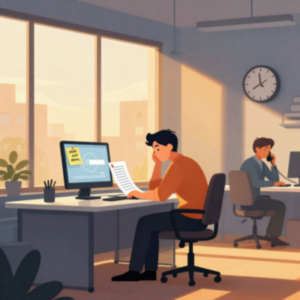
 It’s one of the longest days of the year.
More daylight. More usable hours. More runway to actually make a dent in that to-do list that’s been quietly judging you since January.
And yet…
If you’re like most business owners I talk to, today is going to feel exactly like every other day. The meetings will run long. Something unexpected will come up. And somewhere around 5:30 PM — with the sun still blazing outside your window — you’re going to look at your list and wonder how it happened again.
How did I run out of time on the longest day of the year? 😅
Here’s what I’ve come to believe: for most businesses, time isn’t actually the problem. It’s where the time is going.
The Day Doesn’t Fall Apart All at Once
Nobody sits down on a Monday morning hoping to lose the day. You start with a plan. Maybe even a good one.
And then something small happens.
An employee can’t log in. The Wi-Fi slows down for no reason anyone can identify. A file isn’t where it’s supposed to be. A system takes twice as long to respond as it should.
None of those things are disasters. On their own, each one is a minor annoyance. A two-minute interruption. A quick detour.
But here’s what actually happens when you get pulled off a task:
You don’t just lose the two minutes. You lose the momentum. And according to research from UC Irvine, it takes an average of 23 minutes (and 15 seconds) to fully refocus after an interruption.
So that “quick” Wi-Fi fix? That’s not two minutes. That’s potentially most of the next half hour — gone. And when it happens three or four times before lunch, you’ve already lost a significant chunk of your most productive hours before the afternoon even starts.
Multiply that across your whole team, five days a week, 52 weeks a year, and you’re not looking at a minor inconvenience. You’re looking at a serious, invisible drain on everything your business is trying to accomplish.
It’s not about having more time. It’s about losing less of it. </soapbox>
You Can Feel the Difference
I bet you know exactly what I’m describing — because you’ve also had the other kind of day. The kind where everything just… works.
Systems are fast. Files are where they should be. Nobody gets pulled into an unexpected tech issue. Your team stays focused. You stay focused. Tasks actually get done in the time they were supposed to take.
On those days, you don’t feel like you suddenly have more time. You feel like the day finally worked the way it was always supposed to.
That’s the difference I’m talking about. Not more hours. Just fewer holes in the ones you already have.
Adding Hours — or Headcount — Won’t Fix a Broken Workflow
Here’s the trap a lot of growing businesses fall into:
Things feel slow and inefficient, so the answer seems obvious: work longer, or hire more people.
And maybe that helps. In the short term.
But if the underlying systems are unreliable, slow, or constantly creating small problems that nobody’s officially in charge of fixing — adding more people just means more people experiencing the same friction. The inefficiency doesn’t go away. It scales.
At some point, you have to ask the harder question:
Is our business set up to run well, or are we just working harder to compensate for the fact that it isn’t?
That’s not a comfortable question. But it’s the right one. 💪
What Actually Changes Things
Businesses that run smoothly aren’t just better at managing their time. They’re set up to avoid losing it in the first place.
In practical terms, that means a few specific things:
- Systems that are monitored proactively — so problems get caught before they interrupt someone’s workday, not after.
- Recurring issues that get fixed at the root — not just worked around until they happen again next Tuesday.
- A clear, efficient path when something does go wrong — so the solution doesn’t take longer than the problem.
That kind of support doesn’t just reduce frustration. It protects your team’s focus, your ability to keep momentum, and the actual output your business produces every day.
The goal isn’t a perfect, problem-free business. Every business has issues. The goal is a business where those issues get resolved quickly and quietly — without derailing everyone else in the process.
What the Rest of Your Year Could Look Like
We’re at the midpoint of the year. The longest day is here — and it’s a genuinely useful moment to stop and ask:
Is the second half of this year going to look like the first? Or is it time to change something?
If you can’t get through a normal workday without a handful of interruptions, your business isn’t running at its potential. That’s not a people problem. It’s a systems problem.
And systems problems are fixable.
No jargon. No pressure. Just a practical conversation about where your day is actually going — and what it would look like to stop losing it. 🎯
And if you know a business owner who’s been pushing through the friction and hoping it gets better on its own — send this their way.
It won’t get better on its own. But it absolutely can get better.