
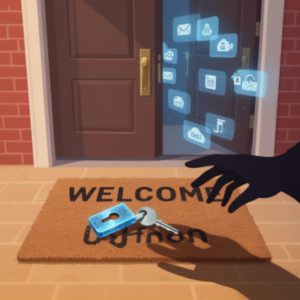
 Picture this.
You walk up to someone’s front door, glance down, and lift the welcome mat.
There’s the key. Right there. Exactly where you’d expect it.
Convenient? Absolutely. Safe? Not even a little.
Here’s the uncomfortable truth: most businesses treat their passwords exactly the same way. 😬
And in honor of World Password Day — yes, that’s a real thing, and yes, it’s in May — let’s talk about why this matters more than most people realize.
The Reuse Problem Nobody Talks About
Here’s how most breaches actually start:
Not inside your business. Somewhere else entirely.
A shopping site. A food delivery app. That subscription you signed up for three years ago and completely forgot about. That company gets breached. Suddenly your email and password are floating around in a database being sold on the dark web for pennies.
And then? Attackers get efficient. They take that same login and try it everywhere. Your email. Your banking portal. Your business applications. Your cloud storage.
One breach. One reused password. Now it’s not just one door that’s open — it’s the whole building.
Think about carrying one physical key that unlocks your house, your office, your car, and every account you’ve had for the past five years. Lose that key once — or let someone copy it — and everything is accessible. That’s what password reuse actually does. It turns one password into a master key for your entire digital life.
Here’s a number that should make you uncomfortable: A Cybernews study of 19 billion passwords exposed in breaches found that 94% are reused or duplicated across multiple accounts.
94%. That’s not a small oversight. That’s nearly everyone leaving multiple doors unlocked.
This type of attack is called credential stuffing. It’s not sophisticated or clever. It’s automated software running your stolen credentials against hundreds of sites while you sleep. By the time you find out, the damage is done.
Security doesn’t fail because passwords are weak. It fails because the same password is used in too many places.
Strong passwords protect individual accounts. Unique passwords protect the entire business. Those are very different things!
The Illusion of ‘Strong Enough’
I know what some of you are thinking: “But my password has a capital letter, a number, AND a symbol. That’s strong!”
Here’s the thing — that may have been true in 2006. But the landscape has changed dramatically.
The most common passwords in 2025? Still variations of “Password1”, “123456”, or a sports team name followed by an exclamation point.
If any of those made you wince… you’re not alone. 🙊
The old assumption was that attackers were sitting there manually guessing passwords. That’s not how it works anymore. Modern attack tools can test billions of password combinations per second. “P@ssw0rd1” fails in seconds. A long, random passphrase like “CorrectHorseBatteryStaple” could take centuries.
Length beats complexity. Every. Single. Time.
But here’s the bigger point that gets missed: even a “great” password is still just one layer of protection. One phishing email. One vendor breach. One sticky note on a monitor. Any of those can undo even the cleverest password.
No matter how clever the password is, it’s still a single point of failure.
Relying on passwords alone is a 2006 security model. The threats have very much moved on. </soapbox>
The Two-Step Fix That Actually Works
If your password is the lock, multi-factor authentication is the deadbolt.
The real solution isn’t coming up with a better password. It’s building a better system. And honestly? Two simple changes close most of the gap.
Step 1: Get a password manager.
Tools like 1Password, Bitwarden, LastPass, or Dashlane generate and store a unique, complex password for every account. Your team never has to remember them — and more importantly, they can’t accidentally reuse them.
The password for your accounting software looks nothing like the one for your email, which looks nothing like the one for your client portal.
Every door gets its own key. None of them live under the welcome mat. 🎉
Step 2: Turn on multi-factor authentication (MFA).
MFA requires something you know (your password) AND something you have — like a code from an app like Google Authenticator or Microsoft Authenticator, or a quick prompt on your phone.
Even if someone gets your password, they still can’t get in. That’s the whole point!
Neither of these requires a rocket science or an IT degree. Both can be set up in an afternoon. Together, they eliminate the vast majority of credential-based attacks before they ever get started.
The Human Reality
Here’s what I love about this approach: it’s designed around how people actually behave.
People will reuse passwords. They’ll forget to update them. They’ll occasionally click on things they shouldn’t.
Good security doesn’t pretend humans are perfect. It builds systems that protect the business in spite of us humanoids.
Most break-ins don’t require advanced tactics. They just require an unlocked door. Don’t leave the key under the mat and make it easy for them. 💪
Where Do You Stand?
Maybe your passwords are already solid. Maybe your team uses a password manager and MFA is turned on across every system. If that’s the case —great work! You’re ahead of most businesses your size.
But if you still have team members reusing passwords, or accounts that only have a single layer of protection… that’s a conversation worth having. Before World Password Day becomes World Password Problem Day.
And if you know a business owner who’s still using the same password they set up in 2019 — no judgment, it happens — send this their way. Fixing it is way easier than they think!
No pressure. No jargon. Just a practical look at where you stand and what it takes to close the gaps. 🎯