
If you run a small business in Anaheim, you have probably already heard of someone in your network getting hit. A clinic in Brea locked out of its scheduling system on a Monday morning. A restaurant group near Disneyland watching its payroll account get drained through a wire fraud. An accounting firm in Orange County that lost three years of client tax files in a ransomware event. Here is what the cybersecurity threats Anaheim small businesses are up against in 2026 — and what you can actually do about it.
These are not enterprise stories. They are the new baseline for SMBs in 2026.
We have been the on-call IT and cybersecurity partner for small businesses across Orange County for years, and the pattern is consistent. Attackers are not picking targets by size anymore. They are picking by ease. A 12-person business with one part-time office manager handling tech is a faster payday than a Fortune 500 with a security operations center. The numbers back this up:
- Small businesses now experience roughly four times as many confirmed breaches as large organizations, according to the Verizon 2025 Data Breach Investigations Report.
- 88% of all small business breaches in 2025 involved ransomware, compared to just 39% for large organizations (Verizon DBIR).
- 49% of small businesses faced a cyberattack in 2026, with average breach losses around $254,000 (CrowdStrike State of SMB Cybersecurity Survey 2026).
- 78% of SMBs fear a major cyber incident could put them out of business entirely (StationX 2026 small business survey).
- 47% of businesses with fewer than 50 employees allocate zero budget to cybersecurity (StrongDM 2025).
The gap between what attackers can do and what most Anaheim small businesses can defend against has widened sharply in the last 12 months.
Here are the cyberthreats hitting hardest right now, and what we are telling our clients to actually do about it.
1. AI-Generated Phishing That Reads Like It Came From Your Vendor
The “Nigerian prince” era of phishing is dead. In 2026, attackers are using generative AI to write emails that match the tone, signature style, and vocabulary of your actual vendors, accountants, and clients.
Recent data shows 82.6% of phishing emails now contain AI-generated content, and AI-generated phishing emails achieve click rates four times higher than traditional ones (CrowdStrike, KnowBe4 2026). Phishing remains the #1 most-reported cybercrime in the United States, and it is the leading initial access vector for ransomware.
What this looks like locally: A bookkeeper at an Anaheim retail business receives an email that appears to be from her CPA, referencing the actual deadline for her quarterly filing and the actual software they share. The link goes to a credential harvesting page. She enters her Microsoft 365 login. Within 30 minutes the attackers are inside her inbox setting up forwarding rules.
What we recommend:
- Deploy AI-aware email security that analyzes sender behavior, tone, and communication patterns, not just signatures and keywords.
- Turn on phishing-resistant MFA (hardware keys or FIDO2 passkeys) for any account with financial or admin access. SMS-based MFA is no longer enough.
- Run quarterly phishing simulations with your team. Once-a-year training does not change behavior.
- Implement a written out-of-band verification policy for any email request involving payment, banking detail changes, or credential resets.
Our cybersecurity services for Orange County businesses build these layers in by default.
2. Deepfake Voice and Video Fraud Targeting Finance Staff
This is the threat category that surprised even seasoned IT teams in the last year. Attackers can now clone a voice from as little as three seconds of audio (McAfee) and run a real-time deepfake video filter on a video call.
The Gartner 2026 CISO Survey found that 41% of organizations experienced a deepfake combined with social engineering on an audio call, and 35% experienced one on a video call. Voice phishing surged 442% between H1 and H2 2024 and has continued climbing through 2025 and into 2026.
The Arup engineering case has become the cautionary tale, where a finance employee transferred $25 million after a deepfake video conference call impersonating the company’s CFO and senior leadership. Every face on that call was AI-generated.
Small businesses in Anaheim are equally exposed. The voice of a local business owner is often available on a LinkedIn video, a podcast appearance, or a TV ad. That is enough.
What we recommend:
- No financial transaction should be approved on the basis of a voice or video request alone. Set this as policy in writing.
- Establish a call-back verification rule: any payment request received by voice, video, or email gets verified by calling the requester back on a known, previously-saved number.
- Train your finance and AP teams specifically on deepfake-driven CEO fraud and vendor impersonation scenarios.
- Use a shared safe word between leadership and finance staff for high-value approvals.
3. Ransomware-as-a-Service and the Industrialization of Attacks
Contrary to what many believe, ransomware did not slow down, but simply professionalized. Affiliate operators now rent ready-to-deploy ransomware kits from RaaS groups, and ransomware-as-a-service infrastructure is growing at roughly 50% year over year (Astra Security 2026).
The cost reality for SMBs:
- The average ransomware incident costs an SMB $120,000 in recovery (VikingCloud 2025), with some incidents reaching $1.6 million (TechAisle).
- Over two-thirds of ransomware attacks between 2024 and 2025 targeted businesses with fewer than 500 employees (VikingCloud).
- Average operational downtime per attack is around 24 days (Coveware), which is close to a month of being unable to invoice, fulfill, or serve clients.
- 75% of SMBs say they could not continue operating if hit with ransomware (StationX 2026).
What we recommend:
- Maintain immutable, offline-tested backups stored separately from your production environment. Backups that an attacker can reach and encrypt are not backups.
- Deploy Endpoint Detection and Response (EDR) with managed monitoring. Traditional antivirus does not catch modern ransomware behavior.
- Patch on a defined schedule. Exploited vulnerabilities are now the most common technical root cause of ransomware in 2026.
- Have a written, tested incident response plan. The first hour after detection determines whether you spend $20,000 or $500,000.
Our data backup services and managed endpoint protection are built specifically for this scenario.
4. Business Email Compromise and Vendor Payment Fraud
BEC continues to be the highest-dollar category of cybercrime against small businesses. In 2024 alone, BEC generated $2.77 billion in U.S. losses, the second-costliest cybercrime category tracked by the FBI Internet Crime Complaint Center. AI-assisted BEC incidents rose 37% in the 2025 IC3 report.
The pattern we see most often in Anaheim:
- Attacker phishes a vendor’s email login.
- Attacker monitors the inbox quietly for 2 to 6 weeks, learning the invoice cadence.
- At the moment a real invoice goes out, the attacker sends a “correction” with updated bank details.
- Your AP team pays the fake account. The real vendor follows up 30 days later asking where their money is.
What we recommend:
- Verify any change in vendor bank details by phone, using the number on file, not the number in the email.
- Use dual approval for any wire or ACH transfer above a defined threshold.
- Deploy DMARC, DKIM, and SPF on your domain. This stops the most common form of email spoofing against you.
- Watch for inbox forwarding rules that nobody set up. This is the classic indicator that an account has been compromised.
5. Cloud Misconfiguration and Identity Sprawl
Most Anaheim SMBs now run on Microsoft 365, Google Workspace, QuickBooks Online, and ten to thirty SaaS tools. Each one has permissions, sharing settings, and integrations. Each one is a potential leak point.
Roughly 95% of cloud breaches happen because of user error or misconfiguration, not because the cloud provider was hacked. The most common findings in our audits:
- Former employees who still have active Microsoft 365 access months after leaving.
- OAuth-connected apps with read access to the entire mailbox that nobody remembers approving.
- Public-link sharing on folders containing client tax returns or HR files.
- Admin accounts being used for daily work instead of separated admin and user accounts.
What we recommend:
- Run a quarterly access review across every cloud platform.
- Enforce conditional access policies that restrict logins by location, device compliance, and risk score.
- Audit OAuth permissions and remove any third-party app that does not need the access it has.
- Separate admin accounts from daily-use accounts.
6. Callback Phishing and Smishing
Callback phishing grew 500% in Q4 2025 (VIPRE Security Group) because it bypasses URL scanning entirely. The email contains no link, just a phone number and a fake invoice claim. The employee calls, and a person on the other end walks them through “fixing” the issue by installing remote access software.
Text-message phishing (smishing) follows a similar pattern, often impersonating shipping carriers, banks, or the IRS. Employees are far more likely to trust a text than an email.
What we recommend:
- Train your team that no legitimate vendor will ask them to install software during an unscheduled phone call.
- Use mobile device management (MDM) to control what can be installed on company phones.
- Add smishing examples to your awareness training. Most programs still only cover email.
7. Supply Chain and Third-Party Vendor Compromise
Your security is now your vendors’ security. When a managed software platform you use gets breached, your data goes with it. We have seen Anaheim businesses get pulled into incidents through their payroll provider, their booking software, their accounting platform, and their marketing tools.
Supply chain attacks are the highest-ROI prevention investment of any threat category, with an 8.4x return on prevention spend (Total Assure 2026 SMB Report).
What we recommend:
- Maintain an inventory of every vendor that has access to your data or systems.
- For any vendor handling regulated data (health, financial, legal), request their SOC 2 report or equivalent before signing.
- Limit each vendor’s access to the minimum needed.
- Have a notification clause in vendor contracts requiring them to disclose breaches within a defined window.
8. IoT and Office Device Exploitation
Smart printers, security cameras, smart TVs in conference rooms, IP phones, point-of-sale terminals, and “smart” thermostats are network-connected computers running outdated firmware. Two-thirds of SMBs have already experienced at least one IoT-related security incident, and the situation has gotten worse as offices add more connected devices.
What we recommend:
- Change every default password on every connected device.
- Put IoT devices on a separate VLAN isolated from your business data network.
- Update firmware on a calendar schedule, not “when we get around to it.”
- Decommission devices that are no longer receiving manufacturer security updates.
9. Insider Threats, Including the Accidental Ones
The most common insider threat is not a malicious employee. It is the well-meaning one who shares a password, downloads a tool from a forum, or forwards confidential data to a personal email “so they can work from home.”
Behavioral analytics tools can flag this kind of activity early. Role-based access control limits how much damage any one employee can accidentally cause.
What we recommend:
- Implement role-based access control (RBAC) so people can only see what they need to do their job.
- Monitor for unusual data transfer, after-hours logins, and bulk downloads.
- Build an offboarding checklist that includes immediate revocation of all access, recovery of devices, and forwarding of email for a defined period.
10. Fileless Malware and Living-off-the-Land Attacks
Modern malware increasingly runs entirely in memory or uses legitimate tools (PowerShell, Windows Management Instrumentation, remote management software) to operate. There is no file for traditional antivirus to scan. This is one of the fastest-growing categories of evasion in 2026.
What we recommend:
- Replace traditional antivirus with behavior-based EDR or XDR.
- Restrict PowerShell execution policies on user workstations.
- Monitor for unexpected use of administrative tools, especially outside business hours.
- Centralize log collection so that suspicious sequences can be detected even when each individual action looks legitimate.
The California Compliance Layer You Cannot Ignore
As you may already know, if you operate in Anaheim, you are subject to the California Consumer Privacy Act (CCPA) and its expansion, the California Privacy Rights Act (CPRA). Both require you to protect personal information of California residents and notify affected individuals after a breach. Penalties run $2,500 per unintentional violation and up to $7,500 per intentional violation, and the California Privacy Protection Agency now actively enforces this.
Sector-specific layers apply on top of that:
- Healthcare practices must meet HIPAA security and breach notification rules. See our guide on HIPAA compliance and IT security.
- Defense contractors and subcontractors in Orange County need CMMC certification. See our CMMC compliance guide.
- Accounting firms handle IRS-regulated client data under the FTC Safeguards Rule. See our breakdown of cybersecurity risks for accounting firms.
Compliance is not the goal of cybersecurity. But getting compliance wrong adds a regulatory bill on top of an already expensive incident.
How CMIT Solutions of Anaheim Helps Small Businesses Stay Ahead
We are a locally operated IT and cybersecurity provider for Orange County small businesses. Our office is at 3100 E Miraloma Ave in Anaheim, and we work on-site and remotely with clients across Anaheim, Orange, Fullerton, Brea, Yorba Linda, and the broader Orange County area.
What our clients use us for:
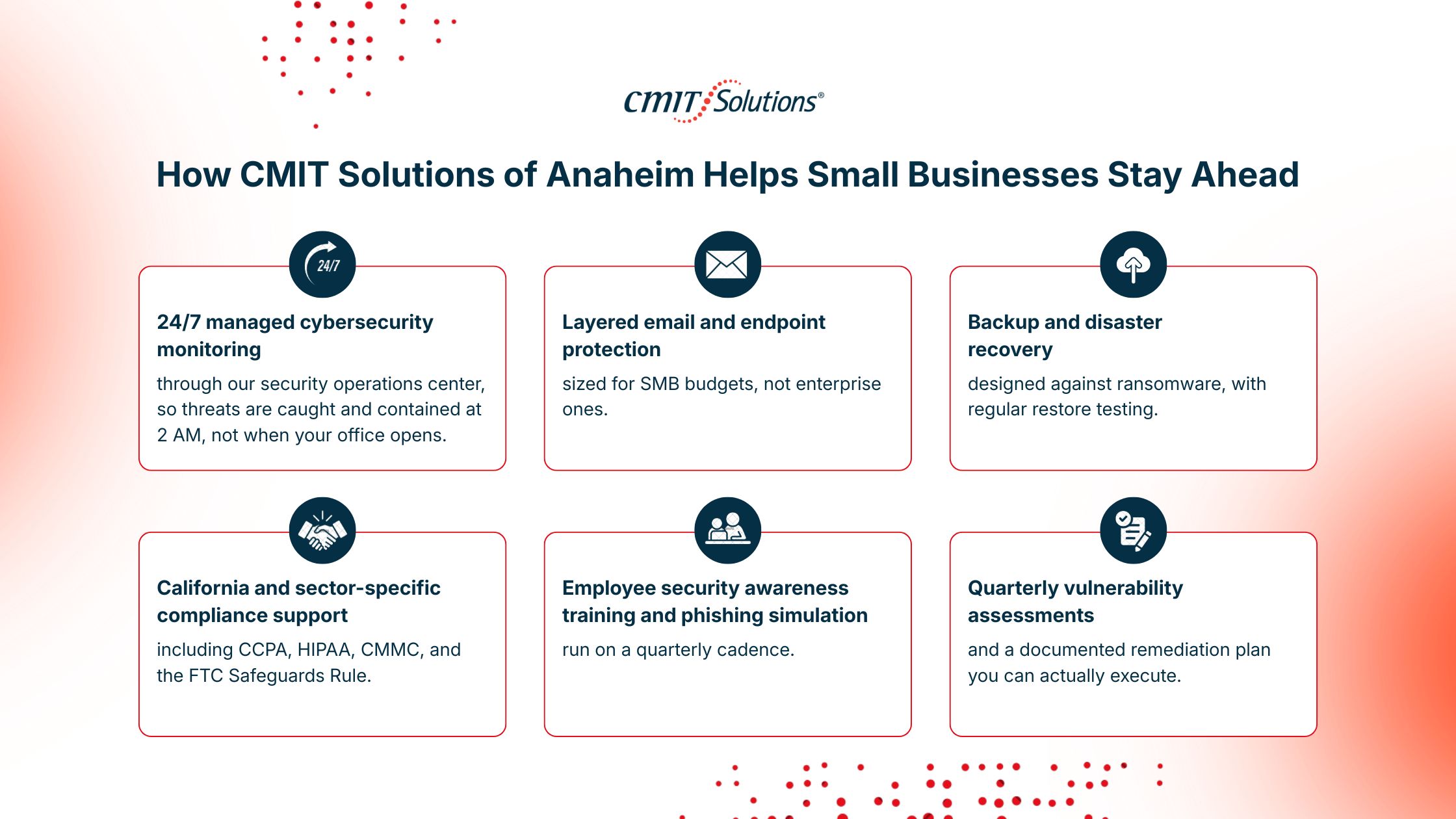
- 24/7 managed cybersecurity monitoring through our security operations center, so threats are caught and contained at 2 AM, not when your office opens.
- Layered email and endpoint protection sized for SMB budgets, not enterprise ones.
- Backup and disaster recovery designed against ransomware, with regular restore testing.
- California and sector-specific compliance support, including CCPA, HIPAA, CMMC, and the FTC Safeguards Rule.
- Employee security awareness training and phishing simulation, run on a quarterly cadence.
- Quarterly vulnerability assessments and a documented remediation plan you can actually execute.
With CMIT Solutions’ managed cybersecurity services, you get access to enterprise-grade security tools and threat intelligence shared across hundreds of offices, applied at small-business scale and pricing.
The Practical Starting Point
If you read this far and you are wondering where to begin, here is the order we use with new clients:
- Inventory. List every device, account, and SaaS tool your business uses.
- Enable phishing-resistant MFA on email, banking, accounting, and payroll. This single step blocks most credential-based attacks.
- Move to tested, immutable backups that an attacker cannot reach from inside your environment.
- Deploy EDR with managed monitoring on every endpoint.
- Run a baseline vulnerability assessment so you know what you are actually defending.
- Build a written incident response plan, including who calls whom in the first hour.
- Train your team quarterly on phishing, deepfakes, and vendor fraud scenarios.
This is also the order in which we onboard new Anaheim small business clients. It is not glamorous and it is not exhaustive, but it covers the threats most likely to actually hit you.
Ready to Stop Guessing About Your Security?
If you want a clear, no-pressure look at where your business stands today, we offer a free security assessment for Anaheim small businesses. We will walk through your current setup, identify the gaps that matter most, and give you a prioritized list of what to fix.
Contact CMIT Solutions of Anaheim or call (657) 230-7099 to schedule your assessment.

Frequently Asked Questions
What is the single biggest cybersecurity threat to Anaheim small businesses in 2026?
AI-generated phishing combined with deepfake voice fraud. The technical barrier to running a convincing impersonation attack has dropped to near zero, and small businesses without verification policies in place are the easiest targets. Layered email security, phishing-resistant MFA, and a written call-back verification policy address most of this risk.
How much should an Anaheim small business spend on cybersecurity per year?
For most Anaheim SMBs we work with, an effective layered program runs between $5,000 and $15,000 per year, depending on headcount, regulatory requirements, and tools already in place. A single ransomware incident averages $120,000 in recovery costs, so prevention typically costs around 50 times less than recovery.
Does my business need cybersecurity if we already use Microsoft 365 or Google Workspace?
Yes. Microsoft and Google secure their infrastructure, but they do not secure how you configure your accounts, what apps you connect, who has admin access, or whether your team falls for phishing. Most cloud breaches we see in Anaheim come from misconfiguration or compromised user accounts, not from the platform itself.
How does the California Consumer Privacy Act affect small businesses in Anaheim?
If you collect personal data from California residents and you meet any of the CCPA thresholds (gross revenue, volume of data processed, or revenue derived from selling personal data), you have notification, access, and deletion obligations. Penalties reach $7,500 per intentional violation, and the California Privacy Protection Agency now actively enforces. A managed IT partner can help you map your data flows and put the required controls in place.
What should we do in the first hour after we suspect a cyberattack?
Isolate affected devices from the network without powering them off, contact your IT and cybersecurity provider, preserve logs, notify your cyber insurance carrier, and avoid communicating about the incident on the potentially compromised email system. Do not pay a ransom without coordinating with law enforcement and counsel first. Having this sequence written down before you need it is the single most undervalued control in SMB security.
Do we still need MFA if we have strong passwords?
Yes, and SMS-based MFA is no longer sufficient on its own. Attackers routinely defeat SMS through SIM-swapping and adversary-in-the-middle phishing kits. Use hardware security keys or app-based authenticator apps on any account with financial, admin, or customer-data access.
How often should small businesses run cybersecurity training?
Quarterly, at minimum. Annual training does not change behavior, and the threat landscape moves too quickly for once-a-year coverage to stay relevant. The most effective programs combine short quarterly modules with simulated phishing tests run between sessions.
What is the difference between antivirus and EDR?
Antivirus looks for known malware signatures on files. EDR (Endpoint Detection and Response) watches behavior across the entire device, including in-memory activity, scripts, and process chains, and can isolate a compromised device automatically. Modern ransomware and fileless malware routinely bypass traditional antivirus, which is why EDR has become the SMB standard.


