
Most cyberattacks and system failures do not happen between 9 a.m. and 5 p.m. They happen at 2 a.m., over the weekend, and during holidays, when nobody is watching. For Anaheim and Orange County businesses running on cloud tools, remote workforces, and just-in-time operations, business-hours-only IT support has become a liability rather than a cost-saving measure.
24/7 IT monitoring services are no longer an enterprise luxury. They are the baseline expected by cyber insurance underwriters, compliance auditors, and enterprise clients evaluating your business as a vendor. This article covers the business case: what round-the-clock monitoring actually protects, which industries need it most, and what Anaheim owners and operators should look for in a provider.
What Is 24/7 IT Monitoring, and Why Does Your Business Need It?
24/7 IT monitoring is continuous oversight of your systems, networks, endpoints, and cloud environments by a managed IT provider. Instead of waiting for an employee to report a problem in the morning, monitoring tools and analysts watch for issues in real time and respond as they emerge.
Why does my business need 24/7 IT monitoring? Three reasons that map directly to business outcomes: revenue protection, compliance evidence, and reputation defense. Every hour a system is down costs money. Every unmonitored gap becomes an audit finding. Every breach that reaches customers before you notice becomes a story your competitors tell.
If your business runs on Microsoft 365, cloud file storage, a hybrid workforce, or any regulated data, the case for always-on IT support services is no longer theoretical.
Why Business-Hours-Only Support Fails in 2026
The traditional break-fix and business-hours IT model was built for a world where employees worked in one office, on one network, during one shift. That world is gone.
Cyberattacks now operate nonstop. Ransomware operators, phishing groups, and business email compromise attackers explicitly target off-hours because they know internal response is slower. The FBI Internet Crime Complaint Center 2024 Annual Report placed California at the top of every U.S. state for reported cybercrime losses, with total nationwide losses exceeding $16.6 billion, a 33% year over year increase. The same report documented that attackers now maintain automated attack infrastructure that never sleeps.
The business risk lands in three places at once. Revenue stops when systems go down. Compliance exposure grows every hour an incident goes undetected. Reputation damage compounds when customers or partners learn about a breach before you do.
Downtime costs have continued to rise as businesses depend more on cloud tools and integrated workflows. For a full breakdown of how downtime is measured and what specific network metrics predict outages, our network monitoring best practices post is the operational resource. In this article, the point is simpler: the cost of downtime is high enough that most Anaheim businesses cannot absorb it without a monitoring capability that catches problems before they cascade.
Which Industries in Anaheim and Orange County Need 24/7 Monitoring Most?
Every business benefits from continuous monitoring, but certain industries in Orange County face higher stakes because of the data they handle, the compliance frameworks they operate under, or the operational continuity their customers expect.
Healthcare and home health. HIPAA requires audit logging, monitoring, and timely incident response. Home health agencies with field staff on tablets and phones have no realistic path to compliance without continuous monitoring of the endpoints those staff use. Patient care depends on systems being available around the clock.
Construction and contracting. Job sites operate outside standard business hours. Superintendents access project management platforms in the early morning and late evening. Ransomware operators know construction firms hold high-value BIM and bid data on deadlines, and Sophos State of Ransomware 2024 found 68% of construction firms hit by ransomware in the prior year. A ransomware event at 2 a.m. that is discovered at 8 a.m. is usually already too late.
Property management and real estate. Multi-site portfolios run access control, security cameras, and tenant portals around the clock. Tenant emergencies happen at night. Systems failure on a Saturday evening becomes a service failure by Monday morning.
Professional services (legal, accounting, financial). Client confidentiality obligations, SEC and FINRA cybersecurity expectations, and cyber insurance requirements all assume continuous monitoring. A breach discovered on Monday that started on Friday night is a documentation problem as much as a security problem.
Manufacturing and distribution. Operations often run second and third shifts. A network failure at 3 a.m. shuts down production and creates supply chain ripple effects that persist for days.
Retail and hospitality. POS systems, PCI-DSS compliance, and customer-facing infrastructure all require monitoring outside standard business hours. Peak transaction volume often falls exactly when internal IT teams are off.
If your business is in any of these categories, 24/7 monitoring for compliance with HIPAA, PCI, and NIST is no longer optional. It is the baseline your auditors, insurers, and enterprise clients are already asking about.
24/7 Monitoring and Compliance: HIPAA, PCI, and NIST Requirements
Compliance frameworks that used to describe monitoring as “recommended” now describe it as required. This is the single fastest-moving driver of 24/7 monitoring adoption in 2026.
HIPAA. The HIPAA Security Rule requires audit controls, information system activity review, and timely response to security incidents. The 2025 HHS notice of proposed rulemaking further tightens these requirements, removing prior “addressable” flexibility for logging and monitoring. Healthcare businesses in Orange County without continuous monitoring are increasingly out of step with what OCR expects.
PCI-DSS 4.0. The Payment Card Industry Data Security Standard 4.0, with mandatory requirements effective March 2025, expands monitoring and logging obligations for any business processing card payments. Requirement 10 in particular assumes continuous log collection and review.
NIST cybersecurity framework. NIST CSF 2.0, published in early 2024, treats continuous monitoring as a core function. Any business referencing NIST as a security framework, including CMMC subcontractors and federal supply chain participants, is expected to operate with monitoring that runs continuously.
Documentation is the practical output. Auditors and underwriters want evidence that monitoring existed, alerts were reviewed, and incidents were responded to on a defined timeline. Business-hours-only IT support cannot produce that evidence for the two-thirds of the week when nobody is watching.
What Happens if Downtime Occurs Overnight Without Monitoring?
This is the question that changes the conversation with most Orange County business owners. The honest answer breaks down by scenario.
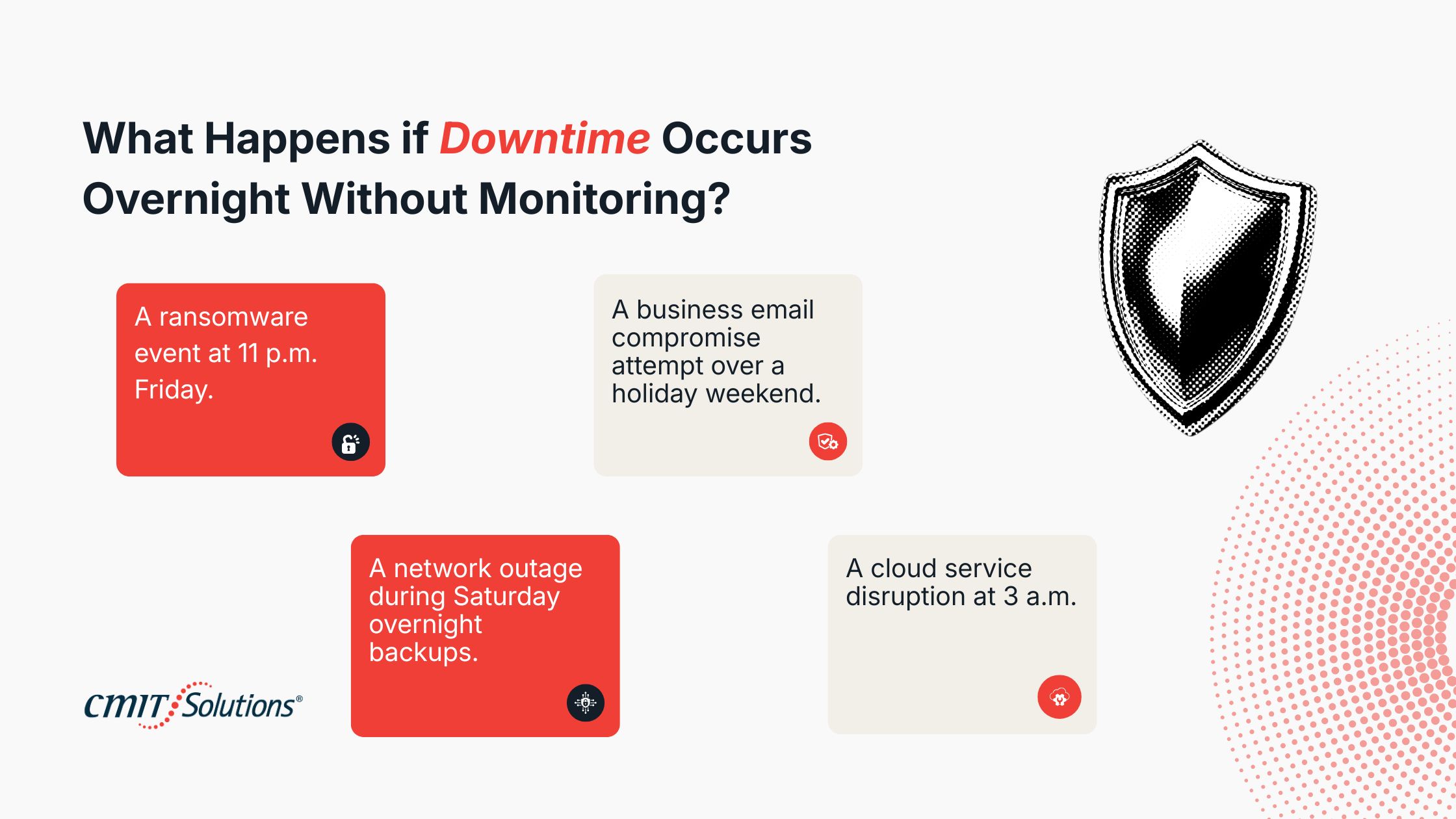
A ransomware event at 11 p.m. Friday. Without 24/7 monitoring, discovery happens Monday morning. By then, the attacker has had a full weekend to move laterally, exfiltrate data, and encrypt backups. Recovery time and cost multiply.
A network outage during Saturday overnight backups. Without monitoring, the failed backup goes unnoticed until the next scheduled review. If a separate incident happens in the interim, there is nothing to restore from.
A business email compromise attempt over a holiday weekend. Without monitoring, the attacker has 72 hours to establish forwarding rules, harvest credentials, and initiate wire transfer fraud before anyone notices unusual activity.
A cloud service disruption at 3 a.m. Without monitoring, employees discover the problem when they start work. Customer-facing systems have been offline for hours before anyone acknowledged the outage.
In every case, the cost of the incident is not defined by the incident itself. It is defined by the gap between when it started and when someone noticed. 24/7 monitoring closes that gap.
Remote and Hybrid Workforces Multiply the Case for Always-On Monitoring
The Anaheim businesses evaluating 24/7 monitoring in 2026 almost always have a hybrid or fully remote element to their workforce. That structure changes the risk profile in three ways.
First, the attack surface extends beyond the office. Employees work from home networks, coffee shops, client sites, and hotels. Monitoring has to cover every endpoint, everywhere, all the time.
Second, work hours are no longer fixed. Sales teams work with East Coast customers before 8 a.m. Engineering teams push code late at night. Field staff access systems at odd hours. Monitoring that only covers 9 to 5 misses when your workforce is actually working.
Third, cloud tools operate outside your network. Microsoft 365, Google Workspace, Salesforce, and every other SaaS platform is monitored by the vendor for their own uptime, not for your account’s security posture. That is your monitoring responsibility, and it does not stop at 5 p.m.
Which Provider Should Anaheim Businesses Choose for 24/7 Monitoring?
Not every managed IT services provider actually delivers true 24/7 monitoring. Many claim it and deliver something closer to “we get paged and call you back in the morning.” The differences matter, and they are worth asking about directly.
Look for the following in a 24/7 IT monitoring services partner in Anaheim:
- True round-the-clock coverage with a live response capability. Ask specifically who responds at 3 a.m. and what their target response time is.
- Local Anaheim presence with technician dispatch. Some incidents require on-site response across Orange County, Los Angeles, Riverside, or San Bernardino counties. Remote-only providers cannot deliver that.
- Cybersecurity built into the monitoring stack. 24/7 monitoring without endpoint detection and response, threat intelligence, and incident response is just uptime checking.
- Documented incident response process. Ask to see the runbook. If there is not one, the monitoring is not audit-ready.
- Compliance-aware reporting. Monthly reports should map to the frameworks your business operates under (HIPAA, PCI, NIST, CMMC).
- Fixed monthly pricing. Break-fix pricing on 24/7 support is a budget grenade waiting to go off.
- Named industry experience. Generic SMB monitoring is not the same as monitoring built for healthcare, construction, or professional services workflows.
“Every Anaheim business we support runs into the same question sooner or later: what happens when something breaks outside of business hours?” says Navin, CMIT Solutions Anaheim & Orange County. “For most owners, the honest answer used to be ‘we deal with it Monday.’ In 2026, that answer is not defensible to a cyber insurance underwriter, a compliance auditor, or an enterprise customer running vendor risk reviews. Proactive IT monitoring is what closes that gap, and it is what our clients tell us gives them their weekends back.”
How Long Does 24/7 Monitoring Setup Take, and Does It Disrupt Operations?
Setup for managed IT monitoring services typically runs two to six weeks depending on environment size, number of endpoints, and integration complexity. Most of the deployment happens in the background without disrupting employees. Agents deploy silently to endpoints. Network monitoring configures at the firewall and switch level. Cloud application monitoring configures at the tenant level.
The one visible change for employees is usually improved response time on IT issues, because the monitoring stack catches problems before helpdesk tickets are filed. Downtime during deployment is rare and, when it occurs, is scheduled outside business hours.
Most Anaheim businesses reach a full monitoring baseline within 30 days and see measurable reductions in unplanned downtime and unresolved incidents within 60 to 90 days.
How CMIT Solutions Anaheim Delivers 24/7 IT Monitoring for Orange County Businesses
CMIT Solutions Anaheim provides 24/7 IT monitoring services for Anaheim and Orange County businesses, delivered by a locally based team with round-the-clock coverage, managed cybersecurity built into every plan, and fixed monthly pricing. Businesses across healthcare, construction, professional services, and property management get one point of contact, one accountability structure, and one team that knows their environment.
If your current IT support goes home at 5 p.m., the risk exposure is measurable, and it is worth a conversation.
Frequently Asked Questions
Why 24/7 monitoring instead of business-hours support?
Cyberattacks, system failures, and cloud disruptions happen around the clock. Business-hours support means incidents that start overnight go undetected until morning, multiplying recovery cost and compliance exposure.
Which industries benefit most from 24/7 monitoring?
Healthcare, construction, property management, professional services, manufacturing, and retail. Any business with compliance obligations, hybrid workforces, or customer-facing systems that operate outside business hours.
Is 24/7 monitoring necessary for small businesses, or just enterprises?
It is now expected for small businesses as well. Cyber insurance underwriters, compliance auditors, and enterprise clients evaluating vendors all ask about continuous monitoring, regardless of business size.
Which provider should Anaheim businesses choose for 24/7 monitoring?
Look for true round-the-clock live response, local Anaheim presence with technician dispatch, cybersecurity built into the monitoring stack, documented incident response, and compliance-aware reporting.
What happens if downtime occurs overnight without monitoring?
The incident goes undetected until someone notices in the morning. Recovery time, data loss, and compliance exposure all grow with the delay. Ransomware and business email compromise events are especially costly when discovered late.
How long does setup take, and does it disrupt current operations?
Two to six weeks is typical for full deployment, most of which happens silently in the background. Employees rarely notice deployment, and unplanned downtime is scheduled outside business hours when needed.