A CMMC-ready managed IT stack includes six components: Microsoft 365 GCC High (not standard M365) for Controlled Unclassified Information handling, 24/7 continuous monitoring backed by a security operations capability, access control built on multi-factor authentication and least-privilege permissions, encrypted backups with tested recovery, a documented incident response plan, and a written System Security Plan (SSP) mapped to the 110 NIST SP 800-171 controls.
For the full compliance picture, including CMMC 2.0 levels, assessment requirements, and the end-to-end certification timeline, see our CMMC Compliance Guide for Orange County Defense Contractors. This guide goes one layer deeper by covering the actual IT stack that has to exist and hold up before a C3PAO will sign off.
Miss any one of these and the assessment fails. This is the operational reality of CMMC-ready IT infrastructure for Orange County defense contractors in 2026, and it is why more OC subcontractors are moving from in-house IT to a managed service provider CMMC-experienced partner this year.
The pressure is not theoretical. New DoD solicitations under DFARS 252.204-7021 now require CMMC self-assessment or third-party certification at award. C3PAO assessor scheduling lead times are measured in months. The DoD’s own Regulatory Impact Analysis estimates roughly $104,000 in initial cost plus $47,000 in annual recurring cost for a small entity at CMMC Level 2, and a large share of that spend is exactly the IT stack described above.
5 Components of a CMMC-Ready IT Stack
Here is what a CMMC-ready IT stack includes, sequenced the way most Orange County contractors need to build it.
- Microsoft 365 GCC High for email, file storage, and collaboration. Standard Microsoft 365 does not meet FedRAMP High or DFARS 7012 flow-down requirements for Controlled Unclassified Information (CUI). GCC High does. This is the foundation, and everything else in the stack depends on it.
- 24/7 continuous monitoring backed by an SOC capability. CMMC Level 2 requires audit logging, monitoring, and incident detection that a 9-to-5 IT model cannot deliver. Continuous monitoring is not a preference in 2026, it is a control requirement.
- Access control: phishing-resistant MFA and least-privilege permissions. Every account, every remote session, every privileged action. Identity is the perimeter for CMMC.
- Encrypted backups with tested recovery. Immutable, encrypted, off-site, and tested on a documented schedule. CMMC assessors will ask for the test log.
- A documented incident response plan and a written System Security Plan (SSP). The SSP maps every one of the 110 NIST SP 800-171 controls to how your organization implements it. Missing or generic documentation is the single most common assessment failure.
Behind these five, a sixth thread runs through every component: employee security awareness training with documented completion records. Assessors will ask for those records too.
Is Microsoft 365 CMMC Compliant?: Microsoft 365 GCC High vs Standard
The single most common question OC contractors ask before signing a CMMC engagement: is Microsoft 365 CMMC compliant? Standard M365 is not, for CUI handling. GCC is closer but has gaps. GCC High is the answer for most Level 2 environments. Here is the comparison that matters.
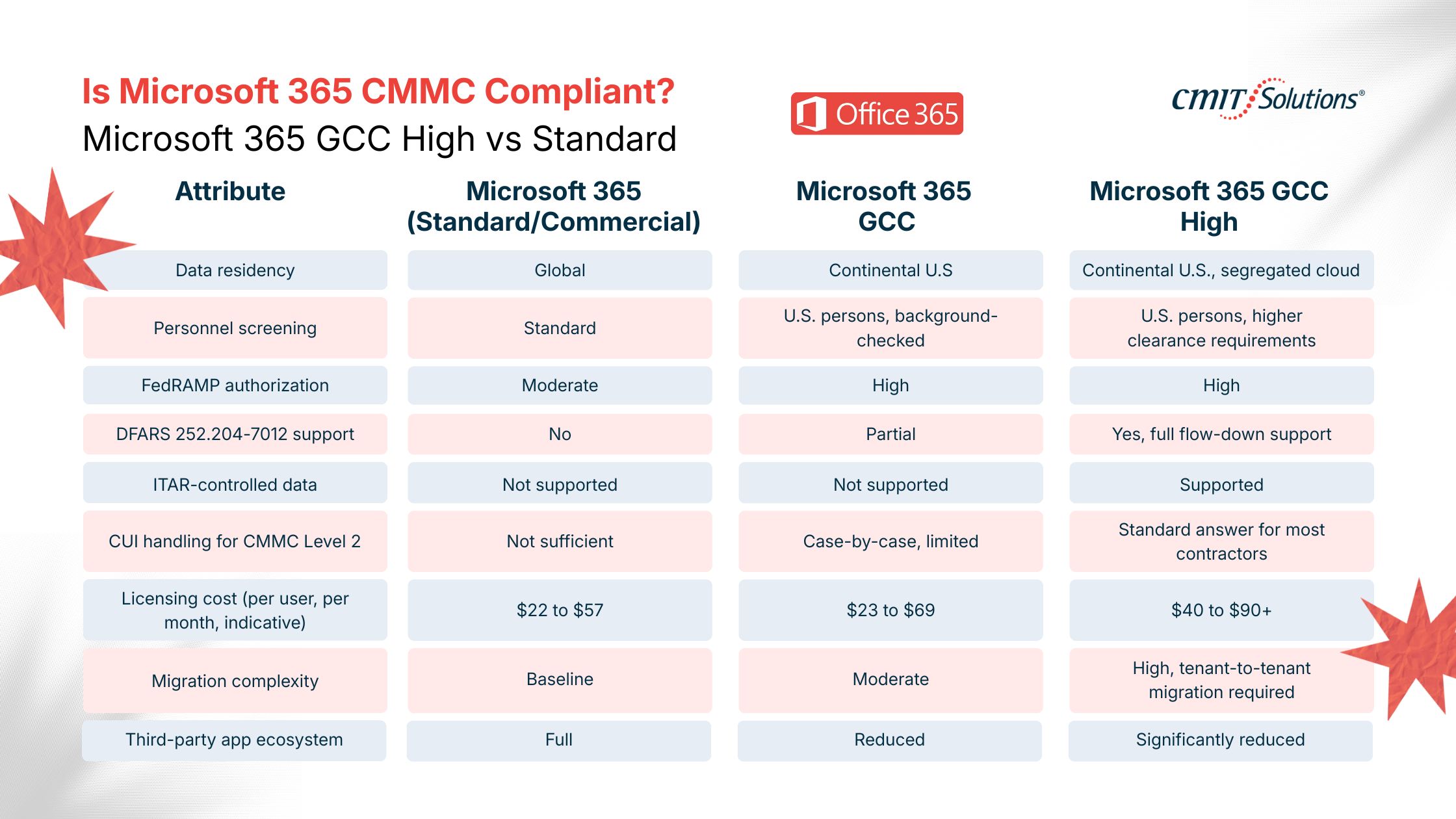
Do I need GCC High for CMMC Level 2? For most Orange County contractors handling CUI, yes. The exceptions are narrow, and the cost of getting this wrong is a failed assessment plus a tenant migration. Most CMIT clients on a CMMC path move to GCC High as step one, not step three.
Why Is 24/7 Monitoring Required for CMMC Compliance?
CMMC Level 2 inherits the audit and accountability, incident response, and system and information integrity control families from NIST SP 800-171. Together they require continuous log collection, review of audit records, detection of unauthorized activity, and timely incident response. None of that survives a business-hours support model. Attackers do not wait until 8 a.m. Pacific to move laterally through a defense subcontractor’s network, and CMMC assessors know it.
24/7 IT support for defense contractors is not a value-add in this stack, it is a control. This is where IT outsourcing in Orange County shifts from cost decision to compliance decision. A managed service provider with an integrated SOC capability, endpoint detection and response, and documented incident response procedures satisfies multiple control families with one engagement.
“Every OC contractor we assess for CMMC-ready IT infrastructure asks the same first question: can we get there without moving to GCC High?” says Navin Gupta, President CMIT Solutions of Anaheim & Orange County. “For almost every Level 2 environment handling CUI, the honest answer is no.”
How Much Does a CMMC-Ready IT Stack Cost?
Contractors ask about CMMC IT cost in two categories: build cost and run cost.
The DoD’s Regulatory Impact Analysis estimates roughly $104,000 in initial cost plus $47,000 in recurring annual cost for a small entity at CMMC Level 2. That figure includes documentation, control implementation, and assessment. The IT stack itself typically breaks down as GCC High licensing (roughly $40 to $90+ per user per month), tenant migration (one-time, project-scoped), managed cybersecurity and 24/7 monitoring (subscription, sized to endpoint count), endpoint detection and response, encrypted backup, and SSP documentation work.
Managed service provider vs in-house IT for CMMC compliance usually comes out in favor of the MSP for small and mid-sized OC contractors, because the fixed cost of building an internal 24/7 SOC and CMMC documentation practice exceeds the cost of a managed engagement below roughly 100 to 150 endpoints.
How Long Does CMMC Readiness Take?
Timeline depends on where you’re starting. A contractor already on Microsoft 365 GCC High with basic monitoring in place can be assessment-ready in as little as 60 days. Most Orange County contractors are on standard M365 with ad hoc IT support, and for that starting point, budget 90 to 120 days to stand up the full stack: GCC High tenant migration, 24/7 monitoring, access control, encrypted backup, and a documented SSP.
That 90 to 120 day window is the infrastructure piece specifically. It sits inside the broader 3 to 9 month compliance timeline covered in our CMMC Compliance Guide for Orange County Defense Contractors, which also covers gap assessment, remediation sequencing, and C3PAO scheduling, the parts of the process that happen before and after the stack itself gets built.
What Happens if You Fail a CMMC Audit?
A failed CMMC assessment does not disqualify a contractor from ever bidding again, but it does close the current window. New DoD contracts requiring CMMC at award go to competitors who passed. Remediation and reassessment take months, and the underlying infrastructure gaps have to be closed before a reassessment will succeed. For OC subcontractors whose pipeline depends on DoD or prime contractor flow-down work, a failed audit is a revenue event.
CMIT Solutions Anaheim: CMMC-Ready IT Support in Orange County
CMIT Solutions Anaheim provides CMMC-ready managed IT services for Orange County defense contractors, including Microsoft 365 GCC High migration, 24/7 monitoring, managed cybersecurity, endpoint detection and response, encrypted backup and disaster recovery, and SSP documentation support. If your firm is building toward a Level 2 assessment or evaluating whether your current IT support in Orange County can get you there, a CMMC readiness assessment is the right first conversation.
FAQs
What is a CMMC-ready managed IT stack?
A CMMC-ready managed IT stack is the set of IT components required to meet CMMC Level 2 controls, typically including Microsoft 365 GCC High, 24/7 monitoring, MFA and least-privilege access, encrypted backups, an incident response plan, and a documented System Security Plan.
Is regular Microsoft 365 sufficient for CMMC compliance?
No. Standard Microsoft 365 does not meet DFARS 252.204-7012 flow-down and CUI handling requirements. Most Level 2 environments require Microsoft 365 GCC High.
What is the difference between Microsoft 365 GCC and GCC High?
GCC is FedRAMP High and hosted in the continental U.S. but does not fully support DFARS 7012 flow-down or ITAR data. GCC High runs in a segregated cloud with U.S. personnel and supports DFARS 7012 and ITAR requirements.
Does 24/7 monitoring mean I need my own SOC, or can it be part of the MSP stack?
No. Most OC contractors get 24/7 monitoring through their MSP’s built-in SOC. CMMC Level 2 requires continuous log collection and incident detection, but doesn’t specify who provides it.
How long does it take to become CMMC ready?
Most Orange County contractors need 90 to 120 days to build the full IT stack, or as little as 60 days if already on GCC High. That’s the infrastructure piece within the broader 3 to 9 month compliance timeline.
Which stack components are required at CMMC Level 1 vs Level 2?
Level 1 covers Federal Contract Information and skips GCC High and full monitoring. Level 2 covers CUI and requires all five: GCC High, monitoring, MFA, encrypted backups, and a documented SSP.
Can one MSP engagement cover the whole CMMC-ready stack, or do I need multiple vendors?
Usually yes, one MSP can cover it. Multiple vendors are typically only needed when your current MSP doesn’t offer GCC High migration or 24/7 monitoring in-house.
What happens if I do not achieve CMMC certification?
New DoD contracts requiring CMMC at award will go to competitors who passed. Remediation and reassessment typically take several months, during which the contract window closes.