
Cybersecurity threats no longer come only from outside your organization. In 2026, most breaches start with a stolen login, an unsecured device, or an employee clicking the wrong link. Traditional security models assume everything inside the network is safe. That assumption no longer works.
For businesses in Orange County handling customer data, financial systems, or cloud tools, Zero Trust Security is no longer optional. It is a practical security approach that reduces risk, limits damage, and keeps operations running even when something goes wrong. If you are evaluating a managed security service provider in Orange County, understanding Zero Trust will help you make smarter decisions about protecting your business.
What Is Zero Trust Security?
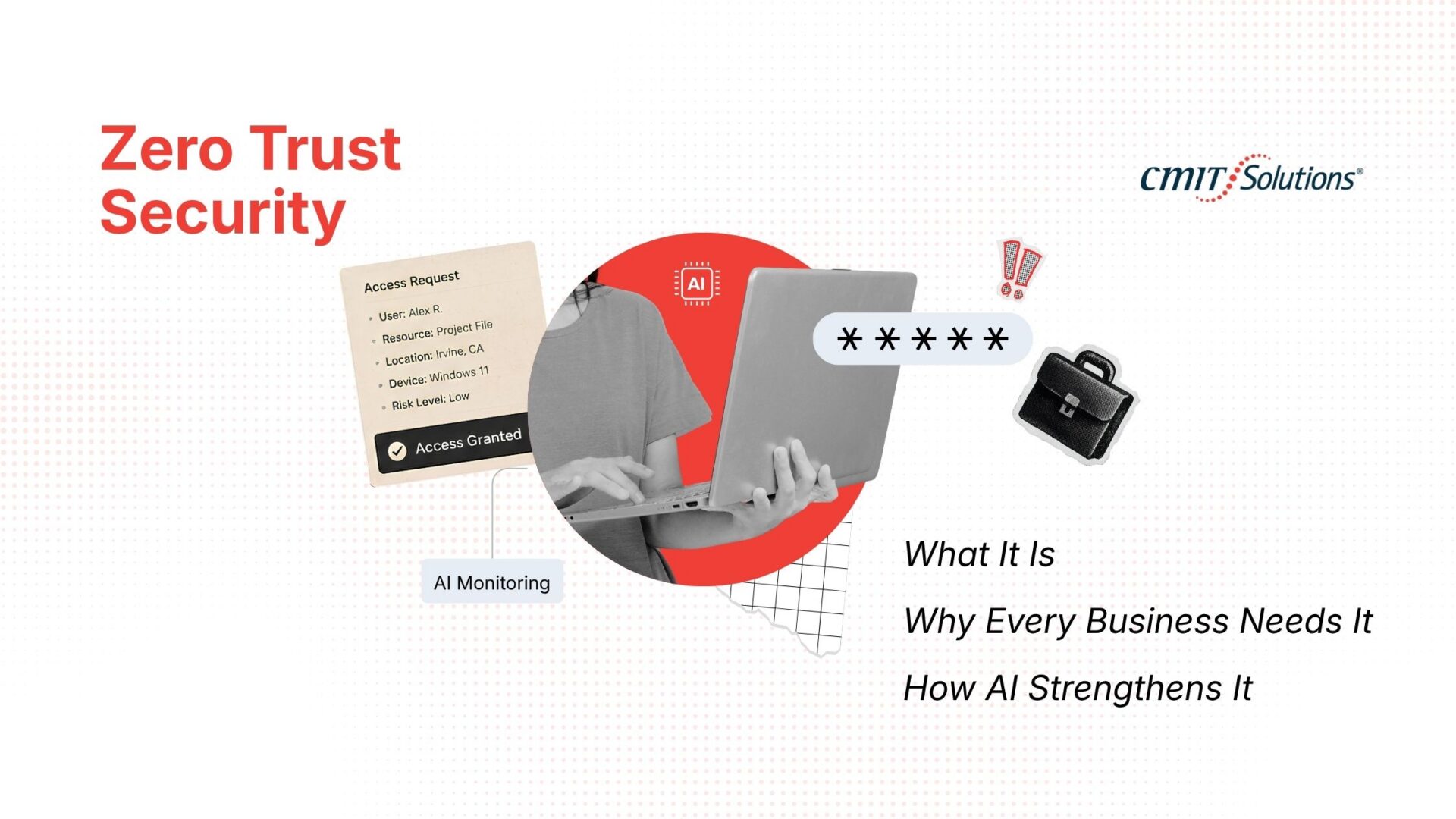
Zero Trust security is a model built on one simple principle: never trust, always verify. Instead of assuming users, devices, or applications are safe once they are inside your network, Zero Trust treats every access request as a potential risk.
The Zero Trust security model was formalized by the National Institute of Standards and Technology in NIST Special Publication 800-207, which now serves as the reference architecture most managed security service providers in Orange County build against. CISA’s Zero Trust Maturity Model 2.0 extends that framework into five pillars: identity, devices, networks, applications and workloads, and data.
This means:
- Every user must verify their identity
- Every device must meet security standards
- Access is granted only to what is absolutely necessary
- Activity is continuously monitored
- Data itself is classified and protected independently of network location
Whether someone is working from the office, home, or a coffee shop, Zero Trust applies the same rules.
Why Traditional Security No Longer Works
Perimeter-based security was designed for a world where employees worked in one office, on company devices, connecting to on-premises servers. That world is gone.
According to Verizon’s 2024 Data Breach Investigations Report, 68% of breaches involved a non-malicious human element, and stolen credentials remained one of the most common initial access vectors across every industry analyzed. Once an attacker is inside a traditional network, lateral movement is easy because the perimeter model assumes internal traffic is trusted.
Here is why the old model breaks in 2026:
- Employees work remotely and use personal devices
- Cloud apps store sensitive business data outside the corporate network
- Phishing attacks bypass perimeter defenses
- Ransomware spreads laterally once inside a network
- Third-party vendors, contractors, and integrations create constant new access points
Once attackers gain access, traditional systems often give them too much freedom. Zero Trust security limits that freedom by treating every access request as untrusted until it is verified.
Zero Trust Security vs. Traditional VPN: A Direct Comparison
One of the most common questions Orange County businesses ask before implementing Zero Trust is how it differs from the VPN they already use. VPNs were designed to extend the perimeter, not eliminate it. Zero Trust Network Access replaces the perimeter model entirely.
| Attribute | Traditional VPN | Zero Trust Network Access (ZTNA) |
|---|---|---|
| Trust model | Trust once authenticated | Verify every request |
| Network access | Broad access to internal network | Granular access to specific applications |
| Lateral movement risk | High | Contained |
| Device posture check | Rarely enforced | Continuous |
| Cloud application support | Limited, often requires backhaul | Native |
| User experience for remote work | Slow, session-based | Faster, application-level |
| Attack surface | Public-facing VPN gateway | No exposed network entry point |
| Alignment with NIST SP 800-207 | Legacy model | Reference architecture |
| Alignment with cyber insurance requirements | Increasingly insufficient | Increasingly required |
For most Orange County small businesses running a mix of Microsoft 365, cloud file storage, and hybrid workforce, a VPN alone no longer meets the standard cyber insurance underwriters are asking for in 2026.
Why Every Orange County Business Needs Zero Trust
Businesses in Orange County are frequent targets due to high digital adoption, cloud usage, and regional concentration of professional services, healthcare, retail, construction, and manufacturing companies. The FBI Internet Crime Complaint Center 2024 Annual Report placed California at the top of every U.S. state for both victim count and reported cybercrime losses, with total nationwide losses exceeding $16.6 billion, a 33% year over year increase.
Common local risks include:
- Phishing emails targeting employees
- Credential theft from reused passwords
- Ransomware attacks on shared drives
- Unauthorized access to cloud platforms
- Business email compromise targeting wire transfers and vendor payments
Zero Trust security helps reduce these risks by:
- Preventing unauthorized lateral movement
- Limiting damage from compromised accounts
- Detecting suspicious behavior early
- Enforcing consistent security policies across office, home, and cloud
For companies using managed cybersecurity services in Orange County, Zero Trust is the foundation of modern protection. IBM’s Cost of a Data Breach Report 2024 found that organizations with mature Zero Trust deployments saw average breach costs $1.76 million lower than those without, one of the highest ROI security investments measured across the report.
How Zero Trust Works in Practice
Zero Trust is not a single product. It is a framework implemented through multiple layers.
Identity verification. Strong authentication, including multi-factor authentication for business accounts, ensures only verified users gain access. Phishing-resistant MFA (authenticator apps or FIDO2 hardware keys) is the 2026 standard.
Device security. Only approved and secure devices are allowed to connect to business systems. Endpoint detection and response in Orange County adds continuous device posture checks and real-time threat detection.
Least privilege access. Users access only the systems they need, nothing more. Access rights are reviewed on a documented schedule, not assumed to be correct because they worked yesterday.
Continuous monitoring. Unusual behavior is flagged and addressed in real time by a managed detection and response capability.
Secure network segmentation. Systems are isolated so breaches cannot spread easily. A professionally managed security service provider designs and manages these layers without disrupting daily operations.
How AI Strengthens Zero Trust Security
The reason Zero Trust security has become more effective in 2026 than it was in 2022 is that AI now powers the “always verify” half of “never trust, always verify” at a scale humans cannot match.
Behavioral analytics for continuous verification. AI models baseline normal user and device behavior, then flag deviations in real time. A finance team member who suddenly downloads 400 files at 2 a.m. from an unrecognized device triggers an automated policy response before an analyst sees the alert.
AI-driven identity threat detection. Machine learning correlates login attempts, geolocation shifts, device fingerprints, and access patterns across cloud and on-premises systems. This is how modern managed detection and response catches credential theft in minutes instead of the 194-day median dwell time IBM reported for identity-based breaches in 2024.
Automated policy enforcement. AI evaluates each access request against dozens of contextual signals (device health, network location, time, sensitivity of the requested resource) and either grants, blocks, or steps up authentication automatically. This is what makes Zero Trust workable for small businesses that cannot staff a 24/7 security operations team.
Adaptive risk scoring. Instead of static rules, AI-driven Zero Trust platforms assign a live risk score to every session and adjust access in real time as conditions change.
Gartner has projected that by 2026, the majority of new remote access deployments will be delivered predominantly through Zero Trust Network Access rather than VPN, driven largely by the AI-enabled verification capabilities described above.
“Every Anaheim and Orange County business we work with runs on cloud tools, remote access, and a workforce that moves between office, home, and job sites,” says Navin Gupta – President, CMIT Solutions Anaheim & Orange County. “The old perimeter is gone. Zero Trust security is how you protect a business that operates the way businesses actually operate in 2026. When we build a zero trust security architecture for a client, we design it around the way their people actually work, not around a network diagram from ten years ago.”
Why Managed Zero Trust Is Better Than DIY Security
Zero Trust security requires constant monitoring, policy updates, and threat analysis. Most internal IT teams are not equipped to handle this alone. That is where managed services make the difference.
With managed cybersecurity services in Orange County, businesses get:
- 24/7 monitoring and threat detection
- Proactive vulnerability management
- Regular security assessments
- Expert response to incidents
- Compliance-ready security controls
- AI-driven behavioral analytics without building an internal data science team
Instead of reacting to breaches, your business stays ahead of them.
How to Implement Zero Trust Security: A 5-Phase Roadmap for Orange County Small Businesses
Zero Trust is deployed in stages, not flipped on overnight. CISA’s Zero Trust Maturity Model 2.0 recommends a phased approach, and the pattern below reflects how most Orange County small businesses actually get there.
Phase 1: Assess and inventory (weeks 1 to 4). Map every user, device, application, and data store. Identify sensitive data and the current access paths to it. This is the phase most DIY attempts skip, and it is why they fail.
Phase 2: Identity foundation (weeks 4 to 10). Deploy phishing-resistant multi-factor authentication for business accounts, consolidate identity providers, and enforce single sign-on. Identity is the new perimeter.
Phase 3: Device and endpoint controls (weeks 8 to 16). Roll out endpoint detection and response in Orange County across every device that touches business data. Enforce device posture checks before access is granted.
Phase 4: Application and data segmentation (weeks 14 to 24). Move remote access from VPN to Zero Trust Network Access. Classify data and enforce least-privilege access to applications and data stores. Deploy zero trust cloud security controls for Microsoft 365, Google Workspace, and any SaaS platform storing sensitive data.
Phase 5: Continuous monitoring and MDR (ongoing). Layer in managed detection and response, AI-driven behavioral analytics, and documented incident response. Zero Trust is not a project you finish, it is a posture you maintain.
Most Orange County small businesses reach a functional Zero Trust posture in six to nine months with a managed partner. Doing it in-house typically runs 12 to 18 months, if it finishes at all.
Signs Your Business Needs Zero Trust Now
You should consider Zero Trust security if:
- Employees work remotely or hybrid
- You use cloud platforms like Microsoft 365 or Google Workspace
- Sensitive data is shared across teams
- You rely on third-party vendors
- Compliance and insurance requirements are increasing
- Your business has ever been a target of business email compromise (BEC)
Signs your business has been a target of business email compromise include unexpected wire transfer requests from executives, vendor banking change requests that bypass normal verification, and email forwarding rules you did not create. Any of these should trigger an immediate Zero Trust access review.
If any of these apply, Zero Trust is not a future upgrade. It is a current necessity.
How Zero Trust Reduces Cyber Insurance Premiums
Cyber insurance underwriters in 2026 are pricing risk based on the specific controls a business has in place, and Zero Trust components dominate the questionnaire. MFA on all remote access, endpoint detection and response, network segmentation, and documented access reviews are now table stakes for renewal, and businesses that can document a Zero
Trust deployment consistently see lower premium increases at renewal than those relying on legacy perimeter controls. Marsh’s 2024 cyber insurance market data showed premium moderation for organizations with mature security controls, while those without saw continued increases.
How CMIT Anaheim Helps Businesses Implement Zero Trust
CMIT Anaheim provides cybersecurity services in Orange County tailored for small and mid-sized businesses. Our approach focuses on protection, visibility, and operational continuity.
We help you:
- Assess current security gaps
- Design a zero trust security strategy aligned with your business
- Implement secure access controls
- Deploy AI-driven monitoring and managed detection and response
- Respond quickly to incidents
Our managed approach ensures Zero Trust works quietly in the background while your team focuses on growth.
Frequently Asked Questions:
What is zero trust security?
Zero trust security is a cybersecurity framework based on the principle “never trust, always verify.” Every user, device, and access request is authenticated and authorized before being granted access to any resource, regardless of network location. NIST SP 800-207 is the reference architecture.
How much does zero trust security cost for a small business?
For most Orange County small businesses, a managed Zero Trust deployment runs $75 to $200 per user per month depending on scope, tooling, and monitoring level. In-house builds typically cost two to three times more when internal labor is included.
How long does it take to implement zero trust security?
Six to nine months with a managed partner is typical for small businesses reaching a functional Zero Trust posture. In-house implementations often take 12 to 18 months.
Is zero trust security only for large enterprises?
No. Zero trust security principles apply to businesses of any size, and small businesses are increasingly required to implement it by cyber insurance carriers, compliance frameworks, and enterprise clients.
What is the difference between zero trust and a traditional firewall?
A firewall protects the network perimeter and trusts traffic once inside. Zero Trust verifies every request continuously, regardless of network location, and grants only least-privilege access to specific applications.
Does zero trust security help with HIPAA compliance?
Yes. Zero Trust controls including MFA, access logging, least-privilege access, and encryption directly map to HIPAA Security Rule technical safeguards and support audit readiness.
What is business email compromise (BEC)?
BEC is a targeted email attack in which an attacker impersonates an executive, vendor, or trusted party to trick employees into transferring money, changing payment details, or sharing sensitive data. The FBI IC3 tracks BEC as one of the highest-dollar cybercrime categories annually.
Can zero trust security prevent ransomware attacks?
Zero Trust significantly reduces ransomware impact by preventing lateral movement, limiting privileged access, and enforcing continuous device verification. Combined with endpoint detection and response and immutable backups, it forms the foundation of ransomware protection in Orange County.
Do I need a SOC if I already have managed IT services?
Managed IT services typically cover systems administration and helpdesk. A security operations capability (in-house SOC or managed detection and response) adds 24/7 threat monitoring, analysis, and response. Most small businesses get this through their managed cybersecurity provider rather than building it in-house.