
It is 7:14 AM. The receptionist tries to open the practice management system and gets an error. A few minutes later, a designer logs in and finds every file renamed with the same odd extension. By 7:30, three different employees called the office manager. Someone notices a text file sitting on every desktop with a message that begins with “Your files have been encrypted.”
This is how most ransomware attacks announce themselves. Not with sirens or smoke. Just the slow realization, over fifteen or twenty minutes, that the entire business has gone offline.
Whether you handle response in-house or engage ransomware recovery services in Orange County, the next twenty-four hours determine almost everything that follows. Whether you recover quickly or take weeks. Whether you preserve evidence or destroy it. Whether your cyber insurance pays out or denies the claim. Whether regulators treat the incident as well-handled or come down hard.
This is what Orange County businesses must do in the first 24 hours after a ransomware attack.
The First Hour Is the One That Matters Most
The first hour shapes the rest of the incident. Most of the damage that compounds over the following weeks comes from decisions made in the first sixty minutes.
The two biggest mistakes are:
- Shutting down infected machines, which destroys forensic evidence held in volatile memory
- Reconnecting affected systems to the network too quickly
What should actually happen in the first hour:
- Disconnect affected systems from the network, but do not power them down
- Stop all network access between sites if you have multiple locations
- Disable shared drive access
- Suspend backup jobs so backups are not overwritten by encrypted data
- Pull a small group of decision makers into a single channel
- Stop external email auto-replies that mention the outage
- Document the time of discovery and the systems affected
The goal of the first hour is containment and evidence preservation. Nothing else.
The First 24 Hours: Ransomware Recovery Checklist for Small Business and Mid-Sized Operators
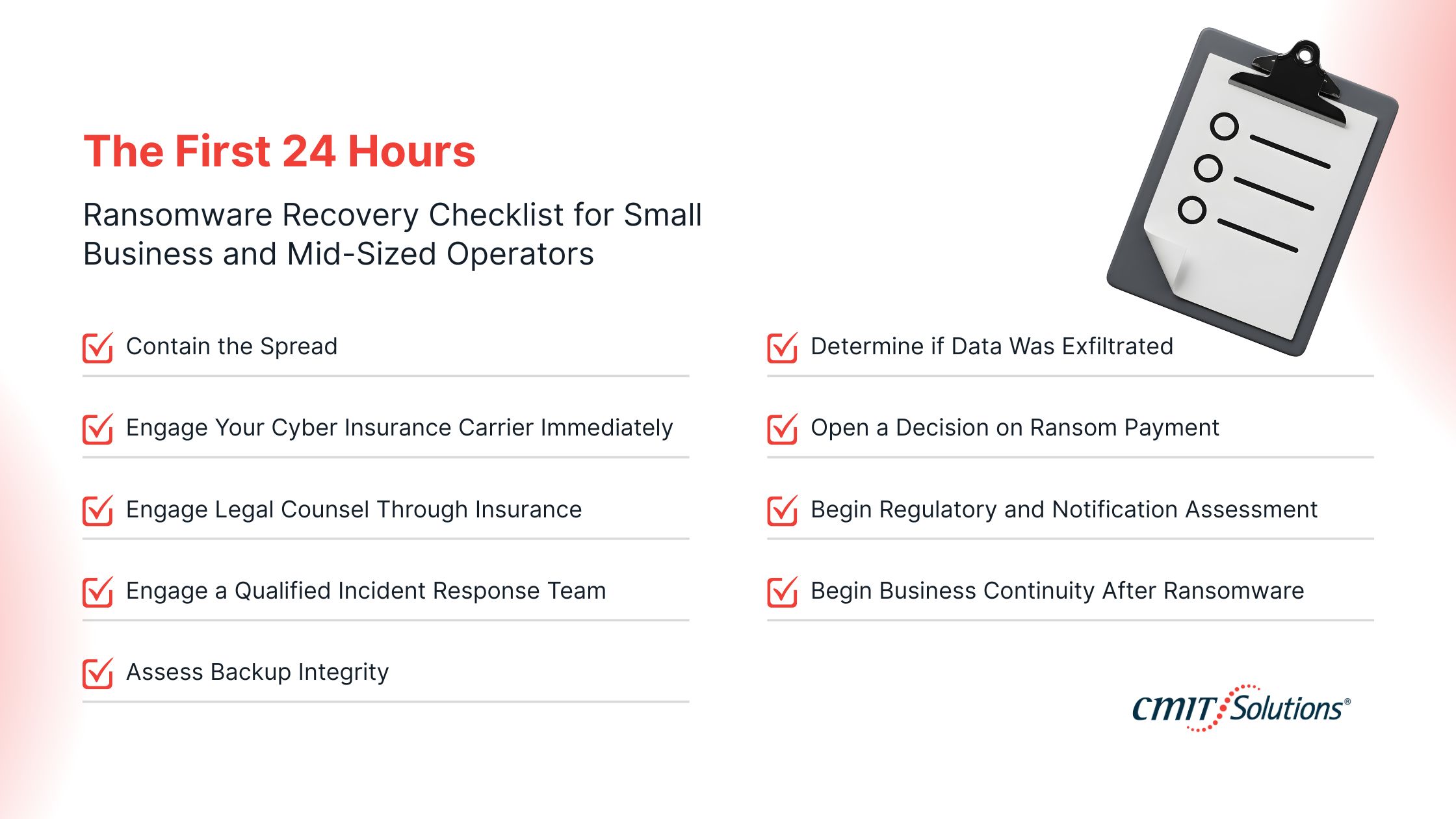
Here is the ransomware recovery checklist for small business leadership teams in Orange County should follow during the first day of an incident.
1. Contain the Spread
After the immediate first-hour disconnection steps, your IT team or incident response partner should:
- Identify infected systems and segments
- Block command-and-control traffic at the firewall
- Disable compromised user accounts
- Force password resets on remaining accounts
- Preserve logs from firewalls, EDR, and email gateways
2. Engage Your Cyber Insurance Carrier Immediately
This is the single most time-sensitive step that leadership teams overlook.
Almost every cyber insurance policy requires notification within hours of discovering an incident. Delaying that call can void the policy or reduce coverage. Cyber insurance incident response teams will typically connect you with:
- A breach coach (specialized attorney)
- An approved incident response firm
- A ransom negotiator if needed
- A forensic investigator
Call your carrier before you call almost anyone else.
3. Engage Legal Counsel Through Insurance
Communications between your business and a breach coach are protected by attorney-client privilege. Communications with an MSP, on their own, are typically not.
Routing the incident through legal counsel preserves privilege over forensic findings, internal communications, and decision documentation.
4. Engage a Qualified Incident Response Team
Cyber incident response is not the same as IT support. Incident response services include:
- Forensic analysis of the attack
- Identification of initial access vector
- Scope determination
- Evidence preservation
- Eradication of attacker presence
- Recovery planning
For Orange County businesses without an existing incident response retainer, this is typically arranged through the insurance carrier or directly with ransomware response services providers.
5. Assess Backup Integrity
Modern ransomware actively targets backups before encrypting production systems. Attackers often sit inside a network for days or weeks before pulling the trigger, which means:
- Online backups may be encrypted along with production
- Backup software credentials may be compromised
- Recent backups may contain the attacker’s persistence mechanisms
Validate backup integrity from offline or immutable copies before starting any restore. Knowing how to restore backups after ransomware safely is one of the most important capabilities your incident response team brings.
6. Determine if Data Was Exfiltrated
Most modern ransomware groups use double extortion. They steal data before encrypting it. Even if you restore cleanly from backup, data exfiltration triggers separate legal and regulatory obligations.
The forensic team should look for:
- Large outbound data transfers
- Suspicious cloud storage uploads
- Compressed archives created shortly before encryption
- Tool footprints associated with known data-theft groups
7. Open a Decision on Ransom Payment
The honest answer to “should I pay the ransomware demand” is that it depends, but the default position should be no.
Reasons not to pay:
- Payment does not guarantee working decryption keys
- Paying may violate OFAC sanctions if the attacker is on a restricted list
- Insurance carriers increasingly refuse to fund ransom payments
- Payment funds future attacks and marks the business as willing to pay
- Recovery from backups is often faster than decryption
In most cases, businesses with tested offline backups and a competent incident response team learn how to recover from a ransomware attack without paying. This is why preparation matters far more than negotiation.
8. Begin Regulatory and Notification Assessment
Depending on industry and data exposure, the notification clock may already be running.
Common obligations include:
- HIPAA breach notification after ransomware incidents involving protected health information
- California Civil Code 1798.82 requirements for personal information breaches
- California Attorney General notification when more than 500 residents are affected
- Payment card brand notification under PCI
- Contractual notification obligations to clients and partners
These timelines are short. Engaging the breach coach early ensures the right notifications happen in the right window.
9. Begin Business Continuity After Ransomware
While incident response is ongoing, the business still has to function. Business continuity after ransomware requires:
- Identifying which workflows can continue on alternate systems
- Communicating with customers, vendors, and partners
- Managing employee communication
- Documenting manual workarounds
- Tracking financial impact for the insurance claim
Recovery and continuity run in parallel. They are not sequential.
Recovery Realities: What Most Businesses Get Wrong
A few realities worth keeping in mind during ransomware attack recovery:
- Decryption is rare. Public ransomware decryption tools 2026 lists from projects like No More Ransom cover some older strains, but most modern variants have no free decryptor.
- Backups can be infected. The question of whether ransomware can be removed from backups is a real one. Modern attacks compromise backup systems on purpose. Immutable and air-gapped backups are now the standard.
- Recovery takes time. Full data recovery after ransomware typically runs from several days to several weeks depending on environment complexity.
- Cleanup is more than restore. Ransomware remediation means removing attacker persistence, rotating all credentials, rebuilding compromised systems, and closing the original entry point.
Final Thoughts
Ransomware is no longer a rare event. It is a planned, professional, and highly targeted attack model that hits Orange County businesses every week across healthcare, legal, manufacturing, financial, and professional services industries.
The businesses that recover well are the ones that prepared before the attack. The businesses that struggle are the ones that figure it out during the incident.
At CMIT Solutions Anaheim & Orange County, we work with growing businesses to build the preparation that makes ransomware survivable. From managed cybersecurity services Orange County leadership teams trust day to day, to ransomware recovery services in Orange County backed by tested backups, immutable storage, and clear incident response playbooks, our role is to make the first 24 hours less chaotic and the recovery faster.
If your business has not tested its incident response plan in the last twelve months, the time to do that is now, not during the next attack.
FAQs
What should I do in the first hour after a ransomware attack?
Disconnect affected systems from the network without powering them down, suspend backup jobs, disable shared drive access, document the time and scope of discovery, and notify your cyber insurance carrier. Preserving forensic evidence is the single most important action in the first hour.
Should I pay the ransomware demand?
The default answer is no. Payment does not guarantee working decryption, funds future attacks, may violate OFAC sanctions, and is increasingly excluded by insurance. Most businesses with tested offline or immutable backups recover without paying.
How long does ransomware recovery typically take?
Most full recoveries run from several days to several weeks. Restore time depends on environment complexity, backup integrity, and how thoroughly the attacker is removed from the network. Rushed recovery often leads to reinfection.
Do I have to report a ransomware attack to the FBI?
Reporting to the FBI is not legally required for most businesses, but it is strongly recommended and often expected by insurance carriers. The FBI’s IC3 portal is the standard reporting channel. Some regulated sectors now face mandatory federal reporting under newer rules.
What are California’s breach notification requirements after a ransomware attack?
California Civil Code 1798.82 requires notification of affected residents without unreasonable delay if personal information was accessed or acquired. Breaches affecting more than 500 California residents also require notification to the California Attorney General. Healthcare providers have additional HIPAA breach notification obligations.
Can my backups be infected too?
Yes. Modern ransomware actively targets backup systems, and attackers often dwell inside a network for days or weeks before encrypting. This is why offline, immutable, and air-gapped backups are now considered the baseline standard.
How do I know if data was stolen during a ransomware attack?
Forensic investigators look for large outbound transfers, suspicious cloud uploads, compressed archive creation, and known data-theft tool signatures. Even if exfiltration is not visible at first, attackers often publish stolen data on leak sites if the ransom is not paid, which becomes a separate notification trigger.
How much does ransomware recovery cost for a small or mid-sized business?
Direct costs typically range from tens of thousands to several hundred thousand dollars for incident response, forensic investigation, remediation, and business continuity work. Indirect costs including lost revenue, customer impact, and regulatory exposure often exceed the direct costs.