
At some point, every operations team notices the same pattern.
Someone signs up for a new app to “move faster.”
Another team shares files through a tool no one else uses.
A free trial turns into a business-critical system without IT knowing it exists.
None of this comes from bad intent. It comes from people trying to get work done.
That’s what makes shadow IT so tricky. It doesn’t feel like a problem until something breaks, data leaks, or an audit asks questions no one can answer.
The solution isn’t locking everything down. It’s giving teams clear, supported choices that make the right path the easiest one.
Why Shadow IT Shows Up in Well-Run Organizations
Shadow IT usually appears when:
- Approved tools don’t meet a specific need
- Getting access feels slow or unclear
- Teams don’t know what’s already available
- People assume “free” means low risk
When there’s no obvious list of approved apps, employees fill the gap themselves. Over time, this creates:
- Unknown data flows
- Inconsistent security controls
- Duplicate tools and costs
- Confusion about ownership and support
The risk isn’t experimentation. The risk is uncontrolled adoption.
The Real Problem Isn’t Apps It’s Visibility
Most businesses don’t actually know:
- Which apps are being used
- Who signed up for them
- What data they access
- Where that data is stored
Without visibility, IT and operations can’t protect what they don’t know exists. Regulators and clients don’t accept “we weren’t aware” as an answer.
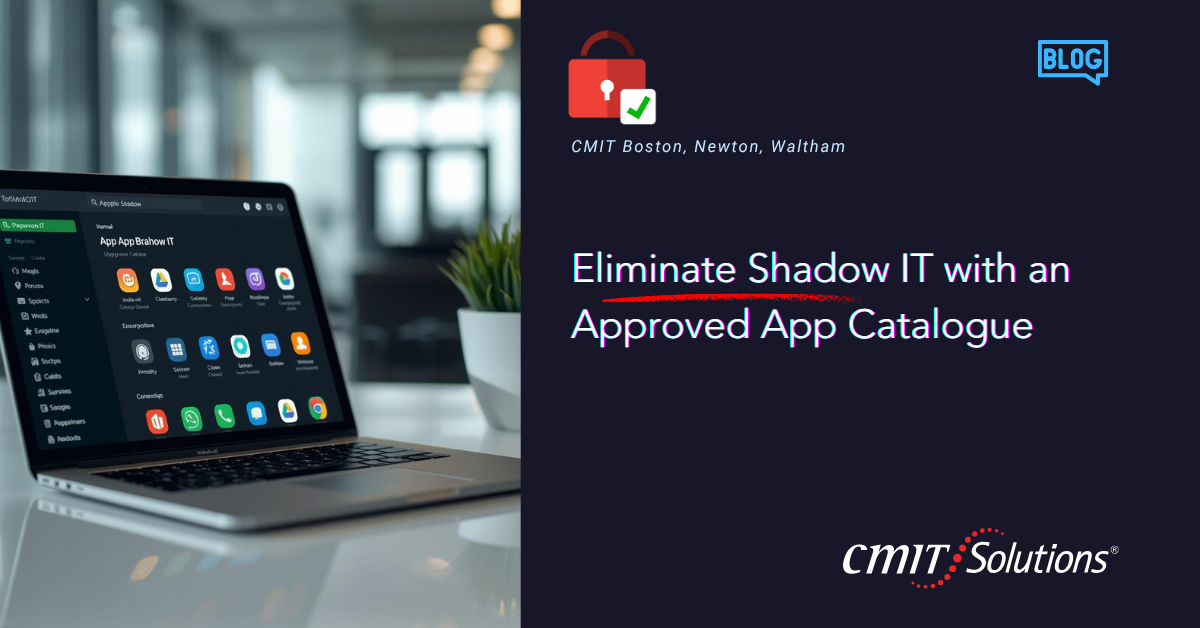
An approved app catalogue brings those unknowns into the open without stopping innovation.

What an Approved App Catalogue Actually Is
An approved app catalogue isn’t a long, restrictive policy document.
It’s a clear, accessible list that answers one simple question:
“Which tools can I safely use to do my job?”
A strong catalogue includes:
- Approved business applications
- Clear descriptions of what each app is for
- Who can use them
- How to request access
- Supported alternatives for common needs
When people know where to look, they stop guessing.
Standardization Without Slowing Teams Down
Operations teams care about speed and reliability.
An approved app catalogue supports both by:
- Reducing tool sprawl
- Limiting duplicate platforms
- Making onboarding faster
- Simplifying support and troubleshooting
Instead of ten tools doing the same thing poorly, teams use a few tools well and know where to get help when something goes wrong.
Enforcing SSO and MFA Without Adding Friction
One of the biggest shadow IT risks is weak authentication.
Apps signed up with personal emails and reused passwords create blind spots that security tools can’t see.
Enforcing:
- Single sign-on (SSO)
- Multi-factor authentication (MFA)
ensures:
- Access is tied to company identities
- Login activity is visible and logged
- Access can be removed immediately when needed
- Security policies are applied consistently
From an operations perspective, this also means fewer password resets and less confusion.
Supported Alternatives Keep Productivity Moving
Banning apps without offering alternatives doesn’t work.
People will always choose the fastest path to get work done. If approved tools don’t meet their needs, they’ll find something that does.
That’s why effective app catalogues:
- Include supported alternatives for common tasks
- Explain why certain tools are approved
- Offer a clear process to request new tools
- Respond quickly to legitimate needs
This turns IT from a gatekeeper into an enabler.

Reducing Data Leakage Without Micromanagement
Shadow IT increases the risk of:
- Files being stored outside secure platforms
- Sensitive data shared without controls
- Information retained longer than necessary
An approved app catalogue reduces these risks by:
- Keeping data inside known environments
- Applying consistent retention and security policies
- Limiting uncontrolled sharing
- Making audits and reviews simpler
The goal isn’t surveillance. It’s predictability.
What Eliminating Shadow IT Looks Like Day to Day
When shadow IT is under control:
- Teams know which tools to use
- Access requests are straightforward
- Security incidents decrease
- Audits become easier
- Support requests are faster to resolve
Most importantly, people stop wasting time working around systems and start trusting them instead.
How Managed IT Services Help Control Shadow IT
This is where CMIT Solutions of Boston, Newton & Waltham provides ongoing value.
Maintaining an approved app catalogue and enforcing controls takes consistent effort—not a one-time setup.
A managed IT services provider helps by:
- Identifying shadow IT usage
- Building and maintaining an approved app list
- Enforcing SSO and MFA across platforms
- Evaluating new apps for security and compliance
- Providing secure, supported alternatives
- Monitoring usage and access over time
This keeps productivity high without increasing risk.
Conclusion: Control Without Friction Is the Goal
Shadow IT isn’t a people problem. It’s a systems problem.
When employees have clear, secure options, they use them. When they don’t, shadow IT fills the gap.
An approved app catalogue gives teams freedom within guardrails so work moves fast without exposing the business to unnecessary risk.
Ready to Bring Shadow IT Under Control?
If your organization isn’t fully confident which apps are in use or where company data is flowing it’s worth addressing now.
CMIT Solutions of Boston, Newton & Waltham helps organizations eliminate shadow IT with practical controls that support operations instead of slowing them down.
Schedule a discovery call to identify hidden risks, streamline app usage, and give your teams secure tools they can actually rely on.
Because the safest systems are the ones people actually use.