

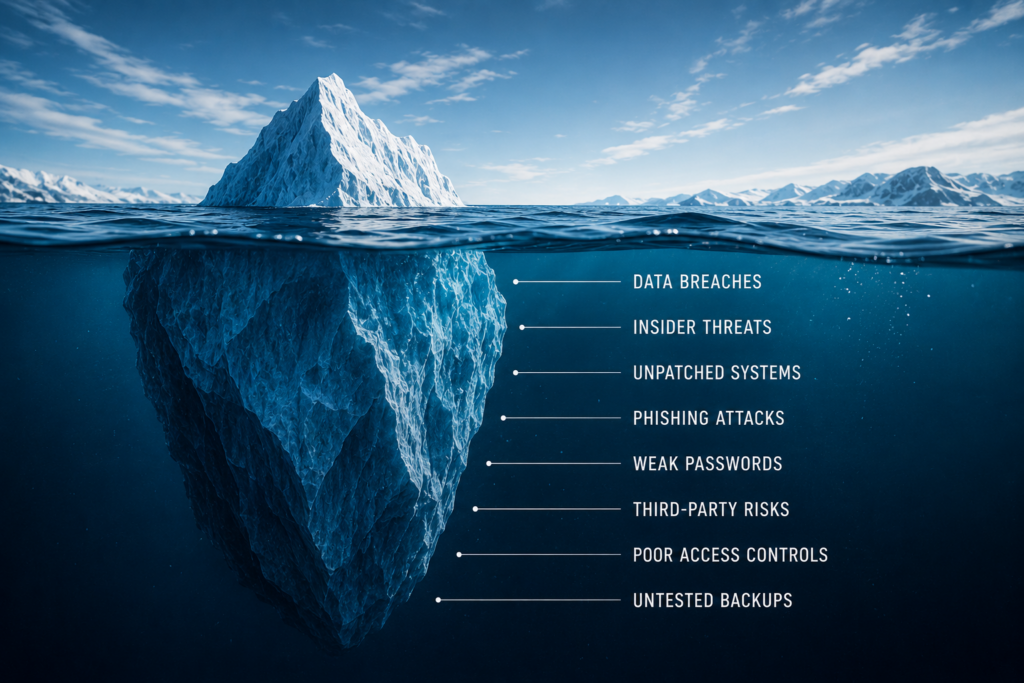
On the surface, the water looks calm.
That’s what makes Shark Week fascinating every year. The danger is never visible on the surface. It’s what’s already moving underneath.
Cybercriminals operate the same way. The threats businesses face right now are designed to blend in with normal operations until the moment something breaks, money moves or systems go down.
During the summer months, when schedules shift, employees travel and oversight gets thinner, cybercriminals know businesses are often paying less attention. It is not that summer creates new vulnerabilities out of nowhere. It is that the same vulnerabilities that exist year-round become easier to exploit when fewer people are watching closely, which is exactly the kind of gap solid it support is designed to close.
Here are three ways they’re circling right now.
Fake Invoices and Vendor Impersonation
Attackers don’t need to hack anything. In many cases, they need to send just one believable email.
This is called business email compromise (BEC) and it works by impersonating a vendor, supplier or executive your team already trusts.
The email arrives looking completely normal, someone on your team pays the “vendor,” and by the time anyone realizes the request wasn’t legitimate, the damage is done.
These attacks spike during vacation season for a simple reason. When the person who normally approves payments is out, requests get rerouted to people who don’t always know what normal looks like. Temporary stand-ins are less likely to question urgency and attackers know it.
The fix is simple to implement: build a verification process for any financial request received via email. A quick confirmation call to a known number, not the number listed in the email, is enough to stop most of these before they go anywhere. Partnering with a managed business cybersecurity services team means having the right email filtering and threat detection controls in place before that fake invoice ever reaches your team.
This kind of protection works best when it is layered. Email filtering catches a large share of these attempts before they land in an inbox at all. A clear internal verification policy catches most of what slips through the filter. And ongoing monitoring through managed security services helps identify unusual payment activity or account behavior before a mistaken payment becomes an unrecoverable loss.
Phishing Attacks That Target Distracted Employees
Phishing works because it’s engineered around how people behave when they’re busy.
Cybercriminals design these moments deliberately. A distracted employee sees a password reset notification and clicks the link. Someone gets a text that looks like it came from IT. An email lands right before a meeting asking for urgent approval on a wire transfer. Nobody stops to verify because stopping feels like losing time.
The most effective protection isn’t a software solution; it’s culture.
Employees need to feel comfortable slowing down when something seems off:
- An unexpected login request
- A payment instruction that came out of nowhere
- A link in an email they weren’t expecting
Speed is a weapon attackers use against you. Slowing down is how you take it away from them. Reinforcing that culture is easier when your business IT support services team actively helps train staff and flag suspicious activity as part of their day-to-day role. Strong unified business communications services also reduce the risk of impersonation by ensuring your team has verified, secure channels they trust for internal requests.
Building this culture is not a one-time training session. It works best as a recurring habit, reinforced through short refreshers rather than a single annual presentation nobody remembers by spring. Businesses that treat security awareness as ongoing, supported by consistent IT guidance, see far fewer successful phishing attempts than businesses that check the training box once a year and move on.
Third-Party Risks That Travel Fast
When a vendor with access to your systems is compromised, the threat doesn’t stay contained to them. It travels directly into your environment through whatever connection they have to your business.
This is supply chain exposure, and most businesses have significantly more of it than they realize. Software tools connected to their network, service providers holding credentials and contractors whose access was never removed after a project ended all present a path that most business owners have never mapped out.
Outsourcing a service doesn’t outsource accountability.
Knowing where you stand with supply chain exposure means being able to answer three questions:
- Which vendors can access your data or systems?
- What are they connecting to?
- Who is responsible internally for managing those relationships?
If those answers aren’t clear, your exposure is opening you up to risk. A thorough business network management program gives you visibility into every connection point across your environment, including the ones third parties are using. Coupling that with a reliable business data backup solution ensures that even if a vendor relationship becomes a liability, your critical data stays protected and recoverable. Working with IT compliance management services also helps you document and audit vendor access so nothing slips through unreviewed.
Vendor risk tends to grow quietly over time. A contractor brought in for a three-month project two years ago may still have active credentials nobody remembered to revoke. A software integration set up in a hurry to hit a deadline may still be pulling more data than the task ever required. None of these gaps look dangerous individually. Together, they form exactly the kind of unmapped exposure attackers are counting on businesses to overlook, especially during a season when fewer people are paying close attention.
Why Summer Specifically Raises the Risk
It is worth spending a moment on why this pattern shows up so reliably every summer, rather than treating it as a vague seasonal warning. Vacation schedules mean more gaps in coverage, with fewer people available to double-check an unusual request before it gets approved. Approval chains shift temporarily, sometimes informally, which means the people making financial decisions this week may not be the people who normally would. And attention naturally drifts when a business slows down its regular cadence of meetings, reviews, and internal check-ins over the summer months.
None of this means summer itself is dangerous. It means summer removes some of the friction that normally slows an attack down during the rest of the year. A phishing email that would get caught by an alert employee in March might sail through in July if that same employee is filling in for someone else and does not know the normal pattern of vendor communication well enough to notice something is off.
This is exactly why proactive managed IT support matters more during exactly the season when internal vigilance naturally dips. Automated monitoring, filtering, and access controls do not take vacation, even when the people who normally rely on their own judgment to catch something suspicious do.
What a Layered Defense Actually Looks Like
None of the three risks above are solved by a single tool or a single policy. They are solved by layers that overlap, so that when one layer misses something, another one catches it.
At the technical layer, that means email filtering, endpoint monitoring, and access controls built on solid network management practices. At the process layer, it means a clear, simple verification procedure for financial requests and a defined approval chain that does not quietly change just because someone is on vacation. At the culture layer, it means employees who feel supported, not punished, for slowing down and asking a question when something feels slightly off.
Cloud-based tools add another dimension worth accounting for. As more vendor connections and business applications move through cloud services rather than sitting on local servers, visibility into those connections has to extend into the cloud too. A vendor integration that lives entirely in a cloud platform is just as capable of introducing risk as one connected to a physical server, and it needs the same level of scrutiny. The right cloud technology solutions approach treats every connection the same way regardless of where it physically runs.
Building a Summer Readiness Checklist
A short, practical checklist can go a long way toward closing the seasonal gap before it gets exploited:
- Confirm who is covering financial approvals while regular approvers are out, and make sure stand-ins know the verification process.
- Review vendor access lists for anything that should have been revoked after a completed project.
- Remind employees, briefly and informally, about the verification habit for unexpected payment or login requests.
- Confirm that email filtering and monitoring tools are active and current, not something set up once years ago and never revisited.
- Check that your data backup and recovery process has been tested recently, in case a compromised vendor connection does result in an incident.
None of these steps require a large investment of time. They require someone to actually walk through them before the season gets busy rather than after something has already gone wrong. Businesses supported by dependable expert outsourced IT solutions or ongoing IT consulting and support tend to have this kind of seasonal review built into their relationship automatically, rather than needing to remember to ask for it.
Support Doesn’t Take a Vacation Either
One of the quieter risks of summer is the assumption that IT support itself slows down along with everything else. If your internal point of contact for technology issues is also out of office, and there is no clear backup plan for who to call, a suspicious email or a strange system alert can sit unaddressed for longer than it should.
This is where 24/7 IT support services make a real difference, since threats do not pause just because your internal team’s schedule has. Having fast IT support available at any hour means a suspicious login attempt gets investigated the moment it happens, not three days later when the usual person returns from vacation. And when something does need a deeper response, advanced IT support ensures the response matches the seriousness of the issue rather than waiting for someone more senior to become available.
Businesses that invest in business technology services built around year-round coverage, not just business-hours coverage, are the ones least likely to be caught off guard during exactly the season when attackers are counting on reduced attention. Whether the underlying question is about vendor access, employee training, or financial approval processes, the same IT procurement discipline that governs which tools your business adopts should extend to making sure those tools are actually monitored, all year, by people who are paying attention even when your own team is not.

Don’t Forget AI Tools in the Summer Review
Vendor risk and phishing are not the only things that get less attention during the summer. AI tools adopted earlier in the year, sometimes without a full review, can carry the same kind of unmapped exposure as an old contractor login. If your team picked up a new AI assistant or automation tool in the spring and nobody has circled back to confirm what data it can access, summer is a reasonable time to close that gap, ideally through a proper AI readiness assessment rather than letting the tool run unreviewed indefinitely.
The same logic applies to productivity applications more broadly. A tool that seemed harmless when it was adopted may have quietly gained more integrations and permissions over time, and a seasonal check is a natural moment to confirm that access still matches what the tool actually needs. Continuous monitoring through solutions like cmit anywhere secure AI helps catch unusual activity across these tools even when internal attention has drifted elsewhere, and pairing that oversight with dedicated ai services support means AI adoption gets the same ongoing scrutiny as every other part of your technology environment, not a one-time approval that never gets revisited.
By the Time You See It, It’s Already Moving
Sharks don’t announce themselves and neither do the cybercriminals targeting your business right now.
The companies that get hit aren’t always the ones that ignore obvious warning signs. They’re the ones who assume everything is fine because nothing looks wrong.
Summer is when schedules get loose, attention drifts and the water looks the calmest. It’s also when attackers are most active.
Our proactive managed IT services help businesses get a clear picture of where they’re exposed across vendors, employee activity and day-to-day operations before something goes wrong.
If you don’t know where your business stands, schedule a 10-minute discovery call.
Call us at (617) 657-1075 or visit our contact us page at https://cmitsolutions.com/boston-ma-1020/ to get started. You can also reach our team anytime through the same contact us page with any questions before you commit to a full review, or explore our broader it consulting and support and managed IT support offerings if you would rather start with a wider conversation.
Frequently Asked Questions
- Why do cyberattacks spike during the summer specifically?
Vacation schedules create temporary gaps in oversight and approval processes, and attackers know that stand-ins and distracted employees are less likely to catch a suspicious request. - What is business email compromise (BEC)?
BEC is an attack where a cybercriminal impersonates a trusted vendor, supplier, or executive by email to trick an employee into making a payment or sharing sensitive information. - How can we verify a vendor payment request is legitimate?
Call a known, previously verified phone number for that vendor, not any number listed in the email itself, before processing any changed payment instructions. - Is phishing training actually effective, or do employees just forget it?
Ongoing, short, recurring training tends to be far more effective than a single annual session, since it keeps awareness current as attack techniques evolve. - What is supply chain exposure?
It refers to the risk introduced by vendors, contractors, or software tools that have access to your systems or data. If one of them is compromised, that risk can travel directly into your environment. - How do we find out which vendors currently have access to our systems?
A vendor access audit, often supported by IT compliance management services, reviews every active connection, credential, and integration tied to outside parties. - Should contractor access be removed automatically after a project ends?
Yes. Access tied to a specific project or timeframe should be reviewed and revoked as soon as that work is complete, rather than left active indefinitely. - What is the single most effective defense against phishing?
A culture where employees feel comfortable slowing down and verifying anything that feels unusual, rather than assuming urgency means legitimacy. - Does email filtering catch every phishing attempt?
No filtering system catches everything. That is why filtering, verification processes, and employee awareness need to work together as layered defenses
. - How quickly should a suspicious login attempt be investigated?
As close to immediately as possible. Delayed investigation gives an attacker more time to move through connected systems before being detected. - Can a small business really be a target for sophisticated attacks?
Yes. Smaller businesses are frequently targeted precisely because their defenses tend to be lighter, making a successful attack easier to execute. - What should happen if an employee accidentally clicks a phishing link?
Report it immediately to IT rather than waiting or trying to handle it alone. Fast reporting significantly reduces the potential damage. - How does vacation coverage increase financial fraud risk?
Temporary approvers may not recognize what a normal request looks like for a given vendor, making them more likely to approve a fraudulent one without questioning it. - Are cloud-based vendor connections riskier than on-premises ones?
Not inherently riskier, but they require the same level of scrutiny. Any connection with access to your data deserves review, regardless of where it is hosted. - What is the fastest way to start closing summer security gaps?
Confirm who is covering financial approvals, review vendor access lists, and remind employees of the verification process for unexpected requests before the season gets busy. - Does having cyber insurance reduce the need for these precautions?
No. Insurance can help offset financial losses after an incident, but it does not prevent the disruption, reputational damage, or time lost recovering from one. - How often should vendor access be reviewed?
At minimum annually, with an additional review any time a project or contract ends, or whenever staff or vendor relationships change significantly. - What role does 24/7 IT support play in preventing these attacks?
Round-the-clock support ensures suspicious activity is investigated the moment it is detected, rather than waiting until regular business hours resume. - Is it realistic to fully eliminate phishing and BEC risk?
No single measure eliminates the risk entirely, but layered defenses, consistent training, and active monitoring significantly reduce both the likelihood and impact of a successful attack. - Where should a business start if it has never assessed its vendor or phishing risk before?
Start with a straightforward discovery conversation that reviews current vendor access, email security controls, and employee awareness, then prioritize the highest-risk gaps first.