
Cyberattacks no longer look like the obvious viruses and pop-up scams of a decade ago. Today’s threats are quiet, patient, and often designed to sit inside a network undetected for weeks before doing real damage. Traditional antivirus software, the kind most small businesses have relied on for years, simply wasn’t built to catch this new generation of attacks.
That gap is exactly why Managed Detection and Response, commonly shortened to MDR, has become one of the fastest-growing categories of cybersecurity service for small and mid-sized businesses. It’s not just another piece of software. It’s a combination of technology and human expertise working together around the clock to catch threats that would otherwise slip through.
This guide explains what MDR actually is, how it differs from the security tools most businesses already have, and why companies across Bothell and Renton are increasingly treating it as a core part of their technology strategy rather than an optional add-on.
Defining Managed Detection and Response
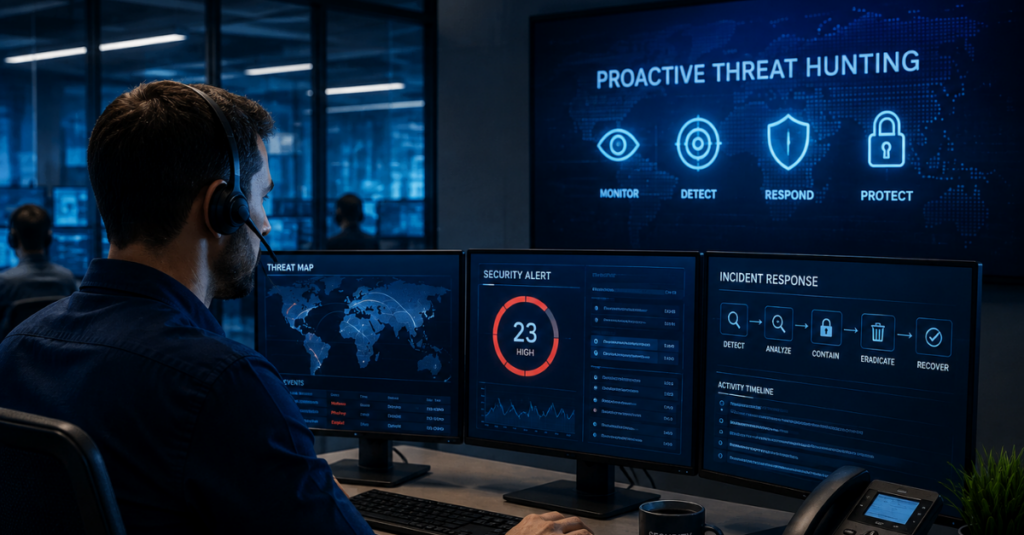
Managed Detection and Response is a security service that combines advanced monitoring technology with a team of human analysts who actively watch for, investigate, and respond to threats in real time. Rather than simply alerting a business that something suspicious happened, MDR providers take action to contain and neutralize threats as they’re detected.
The service typically includes three core components:
- Continuous monitoring across endpoints, networks, and cloud environments
- Threat detection powered by behavioral analysis and threat intelligence
- Active response where trained analysts investigate alerts and take containment action
This combination matters because most small businesses simply don’t have the staff or expertise to watch security alerts every hour of every day. A tool that generates an alert at two in the morning is useless if nobody sees it until the next business day, by which point an attacker may have already moved through the network.
How MDR Differs From Traditional Antivirus Software
Many business owners assume that installing antivirus software on every computer is sufficient protection. That assumption made more sense a decade ago, but it hasn’t kept pace with how modern attacks actually work.
Signature-Based Detection Has Limits
Traditional antivirus tools primarily rely on recognizing known malware signatures, essentially comparing files against a database of previously identified threats. This approach works reasonably well against widely circulated malware, but it struggles against new or customized attacks that haven’t been seen before.
MDR Looks at Behavior, Not Just Signatures
MDR platforms take a different approach, analyzing how programs and users actually behave rather than just checking against a list of known bad files. If an employee’s account suddenly starts accessing files it’s never touched before, or a process attempts to disable security software, MDR tools flag that behavior as suspicious even if no matching virus signature exists.
Human Analysts Fill the Gaps Software Can’t
Software alone still generates false positives and can miss context that a trained analyst would catch immediately. MDR services pair automated detection with human expertise, ensuring that alerts get properly investigated rather than either ignored or acted on incorrectly.
Why Small Businesses Are Adopting MDR in 2026
A few years ago, MDR was considered a tool primarily for large enterprises with dedicated security budgets. That’s changed significantly, and small businesses now represent one of the fastest-growing segments of MDR adoption. Several factors are driving this shift:
- Attackers increasingly target small businesses specifically because they assume weaker defenses
- Cyber insurance providers are starting to require advanced monitoring as a condition of coverage
- The cost of MDR services has dropped as the market has matured and competition has increased
- Compliance requirements in many industries now expect continuous monitoring capabilities
- The shortage of in-house security talent makes outsourced monitoring the only realistic option for most companies
Businesses working with certified IT specialists are finding that MDR fits naturally into a broader managed IT relationship, rather than requiring a separate vendor and a separate learning curve.
The Core Components of an Effective MDR Service
Not all MDR offerings are built the same way, and understanding the core components helps business owners evaluate whether a provider’s service actually delivers meaningful protection.
Endpoint Detection and Response Integration
MDR services are built on top of endpoint detection and response technology, which monitors individual devices like laptops, servers, and workstations for suspicious activity. Understanding endpoint detection basics helps clarify why this layer matters so much: it’s often the first place attacker activity becomes visible, well before it spreads across an entire network.
Network Traffic Analysis
Beyond individual devices, MDR platforms also monitor network traffic patterns, looking for unusual data transfers, connections to known malicious servers, or lateral movement between systems that could indicate an attacker exploring a compromised network.
Threat Intelligence Feeds
Quality MDR providers integrate real-time threat intelligence, meaning they’re constantly updated on the latest attack techniques, malicious domains, and emerging vulnerabilities being exploited in the wild. This intelligence sharpens detection accuracy far beyond what a static, unmonitored tool could achieve on its own.
24/7 Security Operations Center Coverage
The human element of MDR typically operates through a security operations center, staffed around the clock to review alerts, investigate anomalies, and respond to genuine threats immediately rather than waiting for business hours.
Incident Response and Containment
When a genuine threat is confirmed, MDR analysts don’t just notify the business and wait. They take immediate containment action, such as isolating an infected device from the network, disabling compromised accounts, or blocking malicious traffic, often before the business owner even knows an incident occurred.
MDR vs. MSSP vs. SIEM: Clearing Up the Confusion
The cybersecurity industry is full of overlapping acronyms, and it’s easy for business owners to get confused about what they actually need. A quick comparison helps clarify where MDR fits.
Managed Security Service Providers (MSSPs) typically focus on managing security tools and generating alerts, but often leave the actual investigation and response work to the client’s internal team, which most small businesses don’t have.
Security Information and Event Management (SIEM) platforms collect and organize massive volumes of security data, but they require skilled analysts to interpret that data effectively. Without dedicated staff, a SIEM platform can become an expensive tool that nobody has time to actually use.
Managed Detection and Response (MDR) combines the technology of both approaches with an included team of analysts who actively monitor, investigate, and respond on the business’s behalf. For most small and mid-sized companies, this all-in-one model is far more practical than trying to assemble the pieces separately.
Real-World Scenarios Where MDR Makes the Difference
Understanding MDR conceptually is useful, but it helps to see how it plays out in practical situations that small businesses actually face.
Compromised Employee Credentials
An employee’s login credentials get stolen through a phishing email. Without active monitoring, the attacker could log in undetected and slowly access sensitive files over several days. With MDR in place, unusual login behavior, such as an access attempt from an unfamiliar location or device, triggers an immediate investigation and lockout before significant damage occurs.
Ransomware in Its Early Stages
Ransomware doesn’t encrypt an entire network instantly. There’s typically a window, sometimes hours, sometimes days, where attackers are exploring the network before launching the actual encryption. MDR’s behavioral monitoring is specifically designed to catch this early reconnaissance activity, stopping an attack before it reaches the damaging final stage.
Insider Threats
Not every security risk comes from outside the business. MDR monitoring can also flag unusual behavior from legitimate employee accounts, such as an employee downloading unusually large volumes of company data shortly before resigning, which might otherwise go completely unnoticed.
Third-Party Vendor Compromise
Attackers increasingly use compromised vendor accounts or software updates as an entry point into otherwise well-protected networks. Continuous monitoring provides visibility into this kind of indirect attack path that traditional perimeter security often misses entirely.
The Business Case for MDR: Cost vs. Risk
Business owners evaluating MDR services often want to understand the actual return on investment, especially when budgets are tight. The comparison usually comes down to weighing the ongoing cost of the service against the potential cost of an undetected breach.
Consider the following:
- A single ransomware incident can cost far more than years of MDR subscription fees combined
- Regulatory fines and legal costs from a breach often dwarf the price of preventive monitoring
- Reputational damage and client attrition following a breach are difficult to quantify but very real
- Insurance premium increases after a claim can persist for years
Businesses that invest in 24/7 security monitoring as part of their overall technology strategy tend to view it less as an added expense and more as a form of insurance that actively works to prevent the loss in the first place, rather than just compensating for it afterward.
How MDR Supports Regulatory Compliance
Many industries now face regulatory frameworks that explicitly expect continuous security monitoring rather than periodic manual reviews. Healthcare organizations, financial services firms, and legal practices in particular are seeing increased expectations around demonstrating audit ready compliance with modern threat detection capabilities.
MDR services help satisfy these expectations by providing:
- Documented monitoring logs that demonstrate ongoing vigilance
- Faster incident response times that limit the scope of any potential breach
- Detailed reporting that can be presented during compliance audits or insurance renewals
- A clear chain of evidence in the event a regulatory investigation becomes necessary

Choosing the Right MDR Provider
Not all MDR services are created equal, and businesses should ask specific questions before signing a contract. A few important considerations include response time commitments, the provider’s experience with businesses of similar size and industry, and how clearly they communicate during an actual incident.
Key questions to ask a potential provider:
- What is the guaranteed response time once a threat is confirmed?
- Does the service include full incident response, or just alerting?
- How does the provider handle false positives without creating alert fatigue?
- Can the provider demonstrate experience with businesses in your specific industry?
- Is the service bundled with broader IT support, or does it require managing a separate vendor relationship?
Working with a long term IT partner who already understands a business’s existing infrastructure often leads to faster, more effective MDR implementation than starting from scratch with an unfamiliar vendor.
Zero Trust and MDR: A Natural Partnership
MDR works especially well alongside a broader zero trust security model, where no user or device is automatically trusted regardless of its location on the network. Understanding a zero trust approach helps illustrate why these two strategies complement each other so effectively: zero trust limits what an attacker can access even if they get in, while MDR ensures that any suspicious activity within those limited boundaries gets caught and addressed quickly.
Businesses that pair these two approaches typically see a meaningful reduction in both the likelihood and the potential impact of a successful attack.
Implementing MDR: What the Process Actually Looks Like
Business owners considering MDR often want to understand what the rollout process involves before committing. While specifics vary by provider, a typical implementation follows a similar pattern.
- Initial assessment. The provider reviews existing infrastructure, identifying gaps and establishing a baseline understanding of normal network behavior.
- Tool deployment. Endpoint monitoring agents and network sensors get installed across the business’s devices and infrastructure.
- Baseline tuning period. The system learns what normal activity looks like for the specific business, reducing false positives over the following weeks.
- Full monitoring activation. Once tuned, the security operations center begins actively monitoring and responding to genuine threats.
- Ongoing reporting and refinement. Regular reports and periodic reviews ensure the service continues to align with the business’s evolving needs.
Businesses working with an outsourced technology partner for their broader IT needs often find this rollout smoother, since existing familiarity with the network speeds up the tuning and deployment process considerably.
Common Misconceptions About MDR
A few misunderstandings tend to hold businesses back from adopting MDR even when it would clearly benefit them.
“We’re too small to need this.” Attackers don’t discriminate by company size, and smaller businesses often make easier targets precisely because they lack this kind of monitoring.
“Our antivirus software already covers this.” Antivirus tools address a narrow slice of the threat landscape and don’t include active human response, which is central to what MDR actually provides.
“This is too expensive for a small business.” Pricing models have matured significantly, and many providers now offer tiered services that fit within a small business budget, especially when bundled with existing IT support.
“We’ll just handle incidents ourselves when they happen.” Reactive handling after an incident is already underway is dramatically more expensive and disruptive than having monitoring in place to catch it early.
MDR for Specific Industries
Different industries face different risk profiles, and MDR services often get tailored accordingly. Healthcare practices benefit from monitoring that accounts for the sensitivity of patient records. Financial firms need monitoring aligned with strict regulatory expectations. Schools and educational institutions increasingly rely on academic technology support that accounts for the unique mix of student data privacy and limited technical staff common in that sector.
Construction and field service businesses, with employees spread across job sites and using mobile devices extensively, benefit from monitoring that extends beyond a traditional office network to cover a much more distributed set of endpoints.
Bringing MDR Into a Broader IT Strategy
MDR works best as part of a coordinated technology strategy rather than as an isolated purchase. Businesses that combine strong protected network infrastructure, well-configured firewall and monitoring tools, and active detection and response create a layered defense that’s significantly harder for attackers to penetrate than any single tool alone.
This is where working with a veteran IT team that understands both the technical and business sides of security pays off. Rather than bolting MDR onto an otherwise disorganized technology environment, an experienced partner ensures every layer works together cohesively.
What to Expect From an Initial MDR Conversation
Business owners considering MDR for the first time often aren’t sure where to start. A good starting point is a conversation covering the business’s current setup, existing risks, and realistic budget, followed by an assessment for growth that identifies where monitoring would provide the most immediate value.
From there, providers typically recommend a phased approach, starting with the most critical systems and expanding coverage over time as the relationship matures and the business’s needs become clearer.
Why Local Businesses Choose CMIT Solutions of Bothell and Renton
CMIT Solutions of Bothell and Renton works with local businesses to bring MDR and broader security services into a single, coordinated technology strategy rather than a patchwork of disconnected tools. From core IT offerings built around daily operational needs to subscription based IT plans that scale with a growing business, the goal is always to make advanced protection practical and accessible for companies that don’t have the resources of a large enterprise.
Business owners can also learn more through company history overview pages or by reaching out directly to discuss what a tailored MDR strategy would look like for their specific situation.
Whether your business is based in the city itself, needs Renton business support, relies on a Renton support desk for daily issues, or simply wants community based IT that understands the local business environment, the right monitoring strategy starts with an honest conversation about current risk.
Companies exploring growing business IT options, quick turnaround support for urgent issues, classroom technology support for schools, cloud platform management for hybrid infrastructure, statewide IT services across Washington, Issaquah threat protection, threat prevention services, network monitoring solutions, on demand tech help, responsive helpdesk staff, or general IT and networking guidance will find that MDR fits naturally alongside any of these existing service relationships.
If your business is ready to move beyond basic antivirus protection and into active, around the clock protection, now is the time to start the conversation. Contact our team to talk through what MDR could look like for your specific environment.
Frequently Asked Questions