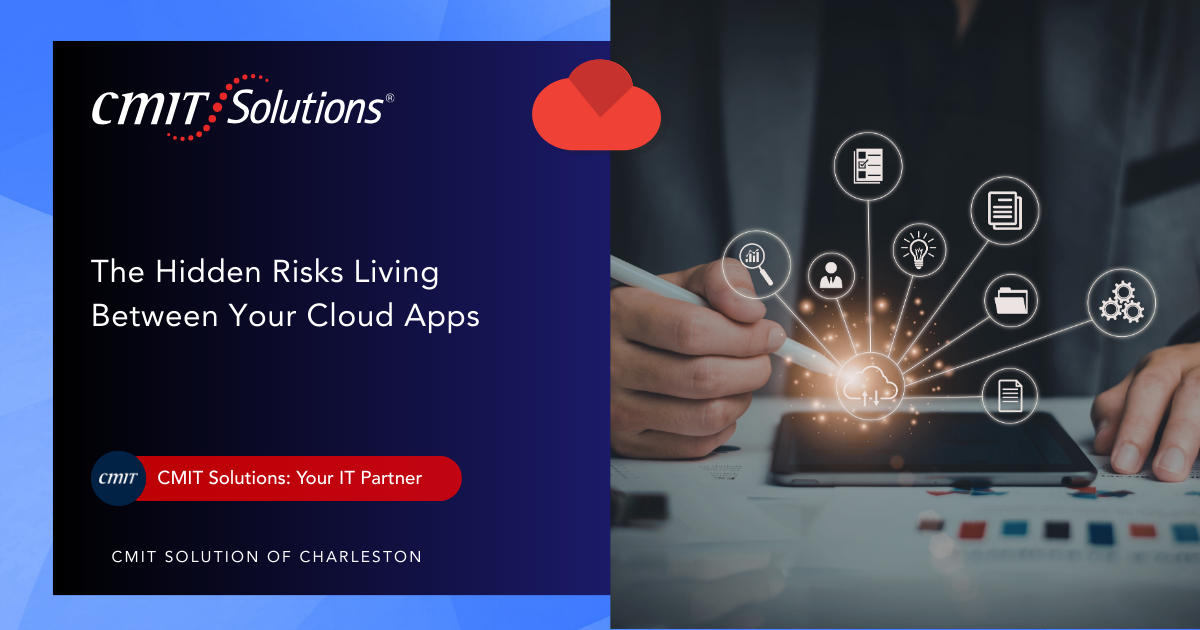
Cloud adoption has transformed how businesses operate. Applications that once lived on internal servers are now accessible from anywhere, enabling speed, flexibility, and collaboration. But while most organizations focus on securing individual cloud applications, many overlook the growing risks that exist between them.
These hidden risks don’t live inside a single platform. They emerge in the gaps between cloud apps, integrations, permissions, data flows, and user access. Over time, these blind spots create security vulnerabilities, compliance challenges, and operational inefficiencies that are difficult to detect until something goes wrong.
At CMIT Solutions of Charleston, we help businesses uncover and address the risks that don’t show up on a single dashboard but quietly undermine cloud security and reliability.
Fragmented Cloud Environments Create Invisible Attack Paths
As businesses adopt more cloud applications, environments become fragmented. Each app may be secure on its own, but attackers often exploit how systems connect and share data.
When integrations are poorly documented or loosely controlled, they create invisible pathways that bypass traditional security controls especially in cloud-first and hybrid setups where technology must support the future of work.
Fragmented cloud environments often introduce risk by:
- Creating undocumented connections between systems
- Allowing attackers to move laterally across applications
- Reducing visibility into how data flows
- Increasing the complexity of securing the environment
Overlapping Permissions Across Apps Expand Access Risk
Cloud applications often use their own permission structures. When users are granted access across multiple platforms, privileges can quietly accumulate beyond what’s necessary.
This access sprawl increases the likelihood that compromised credentials will expose more systems than intended one reason modern environments benefit from stronger identity controls and endpoint security.
Unchecked permissions between cloud apps can lead to:
- Excessive access beyond job requirements
- Difficulty tracking who can access sensitive data
- Increased impact of stolen credentials
- Reduced accountability and audit clarity
Shadow Integrations Introduce Unmonitored Risk
Many cloud apps are connected informally through third-party tools, APIs, or automation platforms. These shadow integrations are often created to improve efficiency but may never be reviewed for security or compliance.
Over time, they become hidden dependencies that few people understand or manage especially when organizations adopt tools without a structured plan like custom IT packages.
Shadow integrations often increase risk by:
- Operating outside standard security oversight
- Introducing weak authentication or encryption
- Allowing unauthorized data access
- Persisting long after their original purpose ends

Data Exposure Happens During App-to-App Transfers
Data is rarely static in cloud environments. It moves constantly between apps shared, synced, exported, and transformed. Each transfer is an opportunity for exposure if not properly secured.
Even when data is protected within an app, it may be vulnerable while in transit or during processing, which is why governance and secure workflows matter as much as tools.
App-to-app data movement creates risk when:
- Transfers are not encrypted or logged
- Data is copied instead of referenced
- Sensitive information is shared unnecessarily
- Visibility into data flow is limited
Inconsistent Security Policies Create Gaps Between Platforms
Each cloud application often enforces its own security rules. Without centralized governance, policies become inconsistent across the environment.
These inconsistencies create gaps attackers can exploit, especially when moving between apps making it critical to align security controls with cybersecurity compliance.
Policy misalignment between cloud apps can result in:
- Uneven enforcement of security standards
- Confusion over responsibility and ownership
- Difficulty maintaining compliance
- Weak points in an otherwise secure environment
Identity Silos Undermine Cloud Security
Identity is the new perimeter in cloud environments, but when identity systems aren’t fully integrated, security weakens. Separate logins, inconsistent authentication methods, and disconnected identity stores create blind spots.
Attackers often exploit identity silos to move undetected, and the risk multiplies when user training isn’t reinforcing safe behavior making security awareness training a key control.
Disconnected identity systems increase risk by:
- Making it harder to enforce consistent authentication
- Allowing compromised credentials to persist longer
- Reducing visibility into user activity
- Complicating access reviews and audits
Limited Monitoring Leaves Gaps Between Applications
Monitoring often focuses on individual apps rather than the interactions between them. This leaves blind spots where suspicious activity can go unnoticed.
Without cross-platform visibility, organizations may miss early indicators of compromise—one reason proactive IT monitoring is so important in cloud ecosystems.
Gaps in cloud monitoring often occur when:
- Logs are siloed within individual apps
- No correlation exists between events across platforms
- Alerting is limited to app-specific issues
- Activity between apps is not tracked
Compliance Risks Multiply Across Cloud App Ecosystems
Compliance requirements apply to data wherever it travels. When data moves between cloud apps, compliance responsibilities follow even if oversight doesn’t.
Hidden compliance risks often emerge when organizations assume one compliant app ensures overall compliance, which is why staying audit-ready with compliance made simple matters across the full workflow.
Compliance challenges between cloud apps arise due to:
- Inconsistent data handling practices
- Limited audit trails across platforms
- Unclear ownership of compliance controls
- Difficulty proving end-to-end compliance

Operational Complexity Masks Security Weaknesses
As cloud environments grow, complexity increases. Complexity makes it harder to see where things are breaking down, especially between systems.
When teams struggle to manage complexity, security issues often go unnoticed—and the financial impact can be significant when outages or incidents occur, as explained in the real cost of downtime.
Operational complexity hides risk by:
- Overwhelming IT teams with disconnected tools
- Making documentation difficult to maintain
- Slowing incident response
- Increasing reliance on assumptions instead of visibility
Strategic Cloud Oversight Reduces Hidden Risk
Hidden risks don’t disappear on their own—they must be addressed intentionally. Strategic oversight brings structure, visibility, and control to cloud environments, reducing exposure between apps.
At CMIT Solutions of Charleston, we focus on securing the connections, not just the platforms guided by long-term partnership principles like leading with trust.
Strategic cloud oversight helps organizations:
- Centralize visibility across cloud apps
- Standardize security and access policies
- Reduce integration-related risk
- Strengthen overall cloud resilience
Conclusion: Securing What Lives Between the Apps
The most dangerous cloud risks aren’t always obvious. They live between applications in permissions, integrations, data flows, and identity systems that quietly grow more complex over time.
By addressing these hidden risks proactively, businesses can strengthen security, simplify compliance, and gain greater confidence in their cloud environments.
At CMIT Solutions of Charleston, we help organizations uncover and secure the spaces between their cloud apps turning fragmented environments into cohesive, resilient systems. If you’re ready to reduce risk and improve cloud control, connect with contact us.
Cloud security isn’t just about protecting apps. It’s about protecting everything that connects them.