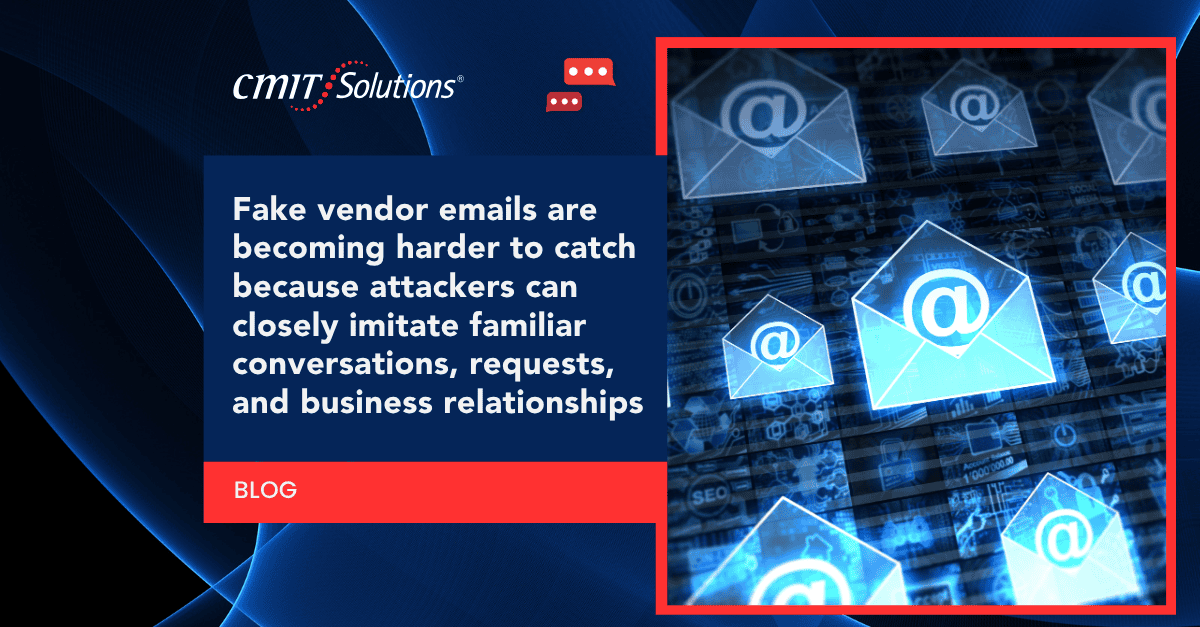
A few years ago, fake vendor emails were fairly easy to catch. Odd formatting, obvious spelling mistakes, and a sender address that clearly did not match the real company gave the scam away almost immediately. That is no longer the case. Business email compromise, often shortened to BEC, has become one of the most financially damaging forms of cybercrime precisely because the emails involved now look, sound, and behave almost exactly like legitimate business correspondence.
A finance team member receives an email that appears to come from a familiar vendor, referencing a real invoice number, written in a tone that matches previous correspondence, asking for payment to be sent to an “updated” bank account. Nothing about it looks unusual. That is the point. CMIT Solutions of Cincinnati East works with businesses that have either narrowly avoided or, in some cases, fallen victim to exactly this kind of attack. This article breaks down why these scams have become so convincing, what red flags still exist, and how a business can build real protection against a threat that keeps getting harder to spot with the naked eye.
What Business Email Compromise Actually Is
Business email compromise refers to a category of scams where an attacker impersonates a trusted party, usually a vendor, executive, or business partner, to trick an employee into making a fraudulent payment or sharing sensitive information. Unlike broad phishing campaigns that cast a wide net, BEC attacks are typically targeted, researched, and patient.
Common variations include:
- Vendor impersonation: an attacker poses as a real supplier requesting payment to a new bank account
- Executive impersonation: an attacker poses as a company leader requesting an urgent wire transfer or gift card purchase
- Payroll diversion: an attacker poses as an employee requesting a change to direct deposit information
- Compromised account attacks: an attacker gains actual access to a real vendor’s email account and sends fraudulent requests from a legitimate address
- Attorney impersonation: an attacker poses as legal counsel handling a confidential, time-sensitive matter to pressure quick action
Every variation relies on the same core tactic: exploiting trust in an existing relationship rather than trying to trick someone into clicking a suspicious link.
Why These Scams Are Getting Harder to Detect
A combination of technical and psychological factors has made business email compromise dramatically more convincing than it was even a few years ago.
AI-Generated Writing Removes the Old Red Flags
Poor grammar and awkward phrasing used to be a reliable warning sign. AI writing tools have effectively eliminated that tell. Attackers can now generate polished, professional emails that match the tone and formality of legitimate business communication almost perfectly, in any language.
Look-Alike Domains Are Nearly Invisible at a Glance
Attackers frequently register domains that differ from a legitimate vendor’s domain by a single character, such as swapping a lowercase “l” for an uppercase “I,” or adding a hyphen that easily blends in at first glance. Unless an employee examines the sender address character by character, these substitutions are extremely difficult to catch in a busy inbox.
Real Account Compromise Skips Impersonation Entirely
In many of the most damaging cases, the attacker is not impersonating the vendor at all. They have actually gained access to the vendor’s real email account, often through a previous phishing attack or credential theft, and are sending fraudulent payment requests from a completely legitimate address. In these cases, there is no fake domain to spot, because nothing about the sender is fake.
Attackers Do Their Homework
Modern BEC attacks often follow a period of reconnaissance where the attacker studies publicly available information, including company websites, LinkedIn profiles, press releases, and even previous email threads obtained through a prior breach. This allows them to reference real projects, real invoice numbers, and real names, making the request feel entirely consistent with an existing relationship.
Urgency and Authority Still Work
Even with more sophisticated technical tactics, the psychological core of these scams remains the same. Attackers create a sense of urgency, often citing a tight deadline or an unhappy client, paired with a request from someone the target does not want to disappoint. This pressure short-circuits the kind of careful verification that would normally catch the fraud.
Why Vendor Impersonation Specifically Is on the Rise
Vendor impersonation has become a particularly common form of BEC because most businesses have far less visibility into their vendors’ security practices than into their own. A company can train its own employees, but it has no control over whether a supplier’s email account has been compromised. This makes vendor relationships an attractive entry point for attackers, since a single successful compromise of one vendor’s inbox can be used to target every one of that vendor’s customers simultaneously.
Businesses handling frequent invoicing and payment cycles are especially exposed. Accounting and finance teams, which process high volumes of vendor correspondence regularly, are often the most targeted group inside an organization, a risk explored further in this piece on accounting firm data risks.
The Financial Impact of a Successful BEC Attack
Business email compromise consistently ranks among the most financially damaging categories of cybercrime, often outpacing ransomware in total reported losses. A few factors contribute to why the financial impact tends to be so severe:
- Wire transfers are often difficult or impossible to reverse once completed
- Attackers frequently request amounts calibrated to look plausible rather than obviously excessive, reducing suspicion
- Losses are often discovered only after the real vendor follows up on an unpaid invoice, sometimes weeks later
- Legal and reputational costs can follow if the incident affects a client or partner relationship
- Cyber insurance policies do not always cover this specific category of loss, depending on the policy’s terms
Smaller and mid-sized businesses are frequently targeted precisely because they tend to have fewer formal verification controls in place compared to larger enterprises. This pattern is consistent with the broader trend of rising cyber threats aimed specifically at smaller organizations that may assume they are too small to be worth an attacker’s time.
Red Flags That Still Exist, Even in Sophisticated Attacks
While BEC scams have become harder to spot, a few warning signs remain useful, particularly when employees are trained to look for them specifically.
- A request to change payment details, especially bank account information, coming through email alone rather than a verified secondary channel
- Unusual urgency paired with a request to bypass normal approval processes
- A subtle change in tone or formality compared to previous correspondence with the same contact
- A reply-to address that differs from the visible sender address, even when the display name looks correct
- Requests that avoid phone verification, often citing being in a meeting or traveling as a reason not to call
- Pressure to keep the transaction confidential from other team members who would normally be involved
None of these signs are foolproof on their own, but a business that trains employees to check for several of them together significantly improves its odds of catching a fraudulent request before money moves.
Why a Single Red Flag Is Rarely Enough to Act On
It is worth noting that any one of these signals alone can have an entirely innocent explanation. A vendor might genuinely be traveling and hard to reach by phone, or a request might carry real urgency without being fraudulent. The value of these red flags comes from looking at them in combination and treating any cluster of them as a reason to slow down and verify, rather than dismissing a single unusual detail because the rest of the email otherwise looks legitimate.
Building a Verification Process That Actually Stops Fraud
Technology alone cannot fully solve business email compromise, because the core vulnerability is human trust, not a technical flaw. A strong verification process closes that gap by requiring confirmation outside the email thread itself before any payment detail changes.
Require Callback Verification for Any Banking Change
Any request to change vendor payment details should be confirmed by phone, using a number pulled from an existing, trusted record rather than a number provided in the email itself. This single habit closes the majority of vendor impersonation attempts, since attackers rarely have access to a legitimate phone line at the real vendor.
Establish Dual Approval for Large Payments
Requiring a second person to review and approve any payment above a set dollar threshold creates a natural checkpoint that a single compromised inbox cannot bypass on its own.
Slow Down Urgent Requests
Building a standard policy that urgent payment requests still go through the normal approval process, regardless of the pressure applied, removes the psychological lever attackers rely on most heavily.
Maintain a Verified Vendor Contact List
Keeping an internal, verified list of vendor contacts and payment details, updated only through a formal process, gives finance teams a reliable reference point to check any incoming request against.
Document Every Verification Step
A simple log of who verified a payment change, when, and how, creates accountability and makes it easier to spot process gaps after the fact if something does go wrong.
Technical Defenses That Reduce Exposure
Alongside process changes, a set of technical protections meaningfully reduces the chances that a fraudulent email reaches an inbox in the first place, or succeeds if it does.
- Email authentication protocols, including SPF, DKIM, and DMARC, help verify that incoming email actually originates from the domain it claims to be from
- Advanced email filtering that flags look-alike domains and unusual sending patterns before messages reach an employee’s inbox
- Layered cybersecurity protection that extends beyond email to cover the broader systems an attacker might use to gather information for a future BEC attempt
- Multi-factor authentication on every email account, reducing the risk that an employee’s own account becomes the compromised source of a future attack
- A zero trust framework that limits how much access any single compromised account could grant an attacker across connected systems
These protections work best layered together, since no single technical control catches every variation of a well-executed BEC attempt.

Training Employees to Slow Down, Not Just Spot Red Flags
Traditional phishing training often focuses on spotting obvious warning signs, but modern business email compromise requires a different mindset. Since many of the old visual cues no longer apply, training needs to emphasize process discipline over pattern recognition alone.
- Teach employees that urgency itself is a warning sign, regardless of how legitimate the request appears
- Reinforce that verifying a payment change by phone is never an overreaction, even for a trusted, longstanding vendor
- Use real, anonymized examples relevant to the specific department being trained, since finance, HR, and executive assistants face different variations of this threat
- Make it clear that flagging a request for verification will never be treated as an inconvenience, even if the request turns out to be legitimate
- Run periodic simulated BEC exercises to keep awareness sharp, since general awareness tends to fade without reinforcement
Employees who understand why urgency and authority are being used against them tend to catch these attempts far more reliably than employees who were simply told to watch for spelling errors.
What to Do If a Fraudulent Payment Is Discovered
Speed matters enormously once a business realizes it has been targeted or has already sent a fraudulent payment.
- Contact the receiving bank immediately to request a recall, since some transfers can still be reversed within a narrow window
- File a report with the FBI’s Internet Crime Complaint Center, which works directly with financial institutions on recovery efforts
- Notify the real vendor so they can warn other customers who may be targeted by the same compromised account
- Change passwords and enable multi-factor authentication on any account suspected of compromise
- Review email forwarding rules, since attackers often set up hidden rules to monitor a compromised inbox without detection
- Document the incident thoroughly for insurance claims and any required regulatory disclosure
The first hours after discovery are the most critical for any chance of financial recovery, which makes having a documented incident response plan in place ahead of time extremely valuable.
Why Speed Matters More Than Perfection
Businesses sometimes hesitate to report a suspected fraud immediately because they want to gather more information first, confirm exactly what happened, or determine who is at fault internally. This instinct, while understandable, works against the business’s own interests. Banks and law enforcement can only act on a recall request within a narrow window, often just hours, before funds are moved again or withdrawn entirely. A response plan that prioritizes immediate notification over internal investigation gives a business the best possible chance at recovering some or all of the lost funds, with the deeper review happening afterward once the immediate window has closed.
How This Threat Connects to Broader Security Gaps
Business email compromise rarely exists as an isolated risk. It often reflects broader gaps in a company’s overall security posture.
- Businesses already struggling with foundational security practices tend to be more vulnerable to BEC as well, a pattern reflected in this overview of common cybersecurity mistakes
- Related social engineering tactics, including QR code phishing scams, often work in tandem with BEC campaigns to harvest the credentials attackers eventually use
- Employees casually using unmanaged AI tools can inadvertently make BEC attacks easier, since everyday workplace AI tools sometimes end up storing details about vendor relationships that attackers could exploit if that data were ever exposed
- Manufacturers and other businesses managing extensive vendor networks are increasingly factoring this risk into broader planning, a trend discussed in this piece on manufacturing cybersecurity investment
A business with strong overall security hygiene, consistent monitoring, and clear internal processes is generally far more resilient against BEC than one relying solely on employees to catch every fraudulent request through vigilance alone.
Industry-Specific Considerations
Some industries face heightened exposure to business email compromise due to the volume and nature of their vendor and client communication.
Legal practices handle high-value transactions, including real estate closings and settlement payments, making them especially attractive targets for BEC schemes involving fraudulent wire instructions. Firms strengthening their defenses often turn toward legal practice data security frameworks that include strict payment verification protocols.
Healthcare organizations manage a large volume of vendor and insurance-related correspondence, creating similar exposure. Guidance on medical practice cybersecurity increasingly includes specific attention to email-based fraud alongside traditional data protection concerns.
Engineering and manufacturing firms with complex supply chains face a wider vendor surface area, increasing the number of potential entry points an attacker could exploit. This is one reason firms with sensitive designs and proprietary data are placing more emphasis on protecting intellectual property alongside financial fraud prevention.
Growing companies that are scaling quickly often add new vendors faster than their internal verification processes can keep up, a gap worth addressing early using the same principles covered in this piece on building a startup technology foundation from day one.
Professional services firms managing high client volumes are also seeing an uptick in impersonation attempts tied to invoicing and retainer payments, a shift discussed in this overview of modern IT support trends shaping how these firms approach both productivity and fraud prevention.
Common Mistakes That Leave Businesses Exposed
A handful of recurring mistakes show up across businesses that have fallen victim to business email compromise.
- Relying entirely on employee vigilance without any formal verification process in place
- Assuming email authentication protocols alone are sufficient protection
- Failing to train new employees on payment verification procedures during onboarding
- Not updating vendor contact information through a controlled, verified process
- Treating BEC awareness as a one-time training topic rather than an ongoing discipline
Businesses recovering from a cloud migration or broader technology transition are sometimes particularly vulnerable during that period, since cloud migration pitfalls can temporarily disrupt normal monitoring and verification routines if the transition is not carefully managed.

Building Long-Term Resilience Against This Threat
Business email compromise is not a threat that gets solved once and then forgotten. Attackers continuously refine their tactics, which means defenses need to evolve alongside them.
- Review and update verification procedures at least annually, incorporating lessons from any near-misses reported internally
- Reassess email security tools periodically to confirm they still catch the latest impersonation techniques
- Keep vendor communication channels documented and easy for employees to reference quickly
- Encourage a culture where flagging a suspicious request is always welcomed, never second-guessed
- Revisit training content regularly as attackers adopt new tactics, particularly as AI-generated content continues to improve
- Coordinate procurement and finance teams so new vendors are added to verified records through a equipment procurement planning process rather than an informal email exchange
Where a Managed IT Partner Fits In
Defending against business email compromise effectively requires a combination of technical safeguards, process discipline, and ongoing employee training, all of which are easier to maintain with the right support in place.
Services that businesses working to strengthen their defenses typically benefit from include:
- Ongoing IT management that includes proactive monitoring of email security configurations
- Network performance monitoring built to catch impersonation attempts before they reach an inbox
- Secure cloud solutions that support properly configured email authentication protocols
- Regulatory compliance guidance for businesses that need documented security controls to satisfy vendor or client requirements
- Reliable data backup coverage to protect records needed for incident investigation and recovery
- Team communication platforms that reduce reliance on email alone for time-sensitive internal coordination
- Strategic technology planning that ties fraud prevention into a broader, coordinated security strategy
- Responsive help desk support for employees who need a fast second opinion on a suspicious request
- Support from a team familiar with local business technology needs across the Cincinnati East region, including the specific vendor relationships common in the area
- A technology readiness review for businesses wanting to understand how AI-driven threats fit into their current security posture
- Flexible support packages that scale protection alongside a growing vendor network
- Business software integration that connects approval workflows across finance and accounting systems, reducing reliance on email as the sole verification step
A trusted regional provider brings dependable technology partner experience and a team of experienced local technicians who help businesses build the layered defenses needed to catch these increasingly convincing scams before real money moves.
Final Thoughts
Business email compromise has evolved well past the easy-to-spot scams of a few years ago. Polished writing, convincing domains, and even genuinely compromised vendor accounts mean that visual red flags alone are no longer a reliable defense. The businesses staying ahead of this threat are combining strong verification habits with layered technical protection and consistent training, rather than relying on any single safeguard to catch every attempt.
If your business wants help closing the gaps that make vendor impersonation fraud possible, CMIT Solutions of Cincinnati East can help build a verification process and security setup designed to catch these attempts before money moves. Schedule a consultation to start strengthening your defenses against this fast-evolving threat.
Frequently Asked Questions