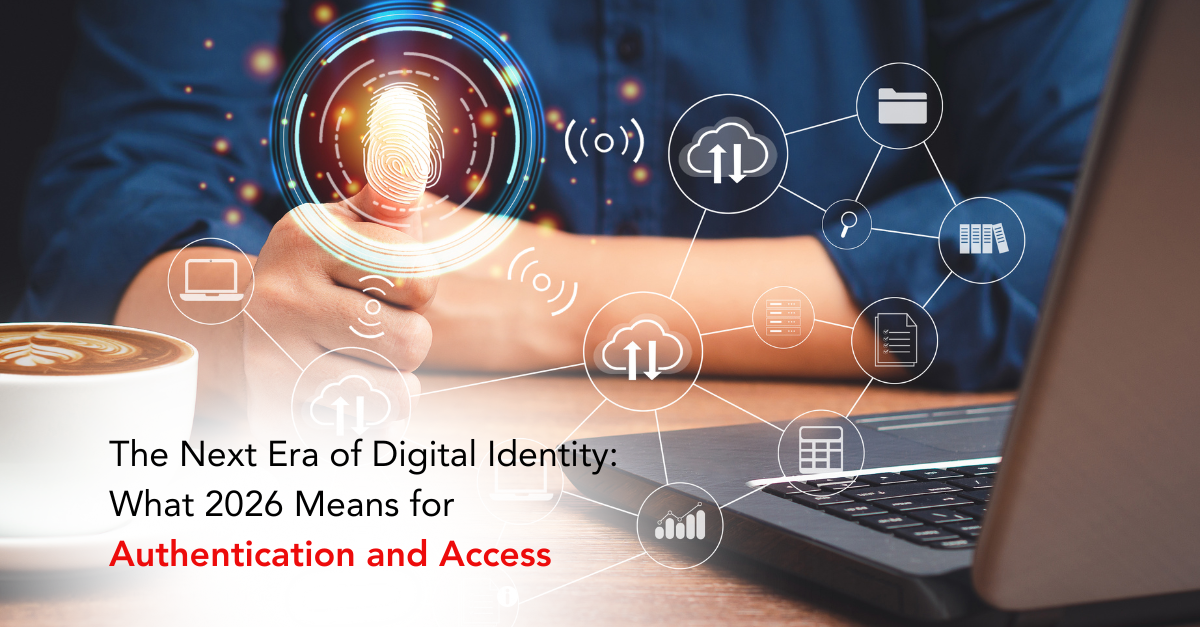
Digital identity is entering a new era. By 2026, authentication and access management will no longer be limited to usernames and passwords. As businesses adopt cloud platforms, remote work expands, and cyber threats grow more sophisticated, identity has become the primary security boundary.
For modern organizations, digital identity is now directly tied to operational resilience, compliance, and trust. The next era of authentication focuses on verifying who users are, how they behave, and whether their access remains appropriate at every moment not just at login.
Why Digital Identity Is Becoming the New Security Perimeter
Traditional security models assumed threats originated outside the network. Today, attackers target identities directly, using stolen credentials to move undetected within trusted systems.
This shift is a core driver behind zero trust security, where trust is never assumed and always verified.
- Identities are now the primary attack surface
- Credential misuse bypasses perimeter defenses
- Cloud environments depend on identity validation
- Continuous verification replaces static trust
Passwords Are Losing Their Effectiveness
Passwords alone are no longer sufficient to protect modern environments. Reuse, phishing, and credential stuffing have made password-only access extremely vulnerable.
These weaknesses are addressed through multi layered cybersecurity strategies that reduce reliance on a single control.
- Password reuse increases breach probability
- Phishing exploits human behavior
- Credential theft enables silent access
- Static authentication fails against modern threats
Multi-Factor Authentication Is Becoming the Baseline
By 2026, multi-factor authentication will be considered a minimum requirement, not an advanced feature. Cyber insurers and compliance frameworks already expect it as standard.
This shift aligns with proactive approaches outlined in proactive IT support.
- MFA blocks most credential-based attacks
- Authentication becomes layered by design
- Identity compromise is significantly reduced
- Security incidents decline
Behavioral Authentication Is Gaining Momentum
Authentication is expanding beyond what users know or possess. Behavioral indicators such as login timing, device posture, and location patterns now influence access decisions.
This evolution reflects real-world application of zero trust action.
- Behavior becomes a trust signal
- Anomalies trigger verification challenges
- Risk-based authentication adapts dynamically
- Access decisions evolve in real time
Cloud Identity Is Replacing On-Prem Access Models
As organizations migrate workloads to the cloud, identity management must follow. Centralized cloud identity platforms simplify access while improving governance.
Businesses adopting a cloud smart approach are better positioned to manage identity securely.
- Cloud identity enables remote access
- Centralized control improves oversight
- Access policies apply consistently
- Scalability supports growth
Network Visibility Supports Identity Protection
Identity-based attacks often go unnoticed without proper monitoring. Visibility into access behavior is critical for early detection.
This is where network visibility becomes essential.
- Unusual access patterns indicate compromise
- Lateral movement becomes detectable
- Identity misuse triggers alerts
- Faster response limits damage

Compliance Is Increasing Identity Requirements
Regulators now expect strict access controls, identity logging, and audit trails. Weak identity practices expose businesses to compliance failures.
Automating identity governance supports automated compliance.
- Identity controls support audits
- Access logs enable accountability
- Least-privilege access reduces exposure
- Compliance becomes continuous
Identity Resilience Supports Business Continuity
When identity systems fail, productivity often stops entirely. Reliable authentication is essential to operational resilience.
This resilience complements ransomware proof backups by protecting access during incidents.
- Secure access during disruption
- Reduced operational downtime
- Faster recovery after incidents
- Business continuity preserved
Strategic Identity Planning Prevents Tool Sprawl
Deploying identity tools reactively leads to fragmented environments and higher risk. Strategic planning ensures identity systems work together cohesively.
This mirrors the value of IT consulting.
- Identity tools integrate effectively
- Redundant systems are eliminated
- Policies remain consistent
- Long-term costs are controlled

Why Managed IT Services Matter for Identity Security
Identity environments require constant updates, monitoring, and policy enforcement. Most businesses lack internal capacity to manage this alone.
Partnering with managed IT services ensures identity systems remain secure.
- Continuous identity monitoring
- Centralized access control
- Rapid response to anomalies
- Predictable operational support
Identity-Driven Organizations Adapt Faster
Strong identity foundations enable businesses to adapt to remote work, acquisitions, and regulatory change.
This adaptability is reinforced through digital transformation.
- Faster onboarding and offboarding
- Secure collaboration
- Improved user experience
- Reduced security friction
The Cost of Ignoring Identity Evolution
Delaying identity modernization increases breach risk and operational disruption. Identity failures cascade quickly across systems.
Preventing disruption through downtime prevention is far more cost-effective.
- Revenue loss from access failures
- Increased cyber exposure
- Compliance penalties
- Long-term recovery strain
Conclusion: Digital Identity Defines Access in 2026
By 2026, digital identity will define how organizations operate securely and efficiently. Authentication will be continuous, adaptive, and deeply integrated into business strategy.
Organizations that invest in identity-first security today will enter the next era with confidence, resilience, and competitive advantage.