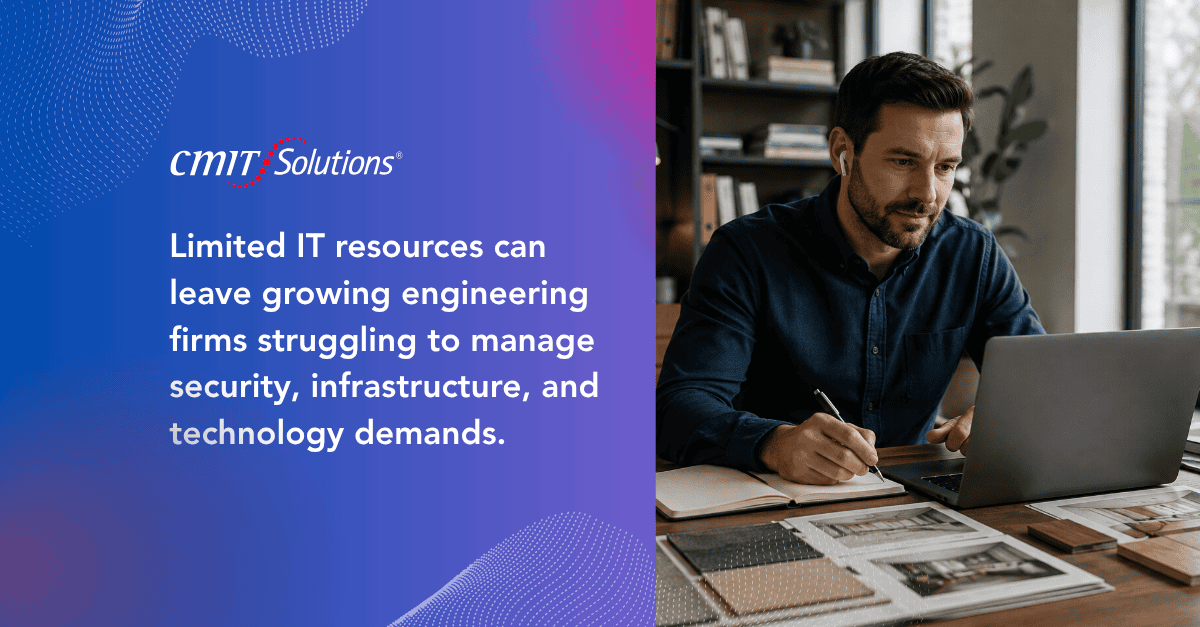
Ask most mid-sized engineering firm leaders what keeps them up at night, and the answer often centers on winning bids, managing project timelines, or retaining skilled staff. Rarely does the answer start with IT staffing. Yet for many growing engineering companies, an undersized internal IT function has quietly become the single biggest operational risk in the business, one that touches security, compliance, project delivery, and client trust all at once.
This isn’t a hypothetical concern. Engineering firms sit in an unusual middle ground: too large to run on a single generalist “the person who’s good with computers,” but often too small to justify a full internal IT department with the specialized coverage that modern threats and technology demands actually require. That gap is where serious risk lives, and it’s growing wider as attack sophistication increases and client expectations rise.
The Mid-Size Staffing Trap
Small firms often get away with minimal IT oversight simply because their exposure is limited. Large enterprises can afford dedicated security teams, network engineers, and help desk staff working around the clock. Mid-sized engineering firms fall into an uncomfortable middle zone: complex enough to face enterprise-level risks, but without the budget or headcount to staff enterprise-level protection.
This creates a predictable pattern:
- One or two internal IT staff responsible for everything from help desk tickets to network security
- No coverage during nights, weekends, or vacations when problems still occur
- Limited specialized expertise across cybersecurity, compliance, and infrastructure planning simultaneously
- Constant reactive firefighting that leaves no time for strategic planning
- High burnout risk for the few staff members carrying the entire technology burden
Firms stuck in this trap often don’t recognize the risk until something breaks, whether that’s a missed vulnerability, a burned-out employee leaving unexpectedly, or a project delay caused by unresolved technical issues. The pattern is explored further in 5 signs your small business has outgrown its current IT setup, which applies directly to engineering firms caught in this exact staffing gap.
Why One or Two IT Staff Can’t Cover Everything
Modern IT and cybersecurity has become too specialized for any single person, or even a small team, to competently cover every discipline. Expecting one generalist IT employee to handle network infrastructure, cybersecurity monitoring, compliance documentation, help desk support, and strategic planning simultaneously sets both the employee and the business up for failure.
Areas that typically get neglected under this model include:
- Proactive security monitoring, since reactive ticket resolution consumes all available time
- Regular vulnerability assessments, which require dedicated focus rather than being squeezed between urgent tickets
- Strategic infrastructure planning, since day-to-day firefighting leaves no room for forward-looking work
- Compliance documentation, which demands consistent attention rather than periodic catch-up efforts
- Backup verification and testing, often assumed to be working until an actual failure proves otherwise
This reality is closely tied to the broader shift discussed in the shift from reactive IT to predictive technology management, where firms stuck in constant reactive mode simply don’t have the bandwidth to build the proactive protections that actually prevent major incidents.
The Security Gap Created by Limited Staffing
Cybersecurity threats don’t pause for staffing limitations, and this is where thin IT coverage creates the most dangerous exposure. Engineering firms hold valuable intellectual property, client project data, and often work with government or regulated clients, making them attractive targets for increasingly sophisticated attackers.
Common gaps that emerge under limited staffing include:
- Delayed patching of known vulnerabilities due to competing priorities
- Inconsistent monitoring that misses early warning signs of an intrusion
- Weak incident response capability, since responding to an active attack requires specialized expertise most generalist staff don’t have
- Outdated security tools that were never properly maintained or updated
- No dedicated staff member monitoring threats outside of standard business hours
Attackers increasingly target exactly this kind of gap, understanding that mid-sized firms often present the security posture of a much larger organization’s target profile without the corresponding defenses. The evolving threat landscape is covered in cybercrime evolution and new threat patterns, a useful reference for understanding exactly what limited internal teams are up against. Closing this gap requires dedicated cybersecurity risk management coverage that a stretched internal team simply can’t provide alone.
Compliance Risk Hiding Behind Thin IT Coverage
Engineering firms working with government contracts, regulated industries, or large corporate clients face growing compliance obligations tied to data security and documentation. Meeting these requirements takes sustained, detailed attention, something limited IT staff rarely have room for amid daily operational demands.
Compliance gaps commonly overlooked under thin staffing include:
- Incomplete or outdated security documentation required for audits
- Missed deadlines for required compliance reviews or certifications
- Inconsistent access control policies that don’t hold up under scrutiny
- Lack of formal incident response plans required by certain contracts or standards
The stakes here are significant, since failing to meet compliance requirements can disqualify a firm from bidding on desirable contracts altogether. The specific checklist relevant to engineering firms is outlined in the cybersecurity compliance checklist every Dallas engineering company needs, a useful benchmark for firms unsure whether their current documentation would hold up. Building this into a structured IT compliance requirements framework prevents compliance from becoming an afterthought squeezed in between other priorities.
The Hidden Cost of Downtime With Limited Coverage
When a critical system fails outside standard business hours, or while the sole IT staff member is on vacation or out sick, resolution time stretches far longer than it should. For project-driven engineering firms, this kind of delay directly threatens deadlines and client relationships.
Consequences of limited after-hours coverage include:
- Extended downtime while waiting for the available staff member to become reachable
- Delayed project deliverables tied to inaccessible files or systems
- Increased stress and burnout for the employee expected to be perpetually on call
- No backup plan when the primary IT contact is genuinely unavailable
The financial and operational cost of this kind of downtime is detailed in proactive network management eliminating downtime, which quantifies exactly what these gaps cost firms that haven’t built in redundant coverage.
Burnout: The Overlooked Risk to Business Continuity
Perhaps the least discussed risk of thin IT staffing is what happens to the business when that one critical employee leaves. Engineering firms running on a single IT staff member often discover, only after that person resigns, just how much undocumented institutional knowledge walked out the door with them.
Warning signs of this risk include:
- Critical passwords, configurations, or processes that exist only in one person’s head
- No documented network diagrams, system inventories, or standard procedures
- Complete dependency on one individual’s availability for any significant technical decision
- No succession plan if that employee becomes unavailable for any reason
This single point of failure represents a genuine business continuity risk, not just an inconvenience. Firms that recognize this early tend to diversify their technology support before a crisis forces the issue, rather than after.
Why Hiring More Internal Staff Isn’t Always the Answer
The instinctive response to recognizing this gap is often to hire additional internal IT staff. In practice, this approach carries significant challenges that make it a difficult solution for many mid-sized firms.
Challenges with internal hiring include:
- High salary costs required to attract specialized cybersecurity and infrastructure talent
- A competitive hiring market where qualified candidates have many options
- Turnover risk that recreates the same knowledge gap the hire was meant to solve
- Difficulty justifying full-time headcount across highly specialized disciplines that a mid-sized firm may not need at full capacity
- Time and cost required for onboarding and ongoing professional development
This challenge is explored in depth in how Dallas engineering firms are scaling IT without hiring a full IT department, which walks through why many growing firms are choosing a different path entirely.
The Case for a Managed IT Partnership Model
Rather than attempting to build a full internal team capable of covering every specialized discipline, many mid-sized engineering firms find a managed partnership model delivers broader, more reliable coverage at a more predictable cost.
Advantages of this approach include:
- Access to a full team of specialists across security, networking, compliance, and infrastructure, rather than relying on one generalist
- 24/7 monitoring and support coverage without staffing multiple shifts internally
- Predictable monthly costs instead of unpredictable hiring, turnover, and training expenses
- Faster scaling during growth periods without recruitment delays
- Documented processes and institutional knowledge that don’t disappear when a single employee leaves
This model addresses the burnout, coverage gaps, and specialization challenges that plague thin internal teams simultaneously. Choosing the right managed IT services partner gives firms access to depth of expertise that would be prohibitively expensive to replicate internally.

What a Hybrid Approach Can Look Like
For firms with some internal IT presence they want to retain, a hybrid model often works well, combining internal staff who understand the business intimately with external partners who provide specialized coverage and after-hours support.
A well-structured hybrid approach includes:
- Internal staff focused on day-to-day user support and business-specific knowledge
- External partners handling specialized security monitoring, compliance, and strategic infrastructure planning
- Clearly defined escalation paths so both teams know when and how to hand off issues
- Regular coordination between internal and external teams to avoid duplicated or missed work
This kind of coordinated model prevents the common failure mode where internal and external support exist in silos, each assuming the other is covering a particular risk area. Reliable proactive IT support built around this collaborative structure closes gaps rather than creating new ones.
Evaluating Whether Your Firm Is Understaffed on IT
Determining whether your engineering firm has outgrown its current IT staffing requires an honest assessment rather than waiting for a crisis to make the answer obvious.
Questions worth asking include:
- Could your business function normally if your primary IT contact was unavailable for two weeks?
- Are security patches and updates applied consistently, or do they lag behind known vulnerabilities?
- Does your firm have documented, tested backup and incident response procedures?
- Is your IT staff spending most of their time on reactive tickets rather than proactive planning?
- Would your current documentation and security posture hold up under a client or regulatory audit?
Honest answers to these questions often reveal gaps that have been quietly accumulating for months or years. Firms navigating this kind of transition from reactive scrambling to intentional planning often find the perspective from reactive to strategic how COOs are using IT to drive growth useful for framing the conversation with leadership.
The Connection Between IT Staffing and Client Confidence
For engineering firms competing for larger contracts, particularly those involving government agencies or corporate clients with their own vendor security requirements, IT staffing gaps can directly affect the ability to win business. Clients increasingly ask detailed questions about security practices, incident response capability, and data handling procedures before signing agreements.
Firms with thin IT coverage often struggle to answer these questions convincingly, while firms with robust, well-documented support, whether internal, external, or hybrid, demonstrate the kind of operational maturity larger clients expect. This connects directly to the trust-building discussed in how CMIT helps engineering teams stay compliant without the overhead, where strong IT support becomes a genuine competitive advantage rather than just a defensive necessity.
Budgeting for Adequate IT Coverage
One reason firms remain understaffed on IT is a budgeting approach that treats technology support as a minimal necessary expense rather than a risk management investment proportional to what’s actually at stake.
A more accurate budgeting approach considers:
- The realistic cost of a major security incident or extended downtime event
- The value of contracts or client relationships that depend on demonstrable security maturity
- The total cost of internal hiring, including salary, benefits, training, and turnover risk
- The comparative cost of a managed partnership providing broader coverage
Firms that continue underinvesting in IT staffing often end up spending far more reactively, through emergency response costs and lost business, than they would have spent on adequate ongoing coverage. This pattern is detailed in why most SMBs waste 40 percent of IT spend, a dynamic that applies directly to firms trying to stretch minimal IT staff across an expanding set of responsibilities.
Infrastructure That Reduces the Burden on Limited Staff
Beyond staffing decisions, the underlying technology infrastructure itself can either compound or relieve the pressure on a thin IT team. Well-designed systems require less constant manual intervention, freeing limited staff to focus on higher-value work.
Infrastructure improvements that reduce ongoing burden include:
- Cloud-based systems that reduce physical hardware maintenance requirements
- Automated monitoring and alerting that catches issues without constant manual checking
- Centralized management tools that simplify oversight across multiple devices and locations
- Reliable backup systems that don’t require constant manual verification
A properly structured cloud migration strategy and network monitoring tools setup can meaningfully reduce the day-to-day burden on limited internal staff, making existing headcount far more effective without requiring additional hires.

Building a Realistic Path Forward
For mid-sized engineering firms recognizing this gap, the path forward doesn’t require an all-or-nothing decision between minimal internal IT and a massive internal buildout. A phased, realistic approach tends to produce better results.
A practical path forward includes:
- Conducting an honest assessment of current IT capacity against actual business risk
- Identifying the highest-risk gaps, typically security monitoring and backup verification
- Evaluating managed partnership options that complement existing internal staff rather than replacing them entirely
- Establishing clear documentation and succession planning regardless of the staffing model chosen
- Reassessing staffing needs regularly as the firm grows and project complexity increases
Reviewing available service packages built for firms at different stages of this journey helps identify a starting point that matches current risk level and budget, without requiring a disruptive overhaul all at once.
Final Thoughts
Limited IT staffing isn’t just an operational inconvenience for mid-sized engineering firms; it’s a genuine business risk touching security, compliance, project delivery, and client trust simultaneously. The firms most exposed to this risk are often the ones who haven’t yet experienced a major incident, creating a false sense of security that thin coverage has been “working fine” simply because nothing catastrophic has happened yet.
CMIT Solutions of Dallas partners with mid-sized engineering firms to close these staffing gaps, whether through fully managed support or a hybrid model that complements existing internal teams. If you want an honest assessment of where your firm’s current IT coverage stands, schedule a consultation
Frequently Asked Questions