
For manufacturers, downtime is never just an inconvenience. Every hour a production line sits idle translates directly into missed shipments, delayed customer orders, and real financial loss. Yet many manufacturing facilities across Southwest Florida still rely on reactive IT support, only calling for help once a server crashes, a network switch fails, or a critical piece of equipment stops communicating with the systems that control it.
CMIT Solutions of Fort Myers South works with manufacturers who are shifting away from that reactive model toward predictive IT monitoring, an approach designed to catch problems before they ever cause a production stoppage. This article explains why downtime happens, how predictive monitoring works, and what manufacturers can do to build a more resilient operation.
The Real Cost of Manufacturing Downtime
Unplanned downtime rarely shows up as a single, isolated expense. It ripples outward through lost production output, idle labor costs, missed delivery windows, and in some cases contractual penalties tied to late shipments. For manufacturers running tight margins, even a few hours of unexpected downtime per month can add up to a significant portion of annual revenue.
Common downtime triggers on a typical shop floor include:
- Failing network switches or outdated cabling causing intermittent connectivity
- Server hardware nearing end of life without a replacement plan in place
- Software running on unsupported operating systems no longer receiving updates
- Cyberattacks specifically targeting production and control systems
- Power fluctuations affecting sensitive industrial equipment
A proactive managed services approach shifts the focus away from waiting for something to break, replacing that pattern with continuous oversight designed to catch warning signs early.
What Predictive IT Monitoring Actually Means
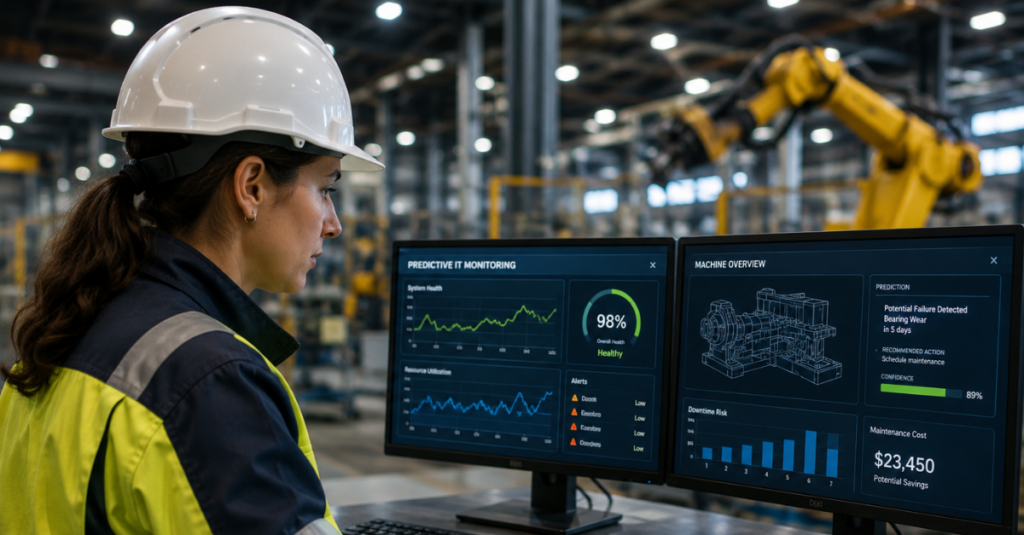
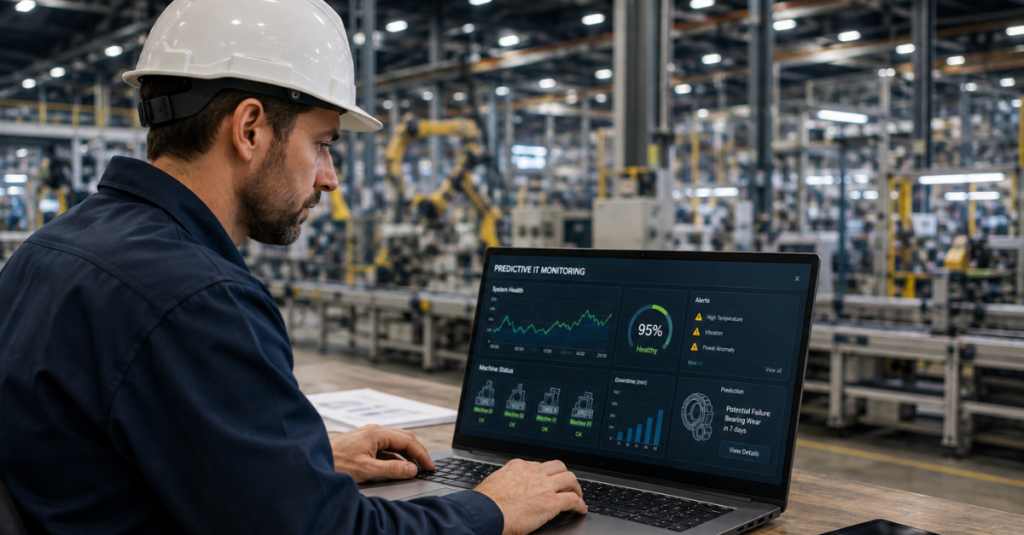
Predictive monitoring uses continuous data collection across servers, network equipment, and connected devices to identify patterns that typically precede a failure. Rather than waiting for a hard drive to fail completely, predictive tools can flag early warning signs such as rising error rates, unusual temperature readings, or degrading performance metrics well before the equipment actually goes down.
This differs meaningfully from traditional break fix support, where a technician only gets involved after something has already stopped working. A broader explanation of how the industry is moving toward this model is covered in a discussion of predictive IT support and why manufacturers in particular benefit from catching issues before they escalate into full production stoppages.
Core components of a predictive monitoring program typically include:
- Continuous health monitoring across servers, workstations, and network hardware
- Automated alerts triggered by performance thresholds rather than complete failures
- Historical trend analysis to identify recurring patterns before they become critical
- Regular reporting that gives leadership visibility into infrastructure health over time
Why Manufacturers Face Unique IT Challenges
Manufacturing environments combine traditional office IT systems with specialized operational technology, including programmable logic controllers, SCADA systems, and connected sensors monitoring everything from temperature to machine vibration. This blend of IT and OT creates a more complex environment than a typical office setting, and it requires monitoring strategies that account for both sides of the operation.
Many of these operational systems were never designed with modern cybersecurity or remote monitoring in mind, which makes proactive network infrastructure management especially important for identifying aging equipment and unsupported systems before they become a liability.
The Connection Between Cybersecurity and Downtime
Cyberattacks have become one of the leading causes of unplanned manufacturing downtime. Ransomware in particular has repeatedly demonstrated the ability to halt entire production lines, sometimes for days or weeks, when attackers gain access to systems controlling scheduling, inventory, or machine operations.
Manufacturers need industrial cybersecurity solutions built specifically to account for the operational technology environment, not just standard office networks, since a compromised control system can have physical consequences beyond a typical data breach.
Preventative measures that reduce both cybersecurity risk and downtime include:
- Segmenting operational technology networks from general office and guest networks
- Applying security patches to control systems on a defined, tested schedule
- Monitoring for unusual traffic patterns between IT and OT environments
- Restricting remote access to production systems to only what is strictly necessary
Real Time Monitoring for Faster Response
Continuous, real time visibility into network and system activity allows problems to be caught and addressed within minutes rather than hours or days. For a manufacturer running around the clock shifts, that speed of response can mean the difference between a brief interruption and an extended production halt.
A growing number of manufacturers are adopting real time monitoring services that provide continuous oversight across the network, flagging anomalies as they happen rather than relying solely on periodic manual checks.
Continuous Exposure Management on the Shop Floor
Traditional annual security assessments leave long gaps during which new vulnerabilities can emerge undetected. A continuous evaluation approach helps manufacturers stay ahead of new risks as equipment, software, and network configurations change throughout the year.
Understanding how continuous exposure management works helps manufacturing leadership prioritize which vulnerabilities pose the greatest operational risk, rather than treating every finding as equally urgent.
Responding to Vulnerabilities Quickly and Correctly
Not every reported vulnerability carries the same level of risk, and manufacturers need a process for evaluating which issues require immediate action versus which can be addressed during a scheduled maintenance window. Reacting to every alert with the same urgency wastes resources and can actually slow down response to genuinely critical issues.
A more effective approach to prioritizing threats is covered in a broader look at vulnerability response strategy that emphasizes evaluating context and actual exploitability rather than reacting purely on how quickly a vulnerability was disclosed.
Network Reliability as a Foundation
Predictive monitoring is only as effective as the underlying network infrastructure it is built on. Aging switches, insufficient bandwidth, and poorly documented network configurations all make it harder to catch problems early and respond effectively when they do arise.
A reliable network infrastructure management foundation should include:
- Redundant connectivity paths to prevent a single point of failure
- Properly documented network topology so issues can be diagnosed quickly
- Regular firmware updates across switches, routers, and firewalls
- Bandwidth monitoring to identify capacity issues before they affect production systems
Backup and Disaster Recovery for Manufacturing Data
Production schedules, inventory records, quality control documentation, and machine configuration data all represent critical information that manufacturers cannot afford to lose. A single server failure without a proper backup strategy in place can set operations back days or weeks while records are reconstructed manually.
Reliable automated data backup systems, tested regularly to confirm successful recovery, give manufacturers confidence that critical data can be restored quickly regardless of what caused the original outage.
A comprehensive plan should also account for broader recovery scenarios, not just data loss. A closer look at disaster recovery planning specific to cyber incidents highlights why recovery from a ransomware attack requires a different sequence of steps than recovery from a simple hardware failure.
Edge Security for Distributed Manufacturing Operations
Manufacturers with multiple facilities, remote monitoring stations, or field service teams face additional security considerations as data moves between locations and devices outside the traditional network perimeter. Each connected endpoint represents a potential entry point if not properly secured.
An overview of how edge security protection strategies are helping distributed operations maintain consistent security standards across every location, not just the main facility, is particularly relevant for manufacturers expanding into multiple sites.
Cloud Infrastructure for Manufacturing Operations
Cloud platforms increasingly support everything from inventory management to production scheduling and quality control documentation. Moving these systems to the cloud can improve accessibility and reduce reliance on aging on premises hardware, but it also requires careful planning to avoid introducing new vulnerabilities.
A properly managed scalable cloud services environment allows manufacturers to scale capacity as production demands change, while maintaining the security controls needed to protect sensitive operational and customer data.
Integrating ERP Systems Without Creating New Risk
Enterprise resource planning systems tie together procurement, inventory, production scheduling, and financial data into a single platform. While this integration improves efficiency, it also means a single point of failure or compromise can affect nearly every part of the operation simultaneously.
Manufacturers considering deeper system integration should review the security implications alongside the operational benefits, as outlined in a broader discussion of ERP system integration and the planning required to implement it securely from the start.
Automating Routine Processes Without Sacrificing Oversight
Manufacturers are increasingly looking at automation to handle repetitive administrative and monitoring tasks, freeing up staff to focus on higher value work. Identifying which processes are genuinely ready for automation, and which still require human oversight, is an important first step before rolling out new tools broadly.
A practical framework for evaluating process automation readiness helps manufacturing leadership avoid automating processes prematurely, which can introduce new points of failure if not properly tested first.
Similarly, broader workflow automation gains achieved through intelligent automation tools are helping manufacturers reduce manual monitoring workload while actually improving response times to emerging issues.
Building an Incident Response Plan for Production Environments
Even with strong preventative monitoring in place, manufacturers need a clear plan for what happens when an incident does occur. A well documented response plan reduces confusion during a high pressure situation and helps limit how far an issue spreads before it is contained.
An effective plan should define:
- Who has authority to isolate affected systems, including production equipment if necessary
- How communication will be handled internally and with affected customers or suppliers
- What backup systems or manual processes can keep critical operations running during recovery
- How the incident will be documented and reviewed afterward to prevent recurrence
Employee Training Across the Facility
Technology alone cannot prevent every downtime event. Staff working on the shop floor, in maintenance, and in administrative roles all need a basic understanding of how their actions affect system security and reliability, from avoiding unauthorized USB devices on production equipment to recognizing phishing attempts targeting purchasing and finance teams.
Training should be tailored to different roles across the facility, since the risks facing a maintenance technician working directly with control systems differ significantly from those facing an office administrator handling email and scheduling.
Compliance Considerations for Manufacturers
Many manufacturers, particularly those serving government or defense related supply chains, face specific regulatory requirements around data protection and cybersecurity practices. Meeting these requirements often overlaps significantly with the same monitoring and security practices that reduce downtime risk in the first place.
Ongoing compliance support services help manufacturers stay aligned with evolving requirements without diverting operational staff away from production responsibilities to manage documentation manually.
Communication Systems That Keep Teams Connected
When an issue does arise, whether a security incident or a simple equipment failure, clear communication across shifts, departments, and locations becomes critical to minimizing downtime. Reliable communication tools ensure that maintenance teams, IT staff, and management can coordinate quickly regardless of where they are physically located.
Integrated communication systems that connect phone, messaging, and video across a facility help ensure that alerts and updates reach the right people immediately rather than getting lost across disconnected tools.
Keeping Daily Operations Running Smoothly
Beyond monitoring and security, manufacturers depend on a range of everyday technology tools to keep production, scheduling, and administrative work running efficiently. Reliable support for these systems reduces the small, everyday frictions that can add up to meaningful lost productivity over time.
Supporting infrastructure worth prioritizing includes:
- Dependable IT support available when shop floor issues arise outside standard business hours
- Workflow productivity tools that keep scheduling, communication, and documentation running smoothly
- Hardware procurement services that ensure aging equipment is replaced proactively rather than after it fails
- A technology resource center covering practical guidance for facility and IT leadership alike
Evaluating Readiness for New Technology
Manufacturers exploring artificial intelligence for quality control, predictive maintenance, or production optimization should first understand where their current infrastructure stands. Rolling out advanced tools on top of an unstable or poorly monitored environment often creates more problems than it solves.
An AI readiness review gives manufacturing leadership a clear picture of what infrastructure improvements should happen first, ensuring new technology investments actually deliver the expected efficiency gains rather than introducing new points of failure.
Long Term Planning Instead of Constant Firefighting
Manufacturers that only address IT issues reactively often find themselves stuck in a cycle of constant firefighting, addressing the same recurring problems without ever solving the underlying cause. Long term planning shifts that pattern toward continuous improvement.
Ongoing expert IT guidance helps facility and operations leadership plan technology investments strategically throughout the year, aligning upgrades and replacements with production schedules rather than scrambling during unplanned outages.
Choosing a Technology Partner That Understands Manufacturing
Not every IT provider understands the operational realities of a manufacturing floor, including the cost of downtime, the mix of IT and OT systems, and the shift based staffing that requires support availability outside typical office hours. Manufacturers evaluating outside support should look for a provider with direct experience in industrial environments.
Helpful indicators to evaluate include:
- Manufacturing success stories demonstrating real experience with similar operations
- Verified client feedback from other facility and operations leaders
- Trusted technology partners reflecting credibility with major industrial and IT vendors
- Transparent flexible service tiers that scale alongside production growth
- A team background page explaining the provider’s experience and approach
- A clear explanation of why partner with us specifically for manufacturing and industrial clients
CMIT Solutions of Fort Myers South has worked with manufacturers throughout the region looking to move away from reactive support and toward a proactive, predictive approach to infrastructure management. More detail on the full range of support available can be found through the Fort Myers technology team serving manufacturers and industrial operations across the area.
Conclusion
Downtime is one of the most expensive and preventable problems a manufacturer can face. Predictive IT monitoring shifts the entire approach from reacting after equipment fails to catching warning signs early enough to address them on a planned schedule rather than during an emergency. Combined with strong network infrastructure, tested backup systems, and a clear incident response plan, manufacturers can significantly reduce both the frequency and severity of unplanned production stoppages.
Facilities that treat IT monitoring as a core operational priority, rather than a background technical concern, consistently see fewer disruptions, faster recovery when issues do arise, and a stronger foundation for future growth.
Unplanned downtime is expensive, but it is also largely preventable with the right monitoring and infrastructure in place. Manufacturers ready to move toward a proactive, predictive approach can schedule a consultation with a team that understands the operational realities of running a production facility in Southwest Florida.
Frequently Asked Questions