
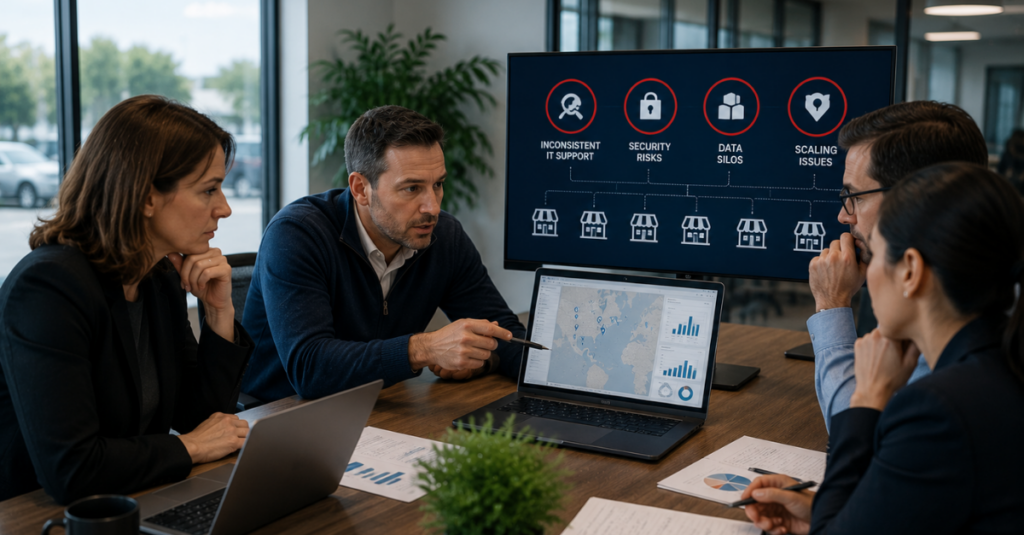
Franchise growth looks straightforward on paper. Open a new location, replicate what works, and scale revenue alongside it. In practice, the technology behind that growth rarely scales as smoothly as the business model itself. Point of sale systems, network configurations, security policies, and communication tools that worked fine for one or two locations often start breaking down the moment a franchise expands to five, ten, or twenty sites.
CMIT Solutions of Fort Myers South works with franchise owners and multi location businesses across Southwest Florida who are running into exactly this problem. This article walks through the hidden IT challenges that quietly slow down franchise growth, and what owners can do to build a technology foundation that actually scales alongside the business.
Why Franchise IT Is Different From Single Location IT
A single location business can often get by with a simple network setup, a handful of workstations, and basic support arrangements. Franchise businesses face an entirely different set of demands because every new location adds complexity rather than simply repeating what already exists.
Each location introduces its own network environment, local staff turnover, physical security considerations, and often its own relationship with vendors and internet providers. Without a consistent framework in place, franchisees end up managing a patchwork of systems that were never designed to work together.
A structured franchise IT strategy helps ownership groups avoid this patchwork approach by establishing standards before growth accelerates rather than trying to unify systems after the fact.
Inconsistent Technology Standards Across Locations
One of the most common hidden challenges in franchise growth is technology drift. The first location might have been set up with careful planning, but by the time a franchise reaches its fifth or sixth site, shortcuts and inconsistent vendor choices have often crept in, whether due to time pressure, local decision making, or simply working with whatever installer happened to be available at the time.
Signs of technology drift across a franchise network include:
- Different point of sale systems or software versions at different locations
- Inconsistent Wi-Fi setups, some secured properly and others left largely open
- Varying backup practices, with some locations backing up data and others not
- Mismatched hardware age, creating uneven performance and support needs
Centralized network management helps bring consistency back across locations, giving ownership a single point of visibility into how every site is actually configured rather than relying on assumptions.
Point of Sale and Operational System Reliability
For most franchise businesses, the point of sale system is the single most critical piece of technology in the building. When it goes down, revenue stops immediately, and customer experience suffers in a very visible way. Yet POS reliability is often treated as an afterthought until it becomes a recurring problem.
Franchise owners should evaluate:
- Whether POS systems have redundant internet connections in case the primary connection fails
- How quickly a technician can respond if a terminal goes down during business hours
- Whether POS data is backed up consistently and can be recovered without data loss
- How consistently software updates are applied across every location
Security Gaps That Multiply Across Locations
A security weakness at one franchise location rarely stays contained to that location alone. Shared corporate systems, centralized customer databases, and interconnected networks mean that a breach at a single site can potentially expose data and access across the entire franchise network.
Comprehensive franchise cybersecurity solutions need to account for this interconnected risk, applying consistent security standards across every location rather than leaving individual franchisees to handle security independently with varying levels of expertise and budget.
Common security gaps that tend to appear as franchises grow include:
- Weak or default passwords left unchanged on network equipment at newer locations
- Lack of multi factor authentication on shared corporate systems
- Guest Wi-Fi networks not properly separated from point of sale or back office systems
- Inconsistent access controls, with former employees retaining access after leaving
Access Management Across a Growing Network
As a franchise adds locations, the number of people who need some form of system access grows quickly, from location managers to regional supervisors to corporate staff. Without a clear structure, access permissions tend to accumulate over time, with employees retaining access to systems and data well beyond what their current role actually requires.
Modern approaches to franchise access controls allow ownership to define clear role based permissions that scale automatically as new locations and staff are added, rather than manually managing access on a location by location basis.
Network Reliability Across Multiple Sites
Every new franchise location depends on a stable internet connection and properly configured local network to run daily operations, from point of sale to inventory management to customer Wi-Fi. Franchise owners often underestimate how much variation exists between locations in terms of available internet providers, building infrastructure, and local network quality.
A dependable multi site network strategy should include:
- Redundant internet connections at each location to prevent a single outage from stopping operations
- Standardized network equipment across all sites to simplify troubleshooting and support
- Centralized monitoring so IT issues can be identified before staff even notice a problem
- Documented network configurations for every location, not just informal knowledge held by a single person
Multi location IT support built around this kind of standardization significantly reduces the time needed to diagnose and resolve issues compared to treating each location as its own isolated problem.
Communication Breakdowns Between Locations
As a franchise network grows, communication between corporate leadership, regional managers, and individual locations becomes increasingly important, and increasingly difficult to manage with disconnected tools. Phone systems, messaging platforms, and video conferencing tools that worked fine for a single office often fall apart once dozens of locations need to stay coordinated.
Reliable cross location communication systems that unify phone, messaging, and video across every site help prevent the communication gaps that often lead to inconsistent execution of corporate initiatives at the location level.
Data Governance Across a Franchise Network
Franchise businesses collect a significant amount of customer and operational data across every location, from loyalty program information to sales transactions to employee records. Without clear governance, this data often ends up scattered across disconnected systems with no consistent policy for how long it should be retained or who should have access to it.
Establishing clear growing business governance practices as a franchise scales helps prevent the data sprawl that becomes increasingly difficult and expensive to untangle the longer it goes unaddressed.
Backup and Disaster Recovery for Multiple Locations
A backup strategy that works well for one location does not automatically scale to twenty. Franchise owners need a consistent approach that ensures every location, regardless of size or local IT sophistication, has reliable data protection in place.
Location based data backup systems standardized across the entire franchise network give ownership confidence that critical data, from sales records to customer information, is protected consistently rather than depending on whether an individual location happened to set things up correctly.
Cloud Infrastructure Supporting Franchise Growth
Cloud based systems have become essential for franchise operations, supporting everything from centralized reporting to inventory management across multiple locations. Moving core systems to the cloud allows ownership to maintain visibility across the entire network without needing to physically visit each site.
A well managed cloud based operations environment allows new locations to be onboarded faster, since core systems can be provisioned centrally rather than configured individually at each new site. Franchise groups exploring this transition should be aware of the most frequent avoiding migration mistakes issues that arise when moving systems without a clear, consistent plan across every location.
Brand and Regulatory Compliance Considerations
Franchise businesses often operate under specific brand standards set by the franchisor, alongside general regulatory requirements tied to their industry, whether that involves payment card data security, employment recordkeeping, or industry specific regulations. Meeting these requirements consistently across every location adds another layer of complexity as the network grows.
Ongoing brand compliance support helps franchise ownership stay aligned with both corporate brand requirements and applicable regulations without placing the entire burden on individual location managers who may not have the expertise to navigate compliance requirements independently.
Standardizing Productivity Tools Across Locations
Employees across different franchise locations often end up using different versions of software, different communication platforms, or entirely different tools for the same task, simply because standardization was never established as the network grew. This inconsistency makes training more difficult and increases the support burden significantly.
Standardized productivity tools deployed consistently across every location simplify onboarding for new employees and reduce the amount of location specific troubleshooting required from IT support.
Business Continuity Planning for a Growing Network
As a franchise network expands, the potential impact of a disruption at any single location, or across multiple locations simultaneously, grows alongside it. A regional weather event, a widespread outage from a shared vendor, or a cybersecurity incident affecting centralized systems can all disrupt operations across many sites at once.
Modern approaches to modern continuity planning account for these interconnected risks, helping franchise ownership prepare for disruptions that could affect the network broadly rather than planning for each location in isolation.
Automation and Workflow Efficiency at Scale
Manual processes that were manageable for a handful of locations often become a significant bottleneck once a franchise network expands. Reporting, inventory reconciliation, and scheduling tasks that used to take a manager an hour can become a full time administrative burden across a growing number of sites.
Franchise groups exploring automation are seeing measurable automation performance gains from tools that handle repetitive reporting and reconciliation tasks automatically, freeing up management time to focus on operations rather than administrative overhead.
Setting Clear Policies for Emerging Technology
As franchise locations begin adopting AI powered tools for scheduling, customer service, or reporting, ownership needs clear guidelines governing how these tools are used consistently across the network. Without a defined policy, individual locations may adopt tools independently, creating inconsistent data handling practices and potential security gaps.
A documented clear AI policy helps ensure that any AI tools adopted across the franchise network meet consistent security and data handling standards, rather than leaving these decisions entirely up to individual location managers.
Before rolling out new technology broadly, franchise ownership can also benefit from an operational AI assessment to understand which locations and processes are actually ready for automation, and which need infrastructure improvements first.
Protecting Remote and Distributed Teams
Franchise operations increasingly involve staff working across multiple locations, regional managers traveling between sites, and corporate teams supporting the network remotely. Each of these distributed users represents a potential access point that needs to be secured consistently, regardless of where they happen to be working from.
An overview of how distributed location security approaches are helping multi location businesses maintain consistent protection for staff working outside a single central office is directly relevant to franchise networks managing this kind of distributed workforce.

Planning IT Investment Alongside Business Growth
Franchise owners often treat IT spending as a reactive cost rather than a planned investment tied directly to growth targets. This approach leads to technology decisions made under pressure, often at the worst possible time, right as a new location is opening and needs everything to work correctly from day one.
A more sustainable approach ties scaling IT planning directly to the franchise’s growth roadmap, ensuring infrastructure, support capacity, and security measures are in place before a new location opens rather than scrambling to catch up afterward.
Understanding the Real Benefits of Outside IT Support
Franchise owners weighing whether to build an internal IT team or work with an outside provider should understand what a properly structured partnership actually delivers beyond simple break fix support. The benefits become particularly clear as a network scales past the point where a single internal IT person can reasonably manage every location.
A broader explanation of the growing business benefits tied to outsourced IT support illustrates why many franchise groups find it more cost effective and reliable than building out a large internal team as they expand.
Procurement Challenges as Locations Multiply
Ordering and deploying hardware consistently across a growing number of locations becomes increasingly difficult without a centralized procurement process. Individual franchisees sourcing their own equipment independently often leads to inconsistent hardware, mismatched warranties, and higher overall costs.
Streamlined bulk equipment procurement processes allow franchise ownership to standardize hardware purchases across the network, simplifying support and often securing better pricing through consolidated vendor relationships.
Support Options That Scale With Franchise Growth
Franchise networks need support arrangements flexible enough to accommodate locations of varying size and complexity, from a single small storefront to a larger flagship location. A one size fits all support plan rarely fits every location equally well.
Franchise owners evaluating outside support should look for:
- Tiered support options that can flex based on location size and complexity
- Certified technology vendors with proven experience across relevant industry platforms
- Franchise growth stories demonstrating real experience supporting multi location businesses
- Direct franchise owner reviews from other multi location clients
- A leadership team overview explaining the provider’s background and experience with franchise operations
- A clear explanation of franchise partnership benefits specific to multi location business models
CMIT Solutions of Fort Myers South has supported franchise owners and multi location businesses throughout the region as they scale, with a full service IT management approach designed specifically around the consistency and standardization that franchise growth requires. Franchise owners can also explore a franchise IT resources library covering practical guidance relevant to multi location operations, backed by a local Fort Myers provider with direct experience supporting growing businesses across Southwest Florida.
Conclusion
Franchise growth introduces IT challenges that rarely show up until a network has already expanded past the point where informal, location by location solutions can keep up. Inconsistent standards, fragmented security practices, and reactive technology spending quietly slow down growth long before ownership realizes technology has become the bottleneck rather than an enabler.
Franchise owners who invest in a consistent, centrally managed technology foundation early are far better positioned to scale smoothly, protect their brand reputation, and avoid the costly cleanup that comes from years of accumulated technology drift across the network.
Inconsistent technology across locations quietly slows down growth long before it becomes an obvious problem. Franchise owners ready to build a consistent, scalable IT foundation can schedule a consultation with a team that understands the operational demands of growing a multi location business in Southwest Florida.
Frequently Asked Questions
Frequently Asked Questions