Somewhere in a shared drive or an employee handbook, most businesses still have a password policy that reads almost exactly the same as it did a decade ago. Eight characters minimum. One uppercase letter. One number. Change it every 90 days. It sounds reasonable, and for years it was considered best practice. The problem is that the assumptions behind that policy no longer hold up, because the tools used to guess, steal, and exploit passwords have changed far faster than most company policies have.
Artificial intelligence has quietly rewritten the rules of password security. Attackers now use machine learning models trained on billions of leaked credentials to predict password patterns with unsettling accuracy. A password that would have taken years to crack through brute force can now be guessed in hours, sometimes minutes, because AI systems have learned exactly how humans think when they create passwords. Meanwhile, phishing kits powered by AI can generate convincing fake login pages in seconds, and voice cloning tools can now impersonate a colleague well enough to talk an employee out of a password over the phone. Even the underlying hardware used for cracking has grown more affordable and more powerful, meaning attacks that once required specialized resources are now within reach of far smaller, less sophisticated groups.
If your organization’s password policy has not been updated to reflect any of this, it is not protecting anyone. CMIT Solutions Fort Myers South, an IT services provider working with businesses across Southwest Florida, rebuilds authentication policies from the ground up, and the starting point is almost always the same conversation: the policy on paper and the reality of how passwords are attacked today are no longer speaking the same language.
Why the Old Rules No Longer Work
The traditional password policy was built around a specific threat model: a human attacker manually guessing passwords or running a basic brute force script against a login page. That threat model is largely obsolete.
- Complexity rules created predictable patterns. Requiring one capital letter, one number, and one symbol led most people to the same handful of substitutions, like turning “a” into “@” or adding “!” at the end. AI models trained on breached password databases have learned these patterns extremely well.
- Frequent forced resets backfired. Requiring a password change every 60 or 90 days pushed employees toward small, predictable variations of their previous password, which are often easier to guess than a completely new one.
- Minimum length requirements were too short. An eight character password, even a complex one, can now be cracked by modern hardware in a matter of hours, sometimes less.
- Reused passwords were never addressed. Old policies rarely accounted for the fact that employees reuse passwords across personal and work accounts, meaning a breach at an unrelated website can hand attackers a working password for your business systems.
A layered cybersecurity protection strategy today has to assume that passwords alone, no matter how complex, are not a reliable barrier anymore. The question is no longer whether a password can be guessed, but how quickly, and what happens after it is.
How AI Has Changed the Way Passwords Are Attacked
It helps to understand exactly what has changed technically, because the shift is not incremental. It represents a fundamentally different kind of threat.
Pattern Based Cracking Has Gotten Smarter
Traditional brute force attacks tried every possible combination of characters, which took enormous time for longer passwords. AI powered cracking tools instead learn from massive datasets of real, previously breached passwords to predict likely candidates first, dramatically narrowing the search. Instead of guessing randomly, the system guesses intelligently, often cracking passwords that meet every traditional complexity requirement within a short window.
Phishing Pages Are Generated Instantly
Attackers used to need some technical skill to build a convincing fake login page. AI tools can now generate a nearly identical clone of a company’s email portal, banking site, or cloud login page in moments, complete with correct branding, layout, and even personalized details pulled from public information about the target.
Voice and Video Cloning Add a New Layer of Deception
Perhaps the most alarming shift is the use of AI generated voice cloning to impersonate executives or IT staff. An employee receiving what sounds like a phone call from their manager or from internal support, asking them to “confirm” a password or approve a reset, is far more likely to comply than someone reading a suspicious email.
Credential Stuffing Has Become Automated at Scale
When a data breach exposes millions of email and password combinations, automated tools now test those combinations against thousands of other websites within minutes, using AI to prioritize which accounts are most likely to have reused credentials. A password created for a personal shopping account years ago can end up being the exact password protecting sensitive business systems today.
Businesses relying on advanced threat defense need to account for all four of these attack methods simultaneously, since modern attackers rarely rely on just one approach.
What a Modern Password Policy Actually Needs
Rewriting a password policy for the AI era does not mean adding more complexity requirements. In many cases, it means removing outdated rules entirely and replacing them with approaches that reflect how attacks actually happen now.
- Length matters more than complexity. A longer passphrase built from unrelated words is significantly harder for AI cracking tools to guess than a short, complex string, and it is easier for employees to remember.
- Forced periodic resets should be reconsidered. Frequent mandatory changes often lead to weaker, more predictable passwords. Resets should be triggered by evidence of compromise, not an arbitrary calendar date.
- Password reuse needs active prevention, not just a policy statement. Tools that check new passwords against known breached credential databases in real time catch reuse before it becomes a liability.
- Every account needs multi-factor authentication, without exception. A stolen or guessed password should never be enough on its own to access business systems.
- Password managers should be standard issue, not optional. Asking employees to memorize dozens of unique, long passwords without a tool to manage them almost guarantees noncompliance.
Building this kind of framework usually requires more than a document update. It requires strategic IT guidance to evaluate current systems, identify where weak authentication is still allowed, and roll out changes without disrupting daily operations.
Multi-Factor Authentication Is No Longer Optional
If there is one single change every business should make immediately, it is enforcing multi-factor authentication across every account that touches business data, without exception for “just this one system” or “just for now.”
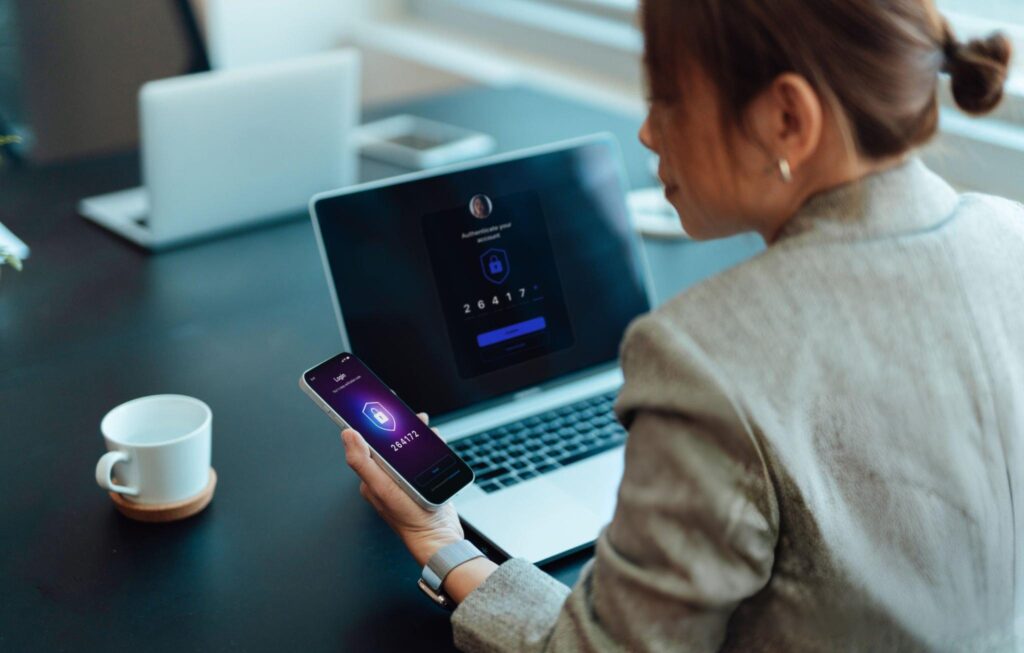
Multi-factor authentication adds a second verification step beyond the password itself, such as a code from an authenticator app, a biometric scan, or a hardware security key. Even if an attacker obtains a working password through AI powered cracking or a phishing attempt, that second layer stops most unauthorized access attempts cold.
Not all multi-factor methods are equally strong, however:
- Text message codes are better than nothing, but they remain vulnerable to SIM swapping attacks, where an attacker convinces a mobile carrier to transfer a phone number to a new device.
- Authenticator apps are considerably more secure than text messages, since the codes are generated locally on the device rather than transmitted over a network that can be intercepted.
- Hardware security keys offer the strongest protection currently available, since they require physical possession of the device and are resistant to most remote phishing attempts.
Rolling out consistent multi-factor authentication across an organization, along with the access management solutions needed to enforce it properly, closes one of the most commonly exploited gaps in business security today.
Why AI Phishing Makes Employee Training More Important, Not Less
It might seem logical to assume that better technology alone can solve the password problem, but the human element remains just as critical, arguably more so now that phishing attempts are harder to spot with the naked eye. A real time monitoring system can catch a lot, but it cannot stop an employee from voluntarily typing their password into a convincing fake page or reading it aloud to a cloned voice on the phone.
Effective training today needs to go beyond the old advice of “look for spelling errors” or “check the sender’s email address,” since AI generated phishing attempts often pass both of those tests easily. Employees need to understand:
- Legitimate IT staff and executives will never ask for a password over phone, email, or chat, under any circumstances.
- Urgency and pressure in a message, especially around password resets or account lockouts, should be treated as a warning sign rather than a reason to act quickly.
- Verifying a request through a separate, known communication channel, rather than replying directly to the message or call, is the safest way to confirm legitimacy.
- Reporting a suspicious request immediately, even if it turns out to be nothing, should always be encouraged rather than discouraged, with a clear path to a responsive help desk support team that can verify the request quickly.
Password Policy and Compliance Risk
For businesses in regulated industries, an outdated password policy is not just a technical weakness, it is an audit finding waiting to happen. Insurance underwriters, regulators, and clients conducting vendor security reviews increasingly ask specific questions about authentication standards, and a policy that has not been reviewed in years often fails those questions before any actual breach occurs. Treating password policy as part of broader compliance risk management rather than a standalone IT task ensures it gets reviewed on the same schedule as other regulatory obligations, instead of being forgotten between audits.
This connection matters even more when a business experiences an incident. Investigators and auditors will almost always ask what authentication standards were in place at the time of a breach, and a policy that still reflects pre-AI assumptions can be used as evidence of negligence, regardless of how the actual attack occurred.

Building a Future-Proof Authentication Strategy
Password policy should not be treated as a document to revisit only when something goes wrong. Businesses that build authentication into their broader technology roadmap tend to stay ahead of emerging threats rather than reacting to them after the fact. A future proof IT strategy accounts for where authentication technology is headed, including passwordless adoption and expanding biometric support, so that policy updates happen on a planned schedule rather than during a scramble after a competitor or vendor experiences a public breach.
Getting there usually starts with expert IT advice tailored to the specific systems a business already runs, since a generic policy template rarely accounts for the mix of cloud platforms, legacy software, and third-party vendor logins most companies actually use day to day.
Vendor and Third-Party Access Deserve the Same Scrutiny
Internal employee accounts are only part of the picture. Many businesses grant password-based access to contractors, vendors, and third-party service providers who may not follow the same authentication standards as internal staff.
- Vendor accounts should be reviewed on the same schedule as employee accounts, not left active indefinitely after a contract ends.
- Shared login credentials used by multiple vendor staff members should be eliminated in favor of individual accounts tied to a real person.
- Third-party access should be limited strictly to the systems and data required for that specific engagement, following the same minimum access principle applied internally.
A single compromised vendor password can be just as damaging as a compromised employee password, and it is often overlooked simply because it falls outside the usual internal review process.
Monitoring Whether the New Policy Is Actually Working
Rolling out a new password policy is only the first step. Businesses need a way to confirm the changes are actually reducing risk rather than just checking a compliance box. Ongoing network access monitoring that tracks failed login attempts, unusual access times, and repeated authentication failures gives a clear, measurable signal of whether the new standards are holding up against real attempts to bypass them.
Pairing this with data protection systems that maintain isolated, tested backups ensures that even if an authentication gap is exploited before it is caught, the business has a reliable way to recover without paying a ransom or losing critical records permanently.
Some businesses are moving beyond passwords entirely, adopting authentication methods that remove the vulnerable element altogether. Passwordless approaches, such as biometric login or device based authentication, eliminate the risk of a password being guessed, phished, or reused in the first place.
This shift ties closely into broader cloud security posture management, since many modern cloud platforms now support passwordless login natively. For businesses not yet ready to eliminate passwords entirely, combining strong passphrase requirements with mandatory multi-factor authentication remains a highly effective middle ground while the technology continues to mature.
Connecting Password Policy to Broader Business Continuity
A weak password policy does not just create a security gap. It creates a business continuity risk, since a single compromised account can be the entry point for a ransomware attack that shuts down operations entirely. Practices and businesses that have mapped out a continuity planning strategy understand that authentication security sits at the very front of that plan, not as an afterthought.
Similarly, a compromised account often becomes the starting point for a scenario requiring cyber recovery planning rather than traditional disaster recovery, since the systems themselves may remain physically intact while access to them is completely lost. Businesses without a tested recovery planning framework specifically built around account compromise often lose far more time than necessary simply figuring out where to start.
Data Governance and Access Controls Go Hand in Hand With Passwords
Strong authentication only solves part of the problem if every employee, once logged in, has access to far more data than their role actually requires. Clear data governance strategies ensure that even if one account is compromised, the damage is contained to only the data that account was ever meant to touch.
This is where role based access, reviewed regularly rather than set once and forgotten, becomes essential. Combined with proactive network management that flags unusual login locations or access times, businesses gain a much clearer picture of when a password related compromise is happening in real time, rather than discovering it weeks later.
Remote Work Has Multiplied the Password Attack Surface
Businesses with remote or hybrid staff face a wider set of password related risks than those operating entirely from a single, controlled office environment.
- Employees working from home often reuse the same password across multiple personal devices that IT has no visibility into.
- Public Wi-Fi networks used while traveling create opportunities for credential interception if connections are not properly secured.
- Personal devices used for work email or file access frequently lack the same security standards enforced on company issued hardware.
Edge security solutions extend protection to wherever employees are actually working, rather than assuming password security only needs to be enforced within a traditional office network. For any business with even a portion of its workforce operating remotely, this is no longer an optional add-on.
Cloud Systems Bring Their Own Password Considerations
As more business operations move into cloud platforms, password policy has to extend well beyond a single company network login. Secure cloud solutions often support single sign-on, which can actually strengthen cloud platform security overall by reducing the number of separate credentials employees need to manage, as long as that single sign-on account itself is protected with strong multi-factor authentication.
Reliable reliable data backup systems also play a role here, since a compromised cloud account with weak password protection can sometimes be used to delete or encrypt stored files. Backup systems that maintain separate, isolated copies protect against this scenario even when authentication itself has already failed.
Automating Password Security Instead of Relying on Willpower
Expecting employees to consistently follow best practices without any supporting technology is unrealistic, especially as password requirements become more sophisticated. Workflow automation tools can automatically flag weak or reused passwords, enforce multi-factor authentication at login, and alert IT staff to unusual access patterns without requiring manual review of every single login event.
This reflects a broader shift happening across the industry, where reactive, manual security processes are being replaced by predictive IT support models that catch authentication issues before they turn into a full account compromise, rather than responding only after damage has already occurred.
Practical Tools That Support Better Password Habits
Beyond policy and enforcement, the everyday tools employees use also shape how well password practices actually stick. Business productivity tools that integrate directly with single sign-on and password manager systems reduce the temptation for staff to write passwords down or reuse them across daily software tools simply for convenience.
Communication tools matter here too. Unified communication systems that centralize internal messaging make it far easier to establish a verified channel for confirming sensitive requests, such as a password reset, separate from email or phone calls that can be spoofed. And when new software or hardware is being introduced, IT procurement services that vet authentication compatibility upfront prevent the common problem of new tools being deployed without proper multi-factor support built in from day one.

Steps to Rewrite Your Password Policy This Quarter
Updating a password policy does not need to happen all at once, but it should start now rather than after an incident forces the issue.
- Replace complexity requirements with a minimum length standard built around passphrases rather than short, symbol-heavy strings.
- Remove arbitrary forced reset schedules and replace them with reset triggers based on evidence of compromise.
- Enforce multi-factor authentication across every business account, prioritizing authenticator apps or hardware keys over text message codes.
- Deploy a company-wide password manager and provide training on how to use it effectively.
- Implement real-time checking against known breached credential databases for any new password created.
- Review access permissions alongside the password policy update, ensuring accounts only have access to what each role actually requires.
- Update employee training materials to reflect current AI-driven phishing and social engineering tactics, not outdated advice.
None of these steps require an enormous technology overhaul, but they do require a partner who understands both the technical implementation and the practical realities of rolling out change across a busy organization. If your current policy has not been reviewed since before AI-powered attacks became common, it is worth a direct conversation to schedule a consultation and find out exactly where the gaps are.
Conclusion
Password policies built for a pre-AI world are no longer protecting the businesses that still rely on them. The tools attackers use today, from pattern-based cracking to voice cloning to instantly generated phishing pages, have made outdated complexity rules and arbitrary reset schedules almost meaningless as standalone defenses. Rewriting a password policy is not simply about adding more rules. It is about replacing assumptions that no longer match reality with practical, enforceable standards built around length, multi-factor authentication, and active monitoring.
CMIT Solutions Fort Myers South helps businesses across the region modernize authentication policy in a way that fits real day-to-day operations, not just a document that sits unread in a shared drive. The businesses that update their approach now, before an AI-assisted attack forces the issue, are the ones that avoid becoming the next example of why the old rules stopped working. Reach out and talk to our team to start the review.
Frequently Asked Questions
- Why are old password complexity rules no longer effective?
Complexity rules like requiring one capital letter and one symbol led most people to predictable patterns that AI cracking tools, trained on billions of breached passwords, have learned to guess quickly. - How long should a password be under a modern policy?
Longer is generally better than more complex. A passphrase of several unrelated words is typically harder for AI-driven cracking tools to guess than a short password packed with symbols. - Should businesses still force password resets every 90 days?
Not automatically. Frequent forced resets often lead to weaker, predictable variations of previous passwords. Resets are more effective when triggered by evidence of a potential compromise. - What is credential stuffing?
It is an automated attack where stolen username and password combinations from one data breach are tested against many other websites and services, hoping the same credentials were reused. - Is multi-factor authentication really necessary for every account?
Yes. A password alone is no longer considered a reliable barrier, since AI powered tools can guess or steal it. Multi-factor authentication adds a critical second layer of verification. - Are text message authentication codes safe to use?
They are better than no second factor at all, but they are vulnerable to SIM swapping attacks. Authenticator apps or hardware security keys offer stronger protection. - What is a passwordless authentication method?
It replaces traditional passwords with alternatives like biometric verification or device-based login, removing the risk of a password being guessed, phished, or reused. - Can AI really clone someone’s voice convincingly enough to trick employees?
Yes. Voice cloning technology has advanced enough that a short audio sample can be used to generate convincing fake calls impersonating executives or IT staff requesting sensitive information. - How does a password manager improve security?
It allows employees to use long, unique passwords for every account without needing to memorize them, removing the temptation to reuse simple passwords across multiple systems. - What should employees do if they suspect a phishing attempt?
Report it immediately through an established internal process, and avoid replying directly to the suspicious message or clicking any links or attachments it contains. - Does single sign-on make password security better or worse?
It can improve security by reducing the number of separate passwords employees manage, as long as the single sign-on account itself is protected with strong multi-factor authentication. - How often should access permissions be reviewed alongside password policy?
Ideally at the same time password policy updates are made, and at minimum annually, to ensure accounts only retain access to the data and systems their role actually requires. - What makes AI-generated phishing emails harder to detect than older scams?
They lack the spelling errors and awkward phrasing that used to serve as warning signs, and they can be personalized using publicly available information about the target and their organization. - Can a strong password policy alone prevent a ransomware attack?
Not alone, but weak password practices are one of the most common entry points attackers use to deploy ransomware, so strengthening authentication significantly reduces that risk. - Should personal devices used for work be included in password policy?
Yes. Any device accessing business email, files, or systems should be covered under the same authentication and password standards as company-issued hardware. - What is SIM swapping and why does it matter for password security?
It is a technique where an attacker convinces a mobile carrier to transfer a victim’s phone number to a new device, allowing them to intercept text-based authentication codes. - How quickly can AI tools crack a traditional eight-character password?
Depending on complexity, some traditional eight-character passwords can now be cracked in hours or less using modern AI-assisted cracking techniques and hardware. - Is it necessary to check new passwords against breached credential databases?
Yes. Real-time checking prevents employees from unknowingly choosing a password that has already been exposed in a prior, unrelated data breach. - How does remote work affect password policy requirements?
Remote employees introduce additional risks through personal devices, home networks, and public Wi-Fi, requiring stronger enforcement and monitoring than a traditional office-only policy. - Where should a business start when rewriting its password policy?
Begin by replacing outdated complexity and reset requirements, enforcing multi-factor authentication everywhere, and reviewing access permissions alongside the policy itself, ideally with guidance from an experienced IT partner.