

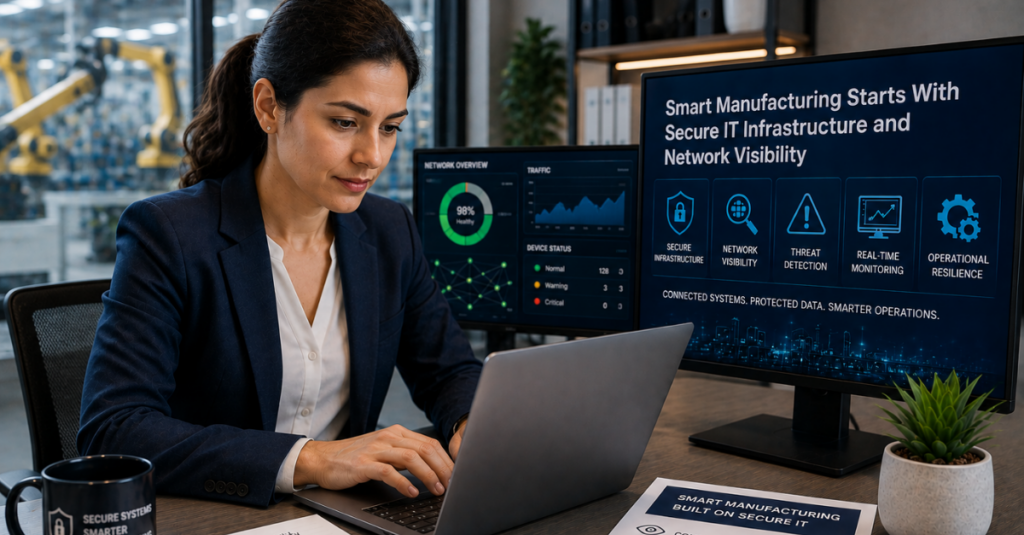
Smart manufacturing promises faster production cycles, predictive maintenance, and data-driven decision making on a scale factory floors have never seen before. Sensors track machine performance in real time, connected equipment talks to cloud platforms, and production data flows seamlessly between the shop floor and the front office. It is a genuinely exciting shift for manufacturers across southeast Wisconsin. It is also a shift that quietly multiplies the number of ways a manufacturing operation can be attacked, disrupted, or shut down entirely, and most manufacturers are only now realizing how far their security has fallen behind their automation.
None of the benefits of smart manufacturing are worth much if the underlying network cannot be trusted. A predictive maintenance system is useless if an attacker can manipulate its data. A connected production line becomes a liability the moment ransomware reaches it. Before a manufacturer adds another sensor, another connected controller, or another cloud dashboard, the foundation underneath all of it needs to be secure, and someone needs to actually be able to see what is happening across that network at all times. Without that visibility, smart manufacturing is not really smart. It is just more exposed.
What Smart Manufacturing Actually Requires
Smart manufacturing is often described in terms of the technology it enables: predictive maintenance, real-time quality control, connected supply chains, and automated production adjustments based on live data. What gets discussed far less often is what that technology actually requires underneath the surface.
Every one of those capabilities depends on a stable, well-monitored network connecting operational technology, the machines, sensors, and controllers on the factory floor, with information technology, the servers, cloud platforms, and business systems that turn raw production data into decisions. That connection point, where OT meets IT, is where most of the risk in smart manufacturing actually lives.
A manufacturer moving toward smart production needs several things in place before the technology itself can deliver real value.
- A network architecture that separates production systems from general business systems, so a compromise in one does not automatically spread to the other.
- Continuous monitoring across both IT and OT environments, since a threat on the factory floor can look completely different from a threat hitting email or file servers.
- Reliable, redundant connectivity, since production equipment increasingly depends on network access to function at all.
- Clear visibility into every connected device, including legacy equipment that was never designed with cybersecurity in mind.
- A tested plan for what happens when, not if, something goes wrong on a connected production line.
Without these fundamentals, adding smart technology to a manufacturing environment amplifies risk faster than it delivers value.
Why IT and OT Convergence Increases Risk
For most of manufacturing history, operational technology and information technology lived in completely separate worlds. Production equipment ran on isolated, proprietary systems that had no connection to the internet or the corporate network. That isolation, sometimes called an air gap, provided a natural layer of protection, even if it was never designed as a security measure.
Smart manufacturing has erased that separation. Machines now report data to cloud dashboards. Maintenance teams remotely monitor equipment performance. Supply chain systems pull production data directly from the factory floor. Every one of these connections is valuable, and every one of them is also a potential entry point for an attacker who previously would have needed physical access to the building to cause damage.
This convergence introduces risks that did not exist in a traditional, isolated manufacturing environment.
- Legacy industrial equipment often runs on outdated operating systems that cannot be patched the same way a modern laptop can, leaving known vulnerabilities exposed indefinitely.
- A single compromised device on the business network can potentially reach production systems if the two are not properly segmented.
- Ransomware that would once have only affected office computers can now halt an entire production line, since so much equipment now depends on network connectivity to operate.
- Remote access tools used for equipment maintenance and vendor support create additional entry points that are easy to overlook during a routine security review.
A closer look at the evolving threat landscape across the region confirms that manufacturers are no longer a secondary target. Attackers understand that a shutdown on the factory floor creates enormous pressure to pay quickly, making manufacturing one of the more attractive sectors for ransomware specifically.
Network Visibility: You Cannot Protect What You Cannot See
Ask most manufacturers how many devices are connected to their network, and the honest answer is often a rough estimate rather than a confirmed number. Between production equipment, sensors, handheld scanners, guest devices, and legacy systems installed years ago by a vendor who no longer supports them, visibility gaps are extremely common, and they are exactly where attackers look first.
Network visibility means having a real-time, accurate picture of every device connected to the network, what it is communicating with, and whether that communication pattern looks normal. Without this visibility, a manufacturer has no way of knowing whether a piece of equipment has been compromised until something visibly breaks, which is often far too late.
A strong network visibility program typically includes:
- Asset discovery and inventory, identifying every device on the network, including equipment that was never formally documented when it was installed.
- Traffic monitoring, flagging unusual communication patterns such as a production controller suddenly trying to reach an external server it has never contacted before.
- Segmentation verification, confirming that boundaries between IT and OT networks are actually holding rather than assuming a firewall rule from years ago is still correctly configured.
- Continuous logging, capturing activity across the network so that if an incident does occur, investigators can reconstruct exactly what happened and when.
This kind of visibility depends heavily on exposure management strategy practices that continuously map an organization’s attack surface rather than relying on a static inventory that becomes outdated the moment a new device gets plugged in. It also connects closely to the idea of a digital trust framework, which focuses on verifying every connection between users, devices, and systems rather than assuming trust simply because a device is already on the network.
Common Vulnerabilities in Manufacturing Environments
Manufacturing environments tend to share a handful of recurring weaknesses, regardless of industry or company size. Recognizing them is the first step toward addressing them.
- Unpatched legacy systems. Many industrial control systems run on operating systems that reached end of life years ago, meaning known vulnerabilities are never fixed because a patch simply does not exist.
- Flat network architecture. When production and business networks are not properly segmented, a single compromised laptop in the front office can potentially reach systems controlling physical equipment.
- Weak remote access controls. Vendors and maintenance technicians often need remote access to equipment, and that access is frequently protected by outdated credentials or minimal authentication requirements.
- Limited staff awareness. Production and maintenance staff are rarely trained on cybersecurity the way office employees are, even though they interact directly with connected equipment every day.
- Inconsistent patch management. Even when patches are available, production schedules often delay updates for months because taking equipment offline, even briefly, feels riskier than leaving it unpatched.
Recognizing outdated infrastructure warning signs early is one of the most effective ways to catch these gaps before they turn into an actual incident rather than after.
The Real Cost of Downtime on the Factory Floor
Downtime means something different in manufacturing than it does in a typical office environment. A server outage in an office might slow down email and file access. A network outage on a production line can halt physical output entirely, and the costs compound quickly.
Consider what an unplanned outage actually costs a manufacturer.
- Idle labor, since production staff cannot work without functioning equipment even though wages continue.
- Missed delivery commitments, which can damage customer relationships and trigger contractual penalties.
- Wasted materials, particularly in processes where a mid-cycle interruption ruins work in progress.
- Recovery costs, which are often far higher than the cost of preventing the incident in the first place.
- Reputational damage with customers who depend on reliable, on-time delivery.
This is exactly why a proactive support model matters so much more in manufacturing than in many other industries, and why practical cyberattack prevention tactics need to be built into daily operations rather than treated as a separate project. Catching a failing switch, an overloaded network segment, or unusual device behavior before it causes a production stoppage is dramatically less expensive than dealing with an actual line shutdown.
Reliable reliable data backup systems also play a direct role in minimizing downtime after an incident does occur. Understanding the practical difference between backup and recovery planning matters here too, since manufacturers often assume having backups automatically means they can recover quickly, when in reality recovery speed depends on a tested, documented process.

Building Secure IT Infrastructure for Manufacturing
Secure infrastructure in a manufacturing environment looks different from a typical office setup, largely because of the mix of legacy equipment, real-time production requirements, and the physical consequences of a system failure. A few foundational elements matter most.
Network segmentation. Separating production systems from business systems, and further segmenting within the production environment itself, limits how far an attacker or a piece of malware can spread if something does get through.
Redundant connectivity. Manufacturing increasingly depends on stable network access to function, which makes redundant internet connections and reliable internal networking essential rather than optional. Upgrades to next gen wireless connectivity are becoming a foundational investment for facilities that depend on wireless sensors and mobile equipment throughout the production floor.
Modernized infrastructure. Aging servers, outdated switches, and unsupported operating systems create both performance bottlenecks and security gaps. Modern productivity tools tend to follow naturally once outdated infrastructure is replaced with systems built for current demands.
Centralized monitoring. A single dashboard that provides visibility across both IT and OT environments allows a small internal team, or a managed partner, to spot problems across the entire operation rather than monitoring systems in disconnected silos.
Zero Trust in an Industrial Environment
Traditional network security assumed that anything already inside the factory network could be trusted. That assumption does not hold up anymore, particularly as vendors, contractors, and remote maintenance teams all require some level of access to production systems.
A zero trust approach requires verification for every access request rather than granting broad trust to anything already connected to the network. In a manufacturing context, this typically means:
- Requiring multi-factor authentication for any remote access to production systems, including vendor maintenance connections.
- Limiting access strictly to what a given role or vendor actually needs, rather than granting broad network-wide access by default.
- Continuously verifying the health and identity of connected devices before allowing them to communicate with production systems.
- Segmenting the network so that a compromised device in one area cannot automatically reach equipment elsewhere in the facility.
Many manufacturers are pairing this with a modern network access model to replace older, less secure remote access tools that vendors and technicians have relied on for years without much oversight.
Cloud Platforms and Data in Smart Manufacturing
Cloud connectivity is central to most smart manufacturing initiatives, powering everything from predictive maintenance dashboards to supply chain visibility tools. Adopting cloud solutions manufacturing teams rely on allows production data to be analyzed, shared, and acted on far faster than legacy on-premises systems ever allowed.
That said, cloud adoption introduces its own set of considerations. Many manufacturers are exploring a multi cloud strategy to avoid depending entirely on a single vendor for critical production data, while keeping close attention on cloud cost control as sensor data volumes grow and monthly cloud bills climb along with them.
As manufacturing teams increasingly manage production data through browser-based dashboards and cloud portals, secure browser perimeter protections have become an important, often overlooked layer of defense, since the browser itself is frequently the first point of contact between an employee and a cloud-connected production system.
Compliance and Supply Chain Risk
Manufacturers are increasingly required to demonstrate strong cybersecurity practices, not just to satisfy their own risk management, but because customers and supply chain partners are demanding it as a condition of doing business. A manufacturer that cannot demonstrate adequate security controls risks losing contracts to competitors who can.
A simplified compliance approach helps translate complex regulatory and customer requirements into practical, achievable steps rather than an overwhelming checklist that never gets fully implemented. This matters even more as expanding privacy rules at the state level add new requirements on top of whatever industry-specific standards a manufacturer already needs to meet.
Modern tools are also changing how this gets managed on an ongoing basis. Automated compliance checks can continuously verify that systems remain aligned with required standards, catching drift the moment it happens rather than discovering a gap during an annual audit, months after it first appeared.
AI, Automation, and Predictive Monitoring on the Factory Floor
Artificial intelligence is playing an increasingly central role in how smart manufacturing operations are monitored and protected. The sheer volume of sensor data, network traffic, and equipment telemetry generated by a modern production facility is far more than any human team could review manually in real time.
Predictive downtime prevention tools use this data to flag failing components before they cause an unplanned stoppage, shifting maintenance from a reactive schedule to a genuinely predictive one. Similarly, AIOps for operations platforms correlate data across IT and OT environments to surface the handful of issues that actually require attention, cutting through the noise that leads to alert fatigue in smaller teams.
On the security side, managed threat detection capabilities are dramatically reducing the time between detection and containment, which matters enormously in a manufacturing environment where a fast-moving threat can reach production equipment within minutes. At the same time, AI powered cyberthreats are evolving just as quickly, with attackers using similar technology to identify vulnerable industrial systems faster than ever before.
Beyond security, AI driven efficiency gains are showing up across quality control, scheduling, and inventory management as manufacturers apply the same underlying technology to operational challenges, not just security ones.
Employee Training for Production and Maintenance Staff
Cybersecurity training in manufacturing environments often focuses entirely on office staff, overlooking the production and maintenance teams who interact directly with connected equipment every day. This is a significant gap, since a technician plugging an unauthorized USB drive into a control system, or clicking a phishing link on a shared production terminal, can create just as much risk as an office-based incident.
Effective employee awareness training for a manufacturing environment should include:
- Basic recognition of phishing attempts and social engineering tactics, tailored to the communication tools production staff actually use.
- Clear policies on connecting personal or unauthorized devices to production networks or equipment.
- Guidance on verifying vendor identity before granting remote access for maintenance or support.
- A straightforward, blame-free process for reporting anything that looks unusual, whether that is an unfamiliar device on the network or an odd request from someone claiming to be a vendor.
Training works best when it is treated as an ongoing part of operations rather than a once-a-year checkbox exercise disconnected from daily work on the floor.
Industries Facing Rising Cyber Risk
Manufacturing is not alone in facing this shift, and looking at other industries offers a useful preview of what happens when connected technology outpaces security investment. A look at industries under attack more frequently shows a consistent pattern: sectors that historically underinvested in cybersecurity because they assumed they were not attractive targets are now discovering just how wrong that assumption was.
Manufacturers should treat this as a direct warning. The same underinvestment that has left other industries exposed applies just as easily to a production facility that has added connected technology faster than it has added security oversight. Staying aware of emerging industry trends helps manufacturing leaders anticipate what is coming next rather than reacting after a competitor or peer organization becomes a cautionary tale.
Choosing the Right IT Partner for a Manufacturing Environment
Not every IT provider understands the unique demands of a manufacturing environment, where uptime requirements, legacy equipment, and the physical consequences of a system failure differ significantly from a standard office setting. A few questions help separate a generalist provider from one genuinely equipped to support smart manufacturing.
- Does the provider have experience with both IT and OT environments, or only traditional office networks?
- Can they provide visibility across production equipment, not just business systems and email?
- Do they understand the operational impact of taking equipment offline for updates, and can they plan around production schedules?
- Is 24/7 monitoring available, given that manufacturing operations often run outside standard business hours?
- Do they offer strategic planning around smart manufacturing initiatives, or purely reactive troubleshooting?
Manufacturers making this shift are often moving away from a strategic technology partner relationship they had outgrown, recognizing that a provider focused only on fixing what breaks cannot support the level of visibility and planning smart manufacturing actually requires. Increasingly, this also means supporting a secure remote infrastructure model, since engineers, quality teams, and management often need secure access to production data and systems from outside the facility itself.
How CMIT Solutions of Southeast Wisconsin Supports Manufacturers
CMIT Solutions of Southeast Wisconsin works with manufacturers across the region to build the kind of secure, well-monitored infrastructure that smart manufacturing initiatives actually depend on. That includes mapping out network visibility across both IT and OT environments, closing gaps in legacy equipment, and building segmentation that keeps a business network issue from ever reaching a production line.
For manufacturers exploring industrial IT services, the most useful starting point is usually an honest assessment of current network visibility, since most facilities discover gaps they were not aware of once someone actually maps out every connected device. Manufacturers ready to take that step can talk to a specialist to get a clear picture of where their infrastructure stands today and what a secure path toward smart manufacturing would look like for their specific operation.
Conclusion
Smart manufacturing offers real, measurable advantages for production efficiency, quality control, and supply chain visibility, but none of those advantages are worth much without a secure foundation underneath them. Every sensor added, every controller connected to the cloud, and every remote maintenance tool deployed expands the attack surface a manufacturer has to defend. Network visibility is not a luxury feature bolted on after the fact. It is the difference between a smart manufacturing initiative that genuinely improves operations and one that quietly creates the exact vulnerabilities an attacker is looking for. Manufacturers across southeast Wisconsin that treat secure IT infrastructure as the starting point, rather than an afterthought, are the ones best positioned to capture the real benefits of smart manufacturing without gambling their production floor on it.
Frequently Asked Questions