Healthcare organizations across Kenosha, Racine, Waukesha, and the surrounding region are sitting on some of the most valuable data on the planet. Patient records, insurance details, billing information, and clinical histories are worth far more on the black market than a stolen credit card number, and criminals know it. Yet many clinics, dental practices, urgent care centers, and specialty providers still operate under the assumption that passing a HIPAA audit means their systems are secure. That assumption is dangerous, and it is exactly why continuous threat monitoring has become a non-negotiable layer of protection for any organization handling protected health information.
HIPAA was written to establish minimum standards for privacy and security. It was never designed to be a real-time defense system. A practice can be fully HIPAA compliant on paper and still be sitting on unpatched software, exposed remote access ports, or an employee who clicked a phishing link an hour ago. Compliance tells you what you should have in place. It does not tell you whether an attacker is already inside your network right now. That gap between “compliant” and “secure” is where breaches happen, and it is why forward-thinking healthcare providers are pairing their compliance programs with always-on monitoring.
The Difference Between Compliance and Actual Security
Compliance frameworks like HIPAA, HITECH, and state-level privacy laws exist to create a baseline. They require risk assessments, access controls, encryption standards, and breach notification procedures. These are good things to have. But a checklist audited once a year, or even once a quarter, is a snapshot in time. Threats do not wait for your next audit cycle.
Consider the mechanics of a typical audit. A HIPAA risk assessment might review your policies, sample a handful of systems, and confirm that encryption and access logging are configured correctly at that moment. Within days, a new vulnerability could be disclosed in software your practice depends on, a former employee’s credentials could still be active, or a vendor connected to your network could be compromised. None of that shows up until the next assessment, which could be months away. This is the same gap CMIT Solutions of Southeast Wisconsin sees across nearly every regulated client, not just in healthcare but wherever compliance has been mistaken for protection rather than a starting point.
Real security requires visibility that never stops. It means knowing, in near real time, when a login attempt looks abnormal, when a device starts communicating with an unfamiliar server, or when data starts moving somewhere it should not. That kind of visibility is what separates organizations that catch an incident in minutes from those that discover a breach eight months later through a patient complaint or a regulator’s letter.
Why Healthcare Is Such an Attractive Target
Healthcare data breaches consistently rank among the most expensive across all industries, and the reasons are structural, not incidental.
- Medical records contain permanent, unchangeable information such as diagnoses, social security numbers, and insurance IDs, which makes them valuable for years after a breach, unlike a credit card that can be cancelled.
- Many healthcare organizations run on a mix of legacy systems, connected medical devices, and third-party software that were never designed with modern cybersecurity in mind.
- Clinical staff are focused on patient care first, which means security awareness often takes a back seat during a busy shift, creating opportunities for phishing and social engineering.
- Smaller practices frequently lack a dedicated IT security team, relying instead on a part-time contractor or an overextended office manager to handle technology decisions.
- Ransomware groups specifically target healthcare because outages directly affect patient safety, which increases the pressure to pay quickly.
This combination makes clinics, dental offices, physical therapy practices, and behavioral health providers throughout southeast Wisconsin just as attractive to attackers as large hospital systems, sometimes more so, because smaller organizations are perceived as easier to breach and less likely to have sophisticated defenses in place. A closer look at the regional cybersecurity threat landscape shows how frequently local organizations, healthcare included, are being probed and targeted.
What Continuous Threat Monitoring Actually Looks Like
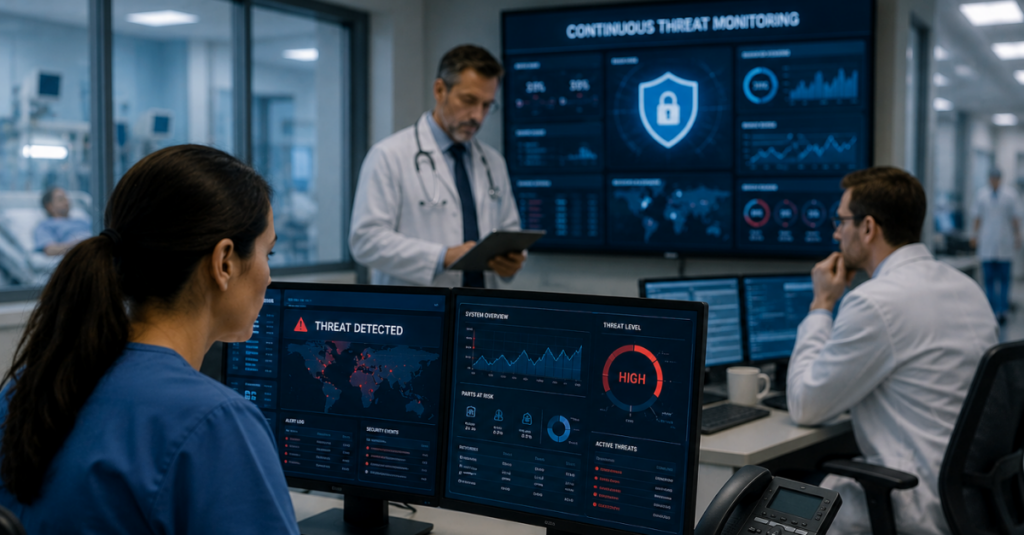
Continuous threat monitoring is not a single tool. It is a layered, ongoing process that watches every part of a healthcare organization’s digital environment around the clock, looking for signs of compromise before they turn into a full-blown incident.
A mature monitoring program typically includes the following elements.
- Network traffic analysis that flags unusual data flows, unexpected connections to foreign IP addresses, or large volumes of data leaving the network at odd hours.
- Endpoint detection and response on every workstation, laptop, and server, watching for suspicious processes, ransomware behavior, or unauthorized software installations.
- Log correlation and analysis across email systems, electronic health record platforms, and cloud applications to spot patterns that a human reviewing logs manually would likely miss.
- User behavior analytics that establish a baseline for how each employee normally accesses systems, then alert when that behavior changes suddenly, such as a login from an unusual location at 3 a.m.
- Vulnerability scanning that runs continuously rather than annually, identifying unpatched software before attackers can exploit it.
- 24/7 security operations coverage, either through an in-house team or a managed partner, so alerts are reviewed and acted on immediately rather than sitting in a queue overnight or over a weekend.
This is fundamentally different from a compliance checklist. It is an active defense posture, and it depends heavily on AI driven threat detection capabilities that can process far more signals than any human team could review manually.
The Real Cost of a Compliance-Only Mindset
Practices that treat HIPAA as the finish line rather than the starting line tend to discover their gaps the hard way. A few patterns show up repeatedly.
Delayed detection. Studies of healthcare breaches consistently show that attackers spend weeks or months inside a network before being discovered. A compliance audit conducted once or twice a year has no chance of catching that kind of dwell time.
Third-party exposure. Billing companies, transcription services, imaging vendors, and cloud EHR providers all touch protected health information. A HIPAA business associate agreement establishes legal responsibility, but it does not monitor that vendor’s network for you. If a connected vendor is breached, the healthcare provider is often still on the hook for notification and remediation.
Alert fatigue without action. Some practices do have security tools generating alerts, but nobody is watching them consistently. An alert that sits unread for three days provides no more protection than having no alert at all.
Outdated infrastructure. Aging servers, unsupported operating systems, and legacy medical devices often cannot be patched the same way modern systems can. Recognizing outdated IT infrastructure signs early is one of the most overlooked steps in reducing a healthcare organization’s overall attack surface.
Underestimating insider risk. Not every threat comes from outside. Departing employees, contractors with lingering access, or simple human error account for a significant share of healthcare data exposure incidents.
Ransomware and the Healthcare Sector
Ransomware deserves its own discussion because of how uniquely damaging it is to patient care. When a hospital or clinic’s systems are locked, the consequences go beyond financial loss. Appointments get cancelled, lab results become inaccessible, prescriptions cannot be filled electronically, and in the most severe cases, patient safety is directly threatened.
Attackers know this, which is why healthcare remains one of the most heavily targeted sectors for ransomware year after year, and building solid cyberattack prevention strategies needs to start long before an incident occurs. A resilient defense against this threat requires more than backups, although a reliable backup system remain essential. It requires monitoring that can catch the early indicators of a ransomware attack, such as unusual file encryption activity or lateral movement across the network, before the payload actually detonates.
Understanding disaster recovery basics alongside active monitoring gives healthcare providers a two-part strategy: stop the attack as early as possible, and have a tested plan to restore operations quickly if prevention fails.
Zero Trust and Access Control in Clinical Environments
Traditional network security assumed that anything inside the office firewall could be trusted. That model has broken down completely, especially in healthcare settings where staff log in from multiple devices, telehealth platforms connect from patients’ homes, and cloud-based EHR systems are accessed from outside the four walls of a clinic.
A zero trust framework operates on a simple principle: never automatically trust any device or user, and verify every single access request regardless of where it originates. For healthcare organizations, this means:
- Requiring multi-factor authentication for every login to systems containing patient data.
- Limiting each employee’s access strictly to the systems and records their role requires.
- Continuously verifying device health before granting network access.
- Segmenting networks so that a compromised guest Wi-Fi connection or a single infected workstation cannot reach clinical systems.
Many practices are also exploring zero trust network access as a replacement for traditional VPN connections, particularly as telehealth and remote administrative work have become permanent fixtures rather than temporary accommodations.
The Role of Employee Behavior
Technology alone cannot solve the problem. A huge percentage of healthcare breaches begin with a phishing email that tricks a staff member into entering credentials or clicking a malicious link. Front desk staff, billing coordinators, nurses, and physicians all represent potential entry points, not because they are careless, but because they are focused on patients, not packet headers.
Employee security awareness training needs to be ongoing rather than a once-a-year video module checked off during onboarding. Practical steps include:
- Running simulated phishing campaigns regularly to reinforce recognition skills.
- Teaching staff how to verify unusual requests for wire transfers or data access, especially those claiming urgency.
- Making it easy and blame-free for employees to report suspicious emails or activity.
- Reinforcing password hygiene and the use of password managers instead of reused or written-down credentials.
Continuous monitoring and continuous training work together. Monitoring catches what slips past training, and training reduces the volume of incidents monitoring has to catch in the first place.
Secure Browsing and the Expanding Attack Surface
Web browsers have quietly become one of the most exploited entry points into healthcare networks, largely because so much clinical and administrative work now happens through browser-based portals, cloud EHR platforms, and telehealth applications. Malicious extensions, drive-by downloads, and credential-harvesting fake login pages all use the browser as the delivery mechanism.
Adopting secure browser technology is becoming a standard part of a layered defense strategy, effectively treating the browser itself as a security perimeter rather than an afterthought.
Cloud Systems, EHR Platforms, and Ongoing Risk
Most healthcare providers now run at least part of their operations in the cloud, whether through a cloud-hosted EHR, billing platform, or document storage system. Cloud adoption brings real benefits in flexibility and cost, but it also introduces new monitoring requirements.
Secure cloud migration strategies need to include continuous configuration monitoring, because a single misconfigured storage bucket or overly permissive sharing setting can expose thousands of patient records without a single line of malicious code being written. As practices expand their footprint, many are also evaluating a multi cloud security strategy to avoid putting all patient data behind a single vendor’s security controls, while keeping a close eye on cloud cost optimization so that added protection does not come with runaway spending.
Predictive and AI-Driven Monitoring
The volume of log data, network events, and system alerts generated by even a mid-sized healthcare practice is far beyond what a human team can review manually in real time. This is where predictive and AI-assisted monitoring tools have changed the equation.
Predictive analytics for downtime can flag a failing server or degrading network component before it causes an outage during patient hours. Similarly, AI powered IT operations platforms can correlate thousands of data points to surface the handful of events that actually matter, cutting through the noise that causes alert fatigue in smaller IT teams.
AI reshaping cyber threats also works in the other direction. Attackers are using the same technology to write more convincing phishing emails and probe for vulnerabilities faster than ever. Continuous monitoring powered by comparable technology is quickly becoming the only realistic way to keep pace.
Cybersecurity Exposure Management for Healthcare
Beyond monitoring for active threats, healthcare organizations need ongoing visibility into their overall exposure: every device, every login credential, every third-party integration that could serve as an entry point. Cybersecurity exposure management practices give practices a continuously updated map of where they are vulnerable, rather than relying on a static risk assessment that is outdated the moment it is filed away.
This is closely tied to digital trust architecture, which focuses on building verified, trustworthy connections between every system, user, and device rather than assuming trust by default.
Compliance Automation Still Has a Place
None of this means compliance work becomes less important. It simply needs to run in parallel with active defense rather than standing in as a substitute for it. Automated compliance monitoring tools can continuously check configurations against HIPAA requirements, flagging drift the moment a setting falls out of compliance rather than waiting for the next scheduled audit.
A simplified compliance framework paired with continuous monitoring gives healthcare providers both halves of the equation: documented, defensible compliance posture, and real-time protection against the threats that compliance alone cannot stop.
Data privacy expectations are also shifting quickly. Expanding data privacy regulations at the state level are layering additional requirements on top of HIPAA, and practices that only track federal requirements risk falling behind on obligations that carry their own penalties.
Connectivity, Infrastructure, and the Foundation of Monitoring
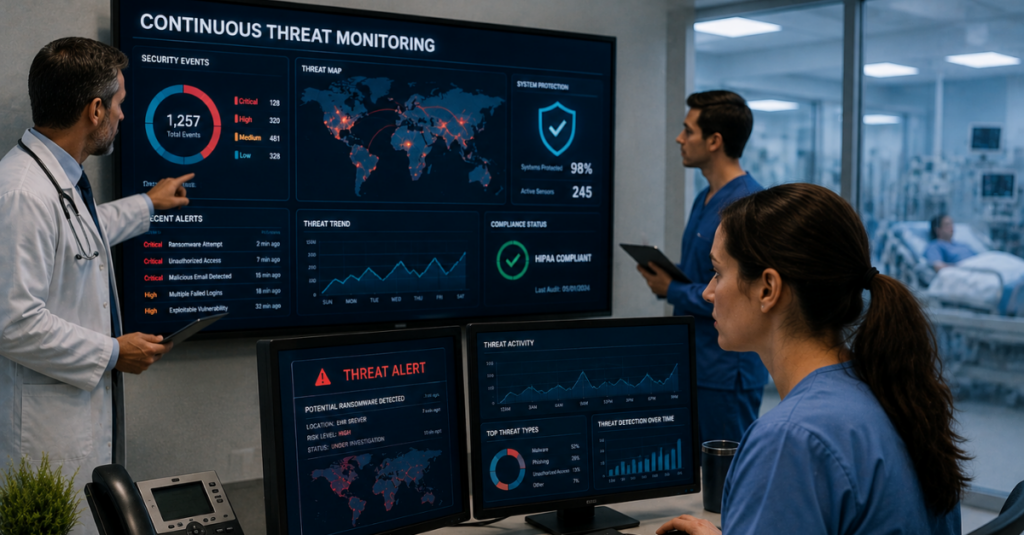
Effective monitoring depends on solid infrastructure underneath it. A practice running on an unreliable network or outdated Wi-Fi cannot support the kind of continuous data collection that real-time threat detection requires. Investments in next generation Wi-Fi are increasingly framed not just as a performance upgrade but as a security foundation, since faster, more stable networks make it easier to deploy modern monitoring tools without disrupting clinical workflows.
The rise of telehealth and hybrid administrative staff has also made secure remote infrastructure a permanent requirement rather than a temporary fix, and monitoring needs to extend to every remote endpoint, not just devices physically inside the practice.
Why Proactive IT Support Beats Reactive Fixes
Too many healthcare practices still operate on a break-fix model, calling for help only after something has already gone wrong. By that point, in a security context, the damage may already be done. A proactive IT support model shifts the relationship from reactive troubleshooting to ongoing prevention, catching small issues before they become expensive emergencies.
This shift often comes with a broader mindset change, moving toward a strategic IT partnership where technology decisions, including security investments, are made with the practice’s long-term goals in mind rather than only addressing whatever broke most recently.
Practices that make this shift often see benefits beyond security. Modern IT productivity tools and AI driven efficiency gains tend to follow naturally once outdated, unmonitored systems are replaced or modernized, since staff spend less time fighting technology and more time with patients.
Lessons From Other Regulated and Targeted Industries
Healthcare is not alone in facing this challenge, and there is value in looking at how other industries are adapting. Growing cybercrime targets in sectors like construction show a similar pattern: industries that historically underinvested in cybersecurity are now being singled out precisely because attackers view them as softer targets. Healthcare providers should take note, since the same underinvestment has historically applied to smaller clinics and practices as well.
Understanding emerging technology trends across other regulated sectors also helps healthcare leaders anticipate what is coming next rather than constantly playing catch-up with the latest threat.
Building a Continuous Monitoring Program: Where to Start
For a healthcare practice that currently relies only on annual HIPAA assessments, building out continuous monitoring can feel overwhelming. A practical starting point looks like this.
- Inventory everything. Know every device, application, and vendor connection that touches patient data. You cannot monitor what you do not know exists.
- Prioritize critical systems first. EHR platforms, billing systems, and email should be the first areas covered by active monitoring, since they represent the highest risk if compromised.
- Establish 24/7 alert coverage. A monitoring tool that nobody reviews outside business hours leaves a wide window of exposure every single night and weekend.
- Layer in employee training. Pair technical monitoring with ongoing phishing simulations and awareness campaigns so staff become an active part of the defense rather than the weakest link.
- Test incident response regularly. Run tabletop exercises so staff know exactly what to do the moment an alert indicates a real problem, rather than figuring it out during an actual crisis.
- Review and adjust quarterly. Threats evolve, and so should the monitoring priorities, alert thresholds, and tools in place.
How CMIT Solutions of Southeast Wisconsin Supports Healthcare Providers
CMIT Solutions of Southeast Wisconsin works with healthcare practices, clinics, and other regulated organizations across the region to build security programs that go beyond a HIPAA checklist. That includes deploying managed cybersecurity services, managing patch cycles, supporting zero trust access controls, and providing the kind of ongoing employee training that keeps human error from undoing strong technical defenses.
For a healthcare provider that wants confirmation their current setup is holding up, a conversation about current gaps and priorities is often the most useful first step. Practices can request a security assessment to get a clear picture of where things stand today and what a continuous monitoring program would look like for their specific environment.
Conclusion
HIPAA compliance is a legal requirement and an important baseline, but it was never intended to function as a real-time security program. Healthcare providers that treat compliance as the finish line are leaving themselves exposed to threats that move far faster than any annual audit cycle can account for. Continuous threat monitoring closes that gap, providing the ongoing visibility needed to catch suspicious activity, unauthorized access, and early signs of ransomware before they turn into a full-scale breach. For healthcare organizations across southeast Wisconsin, pairing strong compliance practices with active, around-the-clock monitoring is quickly becoming the standard for responsible patient data protection, not an optional upgrade.
Frequently Asked Questions