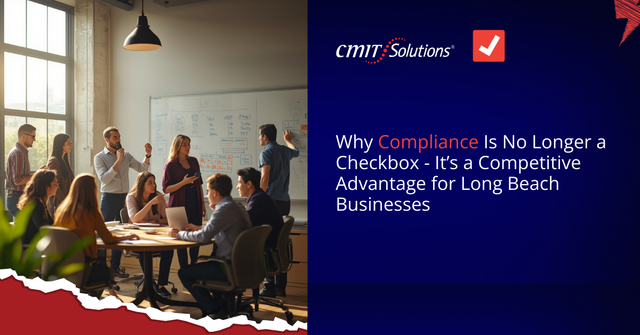
For many businesses, compliance has traditionally been viewed as an obligation rather than an opportunity. Regulations are met, documentation is completed, and audits are passed often with the goal of moving on as quickly as possible. This checkbox approach may satisfy minimum requirements, but it overlooks how deeply compliance now influences trust, resilience, and long-term competitiveness.
As regulatory expectations expand and customers become more aware of how organizations handle data and risk, compliance has evolved into something more strategic. For Long Beach businesses operating in increasingly regulated and interconnected markets, compliance is no longer just about avoiding penalties, it is becoming a differentiator.
The limits of checkbox compliance
Checkbox compliance focuses on meeting requirements at a specific moment in time. Policies are written, controls are implemented, and evidence is collected primarily for audit purposes.
This approach often leads to:
- Controls that exist on paper but not in practice
- Inconsistent enforcement across departments
- Gaps between compliance reviews
- Limited visibility into ongoing risk
In many organizations, this disconnect is amplified by shadow IT, where unsanctioned tools fall outside formal compliance oversight.
While this may satisfy auditors temporarily, it does little to improve daily operations or reduce long-term exposure.
Compliance expectations are becoming continuous
Regulatory frameworks increasingly emphasize ongoing risk management rather than periodic validation. Data protection, privacy, and cybersecurity requirements now expect organizations to demonstrate consistent control over systems and information.
This shift means:
- Compliance is assessed continuously, not episodically
- Operational practices matter as much as written policies
- Monitoring and documentation must be ongoing
- Gaps are more likely to be discovered between audits
Businesses that treat compliance as a living process are better positioned to meet these expectations particularly as compliance expectations continue to evolve.
Trust is becoming a measurable business asset
Customers, partners, and vendors are paying closer attention to how organizations manage risk and protect information. Compliance signals maturity, reliability, and accountability.
Strong compliance practices help businesses:
- Build confidence with clients and partners
- Reduce friction in vendor and contract negotiations
- Demonstrate reliability during due diligence
- Strengthen brand credibility
In competitive markets, trust increasingly influences purchasing decisions, especially when cybersecurity posture is scrutinized through security reviews and risk assessments.

Operational discipline improves efficiency
Well-implemented compliance frameworks often bring structure to areas that previously relied on informal processes. Clear access controls, documentation standards, and accountability reduce ambiguity.
This operational discipline can lead to:
- Fewer errors and rework
- More consistent workflows
- Faster issue resolution
- Clearer ownership of responsibilities
Rather than slowing operations, effective compliance often improves efficiency by eliminating uncertainty and duplication.
Risk reduction supports business continuity
Compliance requirements frequently overlap with sound risk management practices. Controls around data access, system availability, and incident response reduce the likelihood and impact of disruptions.
By embedding compliance into daily operations, businesses:
- Detect issues earlier
- Respond more effectively to incidents
- Limit the scope of potential damage
- Recover more quickly from disruptions
This overlap strengthens business continuity and reduces the operational shock of unexpected events.
Competitive differentiation in regulated industries
In industries where compliance is expected, how it is implemented matters. Organizations that go beyond minimum requirements are often seen as lower-risk partners.
This can provide advantages such as:
- Faster onboarding with enterprise clients
- Fewer delays during security reviews
- Greater confidence from investors and insurers
- Stronger positioning in competitive bids
As cyber risk becomes more visible, compliance maturity increasingly intersects with broader concerns around cyber insurance and insurability.
Alignment between compliance and cybersecurity strategy
Modern compliance frameworks increasingly intersect with cybersecurity. Protecting sensitive data, controlling access, and monitoring activity are foundational to both.
When compliance and security strategies are aligned:
- Controls serve multiple purposes
- Efforts are not duplicated across teams
- Gaps are easier to identify
- Oversight becomes more consistent
This alignment becomes increasingly important as organizations respond to AI-driven threats that challenge traditional, static control models.

Cultural impact of mature compliance practices
Organizations that treat compliance as integral to operations often foster stronger internal accountability. Employees understand expectations, processes are documented, and responsibilities are clear.
This cultural shift:
- Reduces reliance on informal workarounds
- Encourages consistent behavior
- Supports ethical decision-making
- Reinforces organizational values
Over time, compliance becomes part of how the business operates rather than an external obligation.
Why Long Beach businesses are rethinking compliance
Long Beach businesses operate in diverse, competitive environments where trust, reliability, and resilience matter. As regulatory scrutiny increases and customers demand greater transparency, compliance plays a more visible role in business success.
Organizations that approach compliance strategically are better prepared to adapt to change, manage risk, and demonstrate credibility in evolving markets especially when compliance is supported through strategic IT management rather than ad hoc controls.
Conclusion
Compliance is no longer a static requirement to be checked off during an audit cycle. It has become a continuous practice that shapes how businesses manage risk, protect data, and earn trust. When embedded into daily operations, compliance strengthens resilience, improves efficiency, and supports long-term competitiveness rather than acting as a constraint.
CMIT Solutions of Long Beach works with businesses to transform compliance from a basic obligation into a strategic advantage that supports growth, security, and operational confidence.