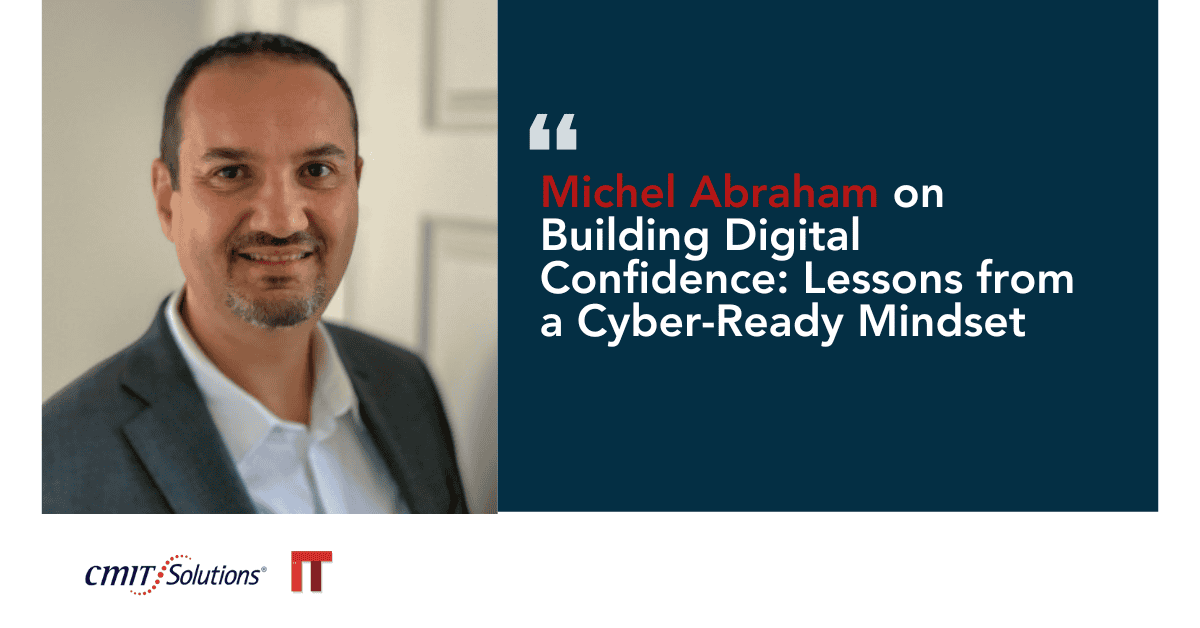
Michel Abraham, President of CMIT Solutions of Long Beach, has spent years helping small and midsized businesses navigate the complexities of cybersecurity and IT transformation. His philosophy is clear: digital confidence is the foundation of modern success. It’s not just about having the right technology it’s about having the right mindset.
This blog explores Michel’s approach to building a cyber-ready organization one where leadership, culture, and technology combine to form true digital resilience.
Defining Digital Confidence
Digital confidence means more than using technology efficiently. It’s about trusting that your systems, data, and people can adapt, respond, and recover no matter what the digital world throws your way.
According to Michel Abraham, “Technology should never be a source of fear; it should be a source of empowerment. A confident business understands risk but operates with control and clarity.”
Core elements of digital confidence:
- Visibility: Knowing where data lives and how it’s protected.
- Resilience: Ensuring continuity even when systems fail.
- Trust: Empowering teams to act securely and responsibly.
- Adaptability: Evolving with technology, not reacting to it.
This perspective aligns with CMIT’s insights on cybersecurity without compromise, which emphasizes that confidence stems from preparation, not perfection.
From Cyber Anxiety to Cyber Readiness
Many business owners view cybersecurity as a necessary burden something reactive and intimidating. Michel Abraham’s approach reframes it as an enabler of trust and continuity.
Key mindset shifts include:
- Moving from fear to focus
- Shifting from one-time protection to continuous improvement
- Treating cybersecurity as an investment, not an expense
Michel believes that cyber-readiness doesn’t come from buying more tools; it comes from strategic alignment. This philosophy echoes CMIT’s approach to proactive IT, where prevention and readiness are at the heart of every IT decision.
Lessons from a Cyber-Ready Mindset
Building digital confidence isn’t a one-time effort. It requires a structured, ongoing commitment to learning, planning, and adapting. Under Michel Abraham’s leadership, CMIT Solutions of Long Beach emphasizes several key lessons:
Start with Visibility
You can’t protect what you can’t see. Businesses must inventory assets, identify vulnerabilities, and monitor data flows. This principle supports CMIT’s insights on network management, where clear visibility is the foundation for secure, efficient operations.
Build Culture, Not Just Controls
Security is as much cultural as it is technical. Michel stresses the importance of employee awareness, accountability, and communication.
This philosophy aligns with CMIT’s security awareness, which empowers teams through ongoing education, turning employees into the first line of defense.
Integrate Continuity and Cybersecurity
True resilience requires merging cybersecurity with business continuity. Regular backups, tested recovery plans, and redundancy protect against downtime. CMIT’s ransomware resilience showcases how these measures turn potential disasters into minor interruptions.
Prioritize the Human Element
Even the best technology fails without human diligence. Michel emphasizes leadership involvement, accountability, and emotional confidence around IT decisions. He says, “When leaders show calm, informed decision-making, the entire organization inherits that confidence.”
Why SMBs Struggle with Digital Confidence
Small and midsized businesses often lack dedicated cybersecurity teams, leaving them vulnerable to threats that larger corporations can absorb. Michel points out that the SMB threat landscape has changed attackers now target smaller organizations precisely because they are unprepared.
Common gaps include:
- Outdated software and devices
- Weak password or access policies
- Reactive IT support models
- Inconsistent employee training
CMIT’s guide to cyber threats reveals that modern attackers exploit these vulnerabilities strategically, using automation and AI to identify easy targets.
Automation and Intelligence: The Next Phase of Confidence
Digital confidence thrives when technology assists humans, not replaces them. Automation and predictive analytics allow businesses to detect issues early, streamline compliance, and simplify maintenance.
Automation strengthens security by:
- Reducing human error
- Detecting anomalies in real-time
- Enforcing consistent security policies
- Accelerating recovery after incidents
This concept builds on CMIT’s intelligent automation, where automation and human oversight coexist to drive smarter IT management.
The Role of Leadership in Cyber Resilience
Michel believes leadership plays the most crucial role in developing digital confidence. Technology alone cannot build trust leadership must communicate strategy, allocate resources, and model security-first behavior.
Effective leadership practices include:
- Making cybersecurity a boardroom topic
- Aligning IT goals with business outcomes
- Encouraging open dialogue on risks
- Rewarding proactive behavior, not just compliance
These habits mirror CMIT’s driving growth, where leadership’s vision and technology strategy are inseparable.

Cyber Confidence Through Zero Trust
Zero Trust isn’t just a security model it’s a mindset. Michel advocates for verifying every user, device, and connection, ensuring that no one gets access simply by default.
Zero Trust in action:
- Implementing multi-factor authentication
- Monitoring behavior continuously
- Restricting data access by role
- Segmenting networks for isolation
CMIT’s expertise in zero trust adoption demonstrates that trust must be earned, not assumed especially in a hybrid work environment.
Cloud Confidence: Flexibility Without Risk
In a cloud-first world, many SMBs struggle to balance scalability and security. Michel advocates for multi-cloud strategies that combine flexibility with strict governance.
Key components of cloud confidence:
- End-to-end encryption
- Policy enforcement across providers
- Automated data classification
- Continuous access monitoring
CMIT’s multi-cloud management provides the framework for achieving that balance, ensuring control over every workload and dataset.
Compliance: Turning Obligation Into Advantage
Michel emphasizes that compliance shouldn’t feel like a burden it should be seen as a competitive advantage. Aligning with frameworks like HIPAA, PCI-DSS, or SOC 2 demonstrates reliability to clients and partners.
Benefits of managed compliance:
- Reduces legal and financial risk
- Strengthens client trust
- Improves internal accountability
- Simplifies audits and reporting
CMIT’s focus on HIPAA and beyond shows that compliance-driven businesses project professionalism and credibility in every transaction.
The Human Factor: Building Confidence Through Training
Technology can only go so far without human understanding. Michel’s team invests heavily in cybersecurity education, ensuring every employee becomes part of the solution.
Effective training programs include:
- Phishing simulations and response drills
- Role-based data handling policies
- Leadership-led security discussions
- Routine awareness updates
These strategies align closely with CMIT’s security awareness, where knowledge and repetition build confidence at every level of the organization.

Why Confidence Outperforms Fear
Michel often tells clients, “Fear leads to paralysis. Confidence leads to action.” In cybersecurity, fear-driven decisions often result in overcompensation or neglect both of which leave organizations exposed.
Confidence-driven organizations:
- Prioritize risk, not panic over it
- Budget strategically, not reactively
- Invest in layered, long-term protection
- Empower teams to report and act
This forward-looking attitude mirrors CMIT’s principles in cybersecurity compliance, emphasizing control, awareness, and adaptability.
Future of Cyber-Ready Leadership
By 2026 and beyond, cyber-ready leadership will be defined by balance: the ability to integrate innovation, resilience, and human intelligence into one seamless ecosystem.
The future mindset will focus on:
- Predictive defense, not reactive response
- Transparent security reporting
- Continuous improvement cycles
- Cyber resilience as a growth driver
This evolution parallels CMIT’s vision in AI innovation, where the leaders who adapt confidently are those who shape the next era of digital trust.
Michel Abraham’s Message to SMBs
Michel’s message to business leaders is clear: Confidence doesn’t come from eliminating risk, it comes from managing it intelligently.
He encourages SMBs to invest in strategy, partnership, and continuous improvement rather than one-off solutions.
Conclusion: The Confident Path Forward
Building digital confidence isn’t about being invincible; it’s about being prepared, informed, and resilient.
With the right mindset, one that blends security, strategy, and leadership any SMB can thrive in a world of constant change.
CMIT Solutions of Long Beach, under Michel Abraham’s leadership, continues to lead by example transforming cybersecurity from a challenge into a core business advantage.
Confidence isn’t a state of mind, it’s a strategic advantage. And when built on a cyber-ready foundation, it becomes the ultimate form of resilience.