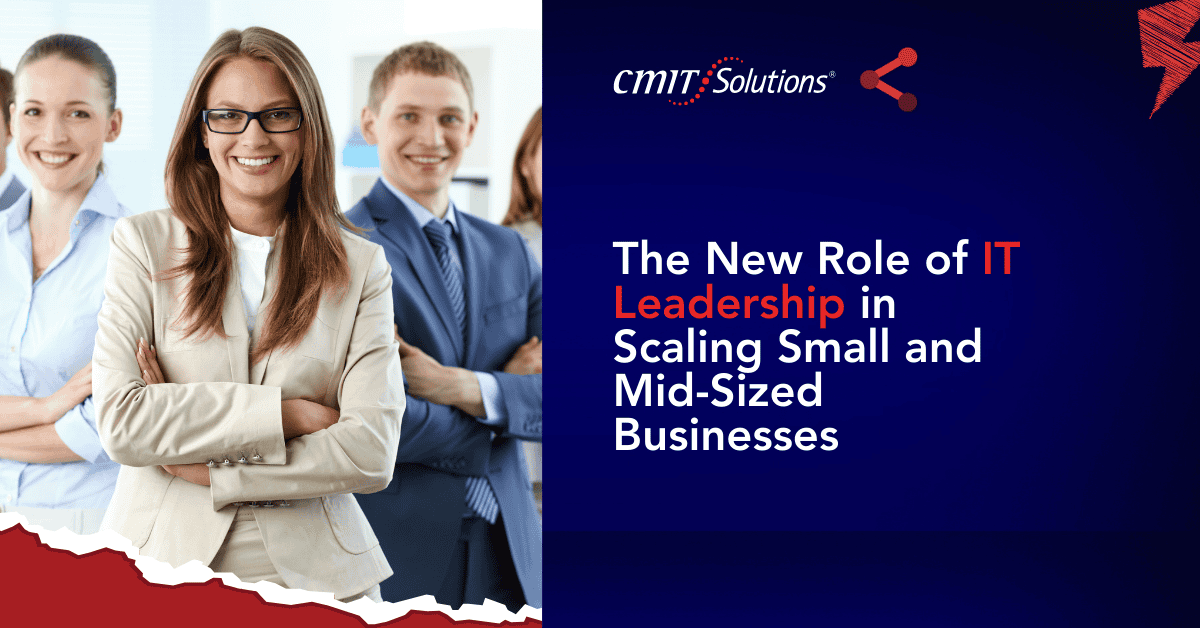
For small and mid-sized businesses, growth is no longer driven solely by sales, operations, or market expansion. Technology now plays a central role in determining how effectively a business can scale. As a result, the role of IT leadership has evolved significantly. What was once a technical, behind-the-scenes function has become a strategic pillar of business growth.
At CMIT Solutions of Long Beach, we work with SMBs that are redefining how IT leadership supports expansion. Today’s IT leaders are not just managing infrastructure they are enabling agility, mitigating risk, improving productivity, and aligning technology decisions with long-term business goals. Understanding this new role is essential for SMBs looking to scale sustainably and competitively.
IT Leadership as a Strategic Business Partner
In growing SMBs, IT leadership is no longer limited to maintaining systems or resolving technical issues. Modern IT leaders are expected to participate in strategic planning and provide insight into how technology can support business objectives.
By aligning IT initiatives with leadership priorities, businesses can avoid reactive decision-making and ensure technology investments directly contribute to growth.
To fulfill this strategic role, IT leadership must focus on:
- Understanding overall business goals and growth plans
- Translating business needs into technology strategies
- Advising leadership on technology risks and opportunities
- Supporting scalability through forward-looking planning
- Aligning IT priorities with organizational objectives
Enabling Scalable Infrastructure for Business Growth
Scaling a business requires infrastructure that can grow without disruption. Legacy systems and ad hoc solutions often become bottlenecks as organizations expand, limiting performance and flexibility.
Modern IT leadership is responsible for designing infrastructure that supports growth while maintaining reliability and security.
To build scalable foundations, IT leaders should prioritize:
- Flexible cloud and hybrid infrastructure models supported by managed cloud services
- Systems that scale with increased users and workloads
- Reduced reliance on rigid, on-premise systems
- Infrastructure resilience and redundancy reinforced by business continuity strategies
- Ongoing performance optimization backed by network management
Driving Technology Standardization Across the Organization
As SMBs grow, inconsistency in technology use can create inefficiencies and security risks. Different departments may adopt tools independently, leading to fragmented systems and workflows.
IT leadership plays a critical role in standardizing technology across the organization to improve efficiency and reduce complexity.
To support consistent growth, IT leaders must focus on:
- Establishing standard platforms and tools
- Reducing duplicate or overlapping technologies supported by cloud sprawl
- Simplifying user experiences across departments
- Improving support and maintenance efficiency guided by transforming IT support
- Enhancing visibility and control over systems

Managing Cybersecurity as a Core Business Risk
Cybersecurity is no longer an isolated technical concern—it is a business risk that directly impacts revenue, reputation, and continuity. As SMBs scale, their attack surface expands, making security leadership increasingly critical.
Modern IT leaders are expected to proactively manage cybersecurity risks rather than react to incidents after they occur.
To integrate security into growth strategies, IT leadership must emphasize:
- Risk-based security planning supported by AI security
- Proactive threat detection and monitoring guided by understanding MDR, EDR, and SIEM
- Secure access controls as teams expand strengthened by passkeys vs passwords
- Incident response and recovery planning reinforced by ransomware resilience
- Continuous improvement of security posture supported by cybersecurity without compromise
Supporting Workforce Growth and Changing Work Models
Scaling SMBs often experience rapid workforce changes, including new hires, remote work, and evolving roles. Technology must adapt quickly to support these shifts without compromising productivity or security.
IT leadership is responsible for enabling seamless onboarding, collaboration, and access as the organization grows.
To support workforce scalability, IT leaders should prioritize:
- Secure and efficient onboarding processes
- Identity-based access management supported by digital identity management
- Tools that support remote and hybrid work strengthened by unified communications
- Consistent user experiences across locations
- Ongoing support for evolving roles
Improving Operational Efficiency Through Automation and Optimization
As businesses scale, manual processes become unsustainable. IT leadership plays a key role in identifying opportunities to automate tasks, streamline workflows, and reduce operational friction.
Technology optimization allows SMBs to grow without proportionally increasing overhead.
To drive efficiency, IT leaders should focus on:
- Automating repetitive IT and business processes supported by the role of automation
- Integrating systems to reduce manual data handling
- Improving system reliability and uptime reinforced by why tech reliability
- Reducing time spent on troubleshooting supported by your IT provider
- Enabling staff to focus on higher-value work
Ensuring Technology Investments Deliver Business Value
Scaling businesses often face pressure to adopt new technologies quickly. Without proper oversight, this can lead to unnecessary complexity and wasted investment.
Modern IT leadership is responsible for evaluating technology decisions through a business lens, ensuring every investment supports growth objectives.
To maximize value, IT leaders must emphasize:
- Clear justification for technology investments
- Alignment with business outcomes supported by driving growth
- Reduction of underutilized tools supported by the subscription trap
- Ongoing evaluation of technology performance
- Strategic prioritization of initiatives

Supporting Compliance and Governance as the Business Grows
As SMBs expand into new markets or industries, compliance and governance requirements often increase. IT leadership must ensure that systems and processes scale in a way that supports accountability and regulatory expectations.
Embedding governance into technology frameworks reduces risk and administrative burden.
To support compliance during growth, IT leaders should focus on:
- Consistent access controls and data protection supported by why cybersecurity compliance
- Centralized monitoring and reporting supported by compliance audits
- Clear documentation of policies and procedures
- Audit readiness across systems supported by IT audits
- Proactive identification of compliance risks supported by the compliance puzzle
Bridging the Gap Between Technology and Employees
Technology only enables growth if employees are prepared to use it effectively. As SMBs scale, training and change management become critical components of IT leadership.
Modern IT leaders must ensure that technology adoption keeps pace with workforce readiness.
To bridge this gap, IT leadership should emphasize:
- Role-based training and onboarding
- Clear communication around technology changes
- Ongoing education and support supported by security awareness
- Feedback-driven improvement
- Alignment between tools and real workflows supported by AI is reshaping
Partnering With External Experts to Extend IT Leadership
Many SMBs do not have the resources to build a full in-house IT leadership team. Strategic partnerships allow businesses to access expertise while maintaining focus on core operations.
At CMIT Solutions of Long Beach, we act as an extension of our clients’ leadership teams providing strategic guidance, proactive management, and scalable IT solutions.
An effective IT partnership supports scaling by providing:
- Strategic planning and advisory services supported by building a future-ready IT roadmap
- Proactive risk and performance management supported by AI-driven threats
- Scalable support and infrastructure supported by why managed IT
- Clear communication and accountability supported by cyberattack wake-up call
- Long-term alignment with growth goals supported by future-proofing your business
Final Thoughts: IT Leadership Is a Growth Enabler, Not a Support Function
The role of IT leadership in scaling small and mid-sized businesses has fundamentally changed. Today, IT leaders are strategic enablers of growth, resilience, and efficiency—not just technical problem solvers.
At CMIT Solutions of Long Beach, we help SMBs embrace this new model of IT leadership by aligning technology with business strategy and supporting sustainable growth. By elevating IT leadership, businesses can scale with confidence, clarity, and control.