Financial services firms operate in one of the most high-risk digital environments of any industry. Client trust, financial integrity, regulatory obligations, and business continuity all depend on the ability to protect sensitive data and critical systems. As cyber threats grow more sophisticated and persistent, traditional security approaches that rely on periodic reviews or reactive responses are no longer sufficient.
Real-time threat monitoring has become an essential component of modern financial security strategies. At CMIT Solutions of Long Beach, we work with financial services firms that are rethinking how they detect, respond to, and manage cyber threats as they occur rather than after damage has already been done. Understanding what real-time threat monitoring truly involves is critical for firms looking to reduce risk without disrupting daily operations.
Why Financial Services Firms Are Prime Targets for Cyber Threats
Financial services organizations manage highly valuable data, including financial records, personal identifiers, transaction histories, and investment information. This makes them attractive targets for a wide range of cyber threats, from credential theft to fraud and ransomware.
Attackers are not only interested in immediate financial gain but also in long-term access that allows them to manipulate systems or steal data over time. This reality requires security strategies that can identify threats as they unfold.
To understand the urgency behind real-time monitoring, firms must recognize why their environments are consistently targeted:
- Concentration of sensitive financial and personal data
- Direct access to funds and transaction systems
- High reliance on digital platforms and integrations
- Strict uptime and availability requirements
- Increased exposure through remote and third-party access
The Limitations of Traditional Security Monitoring Approaches
Many financial firms still rely on periodic log reviews, manual audits, or alerts that trigger only after suspicious activity has escalated. While these methods may identify issues eventually, they often do so too late to prevent damage.
Traditional monitoring focuses on historical data rather than live activity, leaving gaps during critical moments when threats are actively unfolding.
Before adopting real-time monitoring, firms should understand the shortcomings of older approaches:
- Delayed detection of suspicious behavior
- Limited visibility into live system activity
- Reliance on manual review processes
- Inability to correlate events across systems
- Increased time to respond to incidents
What Real-Time Threat Monitoring Actually Means
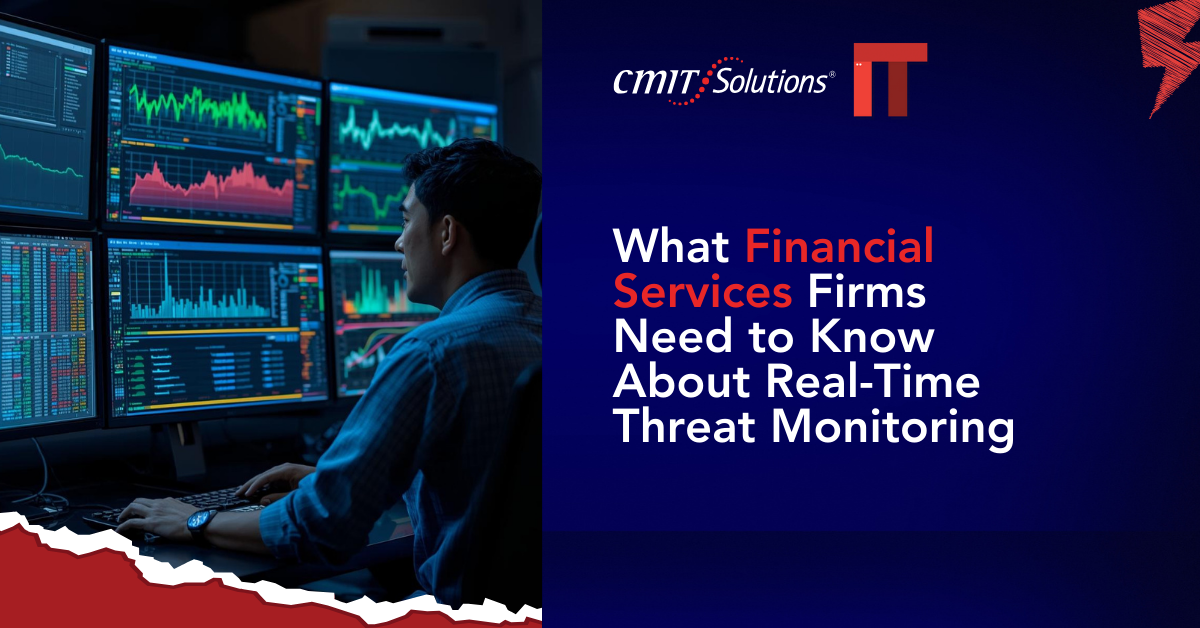
Real-time threat monitoring is not a single tool or product—it is a continuous process that provides immediate visibility into system activity, user behavior, and potential security events as they happen.
Rather than waiting for alerts after damage occurs, real-time monitoring allows firms to detect anomalies early and take action before threats escalate.
To understand its value, financial services firms should view real-time monitoring as:
- Continuous observation of systems and networks supported by network management
- Immediate detection of unusual or risky behavior aligned with understanding MDR, EDR, and SIEM
- Correlation of activity across multiple platforms guided by cybersecurity metrics
- Rapid alerting and escalation of threats supported by AI-driven threats
- Ongoing refinement based on evolving risks informed by cyber threats

Detecting Threats Before Financial Damage Occurs
In financial environments, even small delays in threat detection can lead to significant consequences. Unauthorized transactions, account manipulation, or data exposure can happen quickly once attackers gain access.
Real-time threat monitoring shifts the focus from damage control to prevention by identifying indicators of compromise early in the attack lifecycle.
To reduce financial impact, firms benefit from monitoring capabilities that focus on:
- Unusual login activity or access patterns strengthened by passkeys vs passwords
- Abnormal transaction behavior
- Sudden privilege changes
- Unexpected system configuration changes
- Communication with known malicious endpoints
The Role of User Behavior in Threat Detection
Many modern attacks use valid credentials, making them difficult to detect using traditional perimeter defenses. Real-time threat monitoring places greater emphasis on user behavior rather than just system events.
By establishing baselines for normal activity, firms can identify deviations that may indicate compromised accounts or insider threats.
Behavior-focused monitoring helps firms detect:
- Access from unfamiliar locations or devices
- Activity outside normal working hours
- Attempts to access restricted systems or data
- Rapid or unusual data movement
- Repeated authentication failures
Supporting Compliance Through Continuous Visibility
Financial services firms operate under strict regulatory and compliance expectations. Regulators increasingly expect firms to demonstrate not only that controls exist, but that they are actively monitored and enforced.
Real-time threat monitoring supports compliance by providing continuous visibility into system activity and creating detailed audit trails.
From a compliance perspective, real-time monitoring helps firms achieve:
- Immediate detection of policy violations supported by why cybersecurity compliance
- Documented evidence of security oversight aligned with compliance audits
- Traceability of user actions and system changes
- Faster response to compliance-related incidents
- Improved audit readiness and reporting supported by IT audits demystified

Reducing Response Time During Security Incidents
The speed of response is often the deciding factor in whether a security incident becomes a minor issue or a major crisis. Real-time threat monitoring enables faster investigation and containment by providing immediate context and alerts.
Rather than piecing together events after the fact, security teams can act while threats are still in progress.
To improve response effectiveness, real-time monitoring supports:
- Rapid identification of affected systems
- Immediate isolation of compromised accounts
- Faster escalation to incident response teams
- Reduced downtime and disruption supported by the hidden costs of IT downtime
- More controlled and informed decision-making
Managing Threats Across Complex Financial IT Environments
Financial services firms often operate complex IT environments that include core banking systems, cloud platforms, third-party integrations, and remote access tools. Monitoring these environments in isolation creates blind spots.
Real-time threat monitoring provides unified visibility across systems, helping firms identify risks that span multiple platforms.
To manage complexity, firms should focus on monitoring that enables:
- Centralized visibility across all systems
- Correlation of events from different sources
- Consistent monitoring policies
- Reduced reliance on manual oversight
- Improved understanding of system interdependencies supported by multi-cloud management
Aligning Threat Monitoring With Business Operations
Security measures must support business operations, not hinder them. Financial services firms require monitoring solutions that operate continuously without disrupting transactions, client interactions, or internal workflows.
Well-designed real-time monitoring integrates seamlessly into daily operations while maintaining strong security controls.
To ensure alignment with business needs, firms should prioritize monitoring solutions that:
- Operate with minimal performance impact
- Provide actionable alerts rather than noise
- Support business-critical systems
- Scale with organizational growth supported by driving growth
- Adapt to changing operational demands informed by future-proofing your business
Why Financial Firms Need a Trusted Partner for Real-Time Monitoring
Implementing and managing real-time threat monitoring requires expertise, resources, and ongoing attention. Financial services firms benefit from working with an IT partner that understands both the technical and regulatory demands of the industry.
At CMIT Solutions of Long Beach, we help financial services firms design, implement, and manage real-time monitoring strategies that strengthen security while supporting operational goals.
A trusted IT partner adds value by providing:
- Strategic threat monitoring design supported by AI security
- Continuous oversight and optimization guided by cybersecurity without compromise
- Rapid response coordination informed by cyberattack wake-up call
- Clear communication and reporting
- Long-term alignment with business risk management supported by building a future-ready IT roadmap
Final Thoughts: Real-Time Monitoring Is Now Essential for Financial Security
For financial services firms, real-time threat monitoring is no longer optional it is a foundational requirement for protecting assets, maintaining trust, and meeting regulatory expectations. As threats become faster and more complex, the ability to detect and respond in real time is critical.
At CMIT Solutions of Long Beach, we help financial services organizations move beyond reactive security models by implementing real-time threat monitoring strategies that provide visibility, control, and confidence. With the right approach, firms can protect their operations today while preparing for the threats of tomorrow.