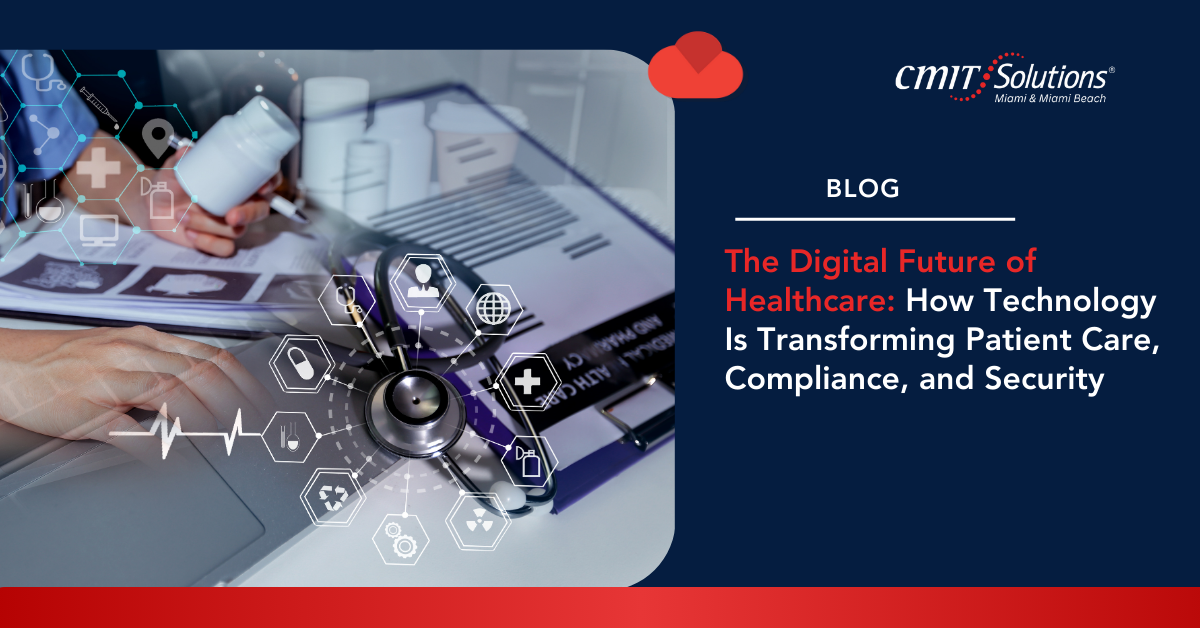
Healthcare organizations are navigating one of the fastest technology evolutions in modern history. From cloud platforms and AI-driven diagnostics to remote monitoring and automated workflows, digital transformation is redefining how care is delivered, documented, and protected.
Yet with innovation comes complexity. Clinics, hospitals, private practices, and specialty providers must now balance modernization with security, compliance, and reliability all while protecting highly sensitive patient data.
Below is a comprehensive look at how digital transformation is reshaping healthcare, with internal insights supported by CMIT Solutions of Miami & Miami Beach.
The Shift Toward Digital-First Healthcare
Healthcare has moved beyond electronic records into a fully integrated digital ecosystem. Providers are implementing a mix of cloud platforms, patient-facing applications, secure communication tools, and advanced analytics to improve clinical, operational, and financial outcomes.
Why the shift is accelerating:
- Rising patient expectations Modern patients expect digital portals, online scheduling, and secure messaging.
- Need for real-time clinical access Providers require instant access to imaging, labs, and patient histories.
- Demand for operational efficiency Administrative automation reduces costs and frees clinical staff.
- Growing cybersecurity risks Healthcare is the most targeted industry for ransomware, as highlighted in cyber threats.
This shift is no longer optional it’s essential for competitive, compliant, and modern healthcare delivery.
Cloud Platforms Are Now the Backbone of Modern Healthcare
Cloud adoption in healthcare has surged due to its ability to manage large data volumes, support secure remote work, and scale rapidly.
Key advantages of healthcare cloud systems:
- Scalable Storage Capacity
Healthcare generates enormous imaging and diagnostic files. Cloud platforms expand instantly eliminating expensive hardware upgrades.
- Stronger Data Protection
Encrypted systems and Zero Trust frameworks protect PHI against attacks. Providers must align with best practices outlined in cloud services.
- Improved Collaboration
Clinicians across departments gain real-time access to records, improving continuity of care.
- Built-In Disaster Recovery
Cloud environments support faster recovery, an essential safeguard reinforced by business continuity.
Cloud systems enable healthcare organizations to deliver more accurate, efficient, and secure patient services.
Automation Is Reducing Errors and Boosting Clinical Efficiency
Automation is streamlining clinical documentation, administrative operations, and reporting — significantly reducing manual workload.
Healthcare automation in action:
- Automated Patient Intake
Digital forms reduce paperwork, decrease wait times, and eliminate transcription errors.
- Claims & Billing Automation
Intelligent engines accelerate coding, prevent denials, and improve revenue cycles.
- Clinical Decision Support
AI-driven tools assist with diagnosis, flag abnormalities, and support physician judgment.
- Operational Forecasting
Predictive analytics anticipate patient volume, staffing needs, and resource allocation.
Automation is increasingly essential for accuracy, compliance, and long-term sustainability in healthcare practices.

Cybersecurity: The Most Critical Priority in Healthcare IT
Healthcare is the most frequently targeted industry for ransomware, due to high-value patient data and reliance on uninterrupted operations. A single breach can shut down systems, delay care, cause patient harm, and result in regulatory fines.
Essential cybersecurity measures every healthcare provider needs:
- Zero Trust Access Controls
Limits unauthorized access to PHI and prevents lateral movement within networks.
- Advanced Endpoint Protection
Solutions like EDR detect abnormal behavior in medical devices and workstations. See EDR solutions.
- Email Protection
Phishing continues to target clinicians and administrative staff. Effective protection includes encrypted email, filtering, and employee training. Learn more in email security.
- 24/7 Threat Monitoring
Real-time detection prevents attackers from exploiting vulnerabilities overnight — consistent with the recommendations in IT support.
Healthcare cybersecurity must be multi-layered, proactive, and compliant with HIPAA administrative, technical, and physical safeguards.
Telehealth and Remote Care Require Secure Digital Infrastructure
Telehealth has become a permanent part of healthcare delivery. Patients expect convenient virtual care for follow-ups, mental health appointments, specialist consultations, chronic disease management, and more.
However, telehealth introduces new challenges:
- Ensuring encrypted video and communication channels
- Verifying patient identity
- Protecting home-network access points
- Securing remote staff devices via MDM
- Maintaining HIPAA-compliant logs and storage
Hybrid care models can improve access and outcomes, but only when supported by strong cybersecurity and compliant digital infrastructure.
Compliance & Data Governance in Healthcare Are Evolving
Modern healthcare compliance now extends beyond HIPAA. Providers must manage access control, audit logs, secure document storage, data retention, email archiving, and third-party vendor risk.
Modern compliance expectations include:
- Accurate Access Logs
Systems must record which users access patient data, when, and why.
- Retention Management
Policies must align with legal and medical requirements, ensuring PHI is preserved — but not over-stored.
- Vendor Risk Evaluation
Third-party software requires compliance verification and signed BAAs.
- Cloud & Backup Compliance
Data must be stored securely, with encrypted backups and rapid recovery processes, as reinforced in data backup.
Healthcare compliance is now as much an IT responsibility as it is a legal one.
AI in Healthcare: Driving Better Decisions and Predictive Care
AI is elevating patient care, diagnostics, and hospital operations. Its value continues to grow as systems become more advanced.
Key applications of AI in healthcare:
- Diagnostic Imaging Analysis
AI detects early signs of disease faster than traditional manual review.
- Predictive Health Monitoring
Alerts clinicians about patient deterioration in real time.
- Population Health Analytics
Identifies trends and risk factors across patient groups.
- Automated Triage Support
Helps prioritize urgent cases.
However, AI must be ethically governed to avoid data bias, ensure accuracy, and comply with regulatory standards.

Disaster Recovery Is a Clinical Priority Not Just an IT Concern
Healthcare organizations cannot afford downtime. A system outage can delay critical treatments, compromise lab access, and jeopardize lives.
Healthcare disaster recovery plans must include:
- Encrypted, off-site backups
- Immutable backup versions
- Failover systems for EHR and imaging
- Real-time replication
- Incident response planning
- Regular recovery drills
Downtime prevention strategies follow the principles outlined in business continuity.
Why Healthcare Organizations Are Turning to Managed IT Services
Digital healthcare requires 24/7 uptime, airtight security, compliant systems, and real-time responsiveness. Most healthcare organizations now partner with MSPs to manage these demands.
A qualified healthcare MSP provides:
- HIPAA-aligned cybersecurity management
- Comprehensive cloud migration and optimization
- Device security for clinical and administrative staff
- 24/7 monitoring and threat response
- Backup and disaster recovery management
- Endpoint patching and system hardening
- Technology planning that supports clinical workflows
This partnership allows healthcare providers to focus on patient care while IT specialists handle infrastructure, security, and compliance.
Conclusion: The Future of Healthcare Is Digital, Secure, and Patient-Centered
Digital transformation is reshaping how healthcare organizations operate. Cloud platforms, automation, cybersecurity, AI-powered tools, and reliable disaster recovery systems are now essential for delivering safe, efficient, and modern care.
Healthcare providers that adopt these technologies will:
- Strengthen patient outcomes
- Enhance security and compliance
- Reduce operational costs
- Increase efficiency
- Improve care coordination
- Build long-term resilience
Those that fail to evolve risk operational disruption, compliance penalties, cybersecurity exposure, and declining patient satisfaction.