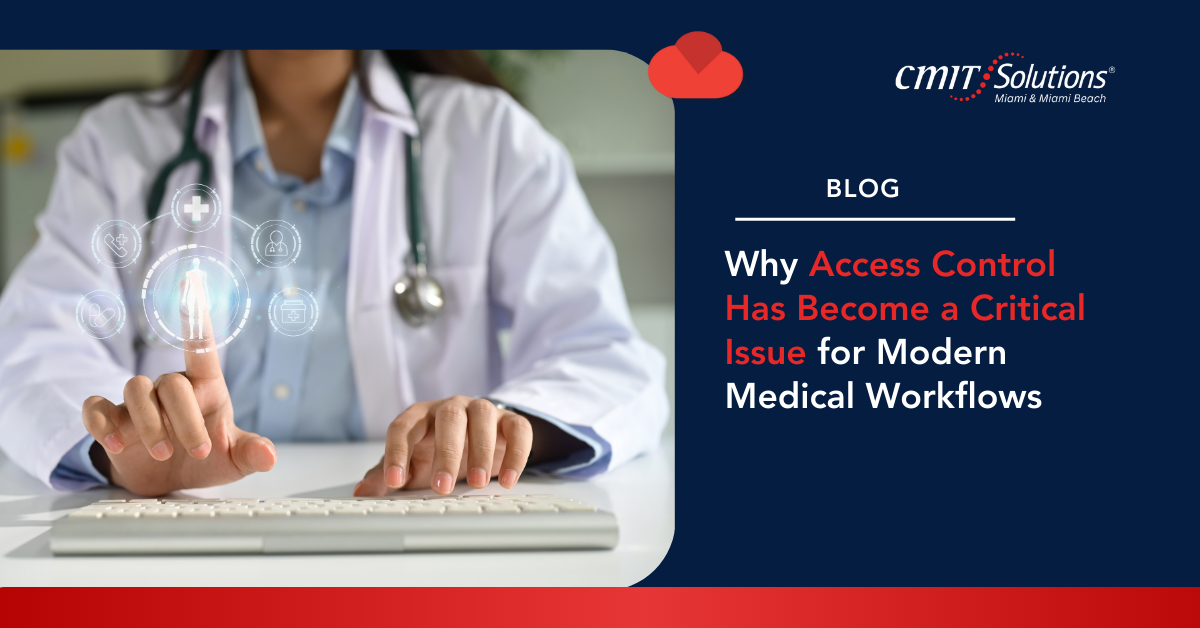
Healthcare workflows have evolved dramatically in recent years. Electronic health records, telehealth platforms, cloud-based systems, connected medical devices, and remote access tools now play a central role in patient care. While these advancements improve efficiency and accessibility, they also introduce new challenges particularly around who can access patient information and clinical systems.
Access control has moved from a technical consideration to a core operational and clinical concern. When access is too limited, care can be delayed. When access is too broad, patient privacy and data security are put at risk. Modern medical workflows demand a balanced approach that protects sensitive information without interfering with timely care delivery.
At CMIT Solutions of Miami & Miami Beach, we work with healthcare organizations to design access control strategies that support clinical efficiency while safeguarding patient information. Below are ten key reasons why access control has become a critical issue for today’s medical workflows.
Patient Information Is Spread Across More Systems Than Ever
Modern healthcare environments rely on a wide range of digital systems beyond electronic health records. Scheduling tools, imaging platforms, billing systems, telehealth applications, and patient portals all store or process sensitive data.
Access control must now account for this expanding ecosystem. Without consistent rules across systems, patient information can be exposed unintentionally or become difficult to manage.
Understanding where data resides is the first step toward controlling access.
Key systems requiring access governance include:
- Electronic health record platforms
- Practice management and billing systems
- Telehealth and virtual care tools
- Integrated third-party healthcare applications
Clinical Roles Require Different Levels of Access
Not every staff member needs access to the same patient information. Physicians, nurses, administrative staff, and support teams all interact with data differently based on their responsibilities.
Modern access control strategies align permissions with clinical roles, ensuring staff can perform their duties efficiently without unnecessary exposure to sensitive information.
Precision improves both security and workflow efficiency.
Role-based access helps healthcare practices:
- Limit exposure of sensitive patient data
- Reduce confusion about system permissions
- Support faster, more focused workflows
- Maintain accountability across teams
Hybrid and Remote Work Have Expanded Access Points
Healthcare workflows now extend beyond the physical facility. Administrative staff, clinicians, and support teams may access systems remotely or in hybrid arrangements, increasing the number of access points to patient data.
Access control must ensure that security standards remain consistent regardless of location. Remote access should be just as controlled and monitored as in-office access.
Location-independent controls are now essential.
Hybrid-related access challenges include:
- Access from unsecured networks
- Use of multiple devices per user
- Reduced visibility into remote activity
- Increased risk of credential misuse

Timely Access Is Essential for Patient Care
In healthcare, delays can directly impact patient outcomes. Overly restrictive access controls can slow workflows, frustrate clinicians, and interfere with care delivery.
Modern access control balances security with speed, ensuring clinicians can access critical information when they need it—without unnecessary barriers.
Access should support care, not hinder it.
Well-designed access controls help by:
- Reducing delays in accessing patient records
- Supporting rapid clinical decision-making
- Minimizing unnecessary authentication steps
- Preserving workflow efficiency during peak hours
Overly Broad Access Increases Risk of Data Exposure
When access permissions are too broad, patient information is exposed to unnecessary risk. Accidental disclosures, improper access, or internal misuse become more likely when controls are not precise.
Healthcare organizations are tightening access policies to reduce exposure while still enabling collaboration.
Limiting access reduces the impact of mistakes.
Risks of overly broad access include:
- Unauthorized viewing of patient records
- Accidental data sharing across departments
- Increased difficulty identifying responsibility
- Greater impact during security incidents
Connected Medical Devices Introduce New Access Challenges
Modern medical workflows increasingly rely on connected devices for diagnostics, monitoring, and treatment. These devices often connect directly to clinical systems and patient records.
Access control must extend to device data and interfaces, ensuring only authorized users and systems can interact with them.
Device access is part of patient data protection.
Key device-related access concerns include:
- Unauthorized access to device data
- Insecure device integrations
- Lack of visibility into device usage
- Difficulty managing permissions across devices
Human Error Is More Likely Without Clear Access Boundaries
Healthcare environments are fast-paced and complex. Without clear access boundaries, staff may inadvertently access the wrong records, share information incorrectly, or use systems outside their intended scope.
Access control reduces reliance on memory and judgment by enforcing clear rules through technology.
Designing for error prevention improves safety.
Access boundaries help prevent errors such as:
- Opening the wrong patient record
- Modifying data outside assigned responsibilities
- Sharing information unintentionally
- Using systems incorrectly under pressure

Visibility Into Access Activity Is Essential for Oversight
Healthcare organizations cannot manage what they cannot see. Modern access control systems provide visibility into who is accessing patient information and how it is being used.
This visibility supports accountability, incident response, and continuous improvement.
Awareness strengthens security and trust.
Benefits of access visibility include:
- Early detection of unusual access patterns
- Faster investigation of potential issues
- Improved compliance readiness
- Stronger confidence in data protection practices
Compliance Expectations Depend on Controlled Access
Healthcare organizations operate under strict privacy and data protection requirements. Demonstrating controlled access to patient information is a key component of compliance.
Modern access control systems help healthcare practices meet these expectations consistently and efficiently.
Compliance is reinforced through control and documentation.
Access control supports compliance by enabling:
- Clear audit trails for patient data access
- Enforceable privacy policies
- Consistent application of security standards
- Faster response to audits and reviews
Managed IT Partnerships Strengthen Access Control Strategy
Effective access control requires ongoing oversight, adjustment, and expertise. Healthcare practices benefit from partnering with IT providers who understand clinical workflows and patient data protection requirements.
At CMIT Solutions of Miami & Miami Beach, we help healthcare organizations design access control strategies that align with real-world medical workflows. Our focus is on protecting patient information without disrupting care delivery.
The right partnership ensures access control evolves with healthcare needs, supported by proactive managed IT services and always-on IT support.
Advantages of working with a healthcare-focused IT partner include:
- Expertise in healthcare systems and workflows
- Proactive monitoring and optimization
- Scalable access control solutions
- Ongoing guidance as technology evolves
Conclusion: Access Control Is Foundational to Modern Medical Care
Access control is no longer a background IT function it is a critical component of modern medical workflows. As healthcare environments become more digital and interconnected, controlling who can access patient information is essential to protecting privacy, supporting care delivery, and maintaining trust.
By implementing thoughtful access control strategies and partnering with experts like CMIT Solutions of Miami & Miami Beach, healthcare practices can secure patient information while enabling efficient, high-quality care. In today’s healthcare landscape, strong access control supports both security and better patient outcomes, strengthened by modern cybersecurity and dependable data backup and recovery.