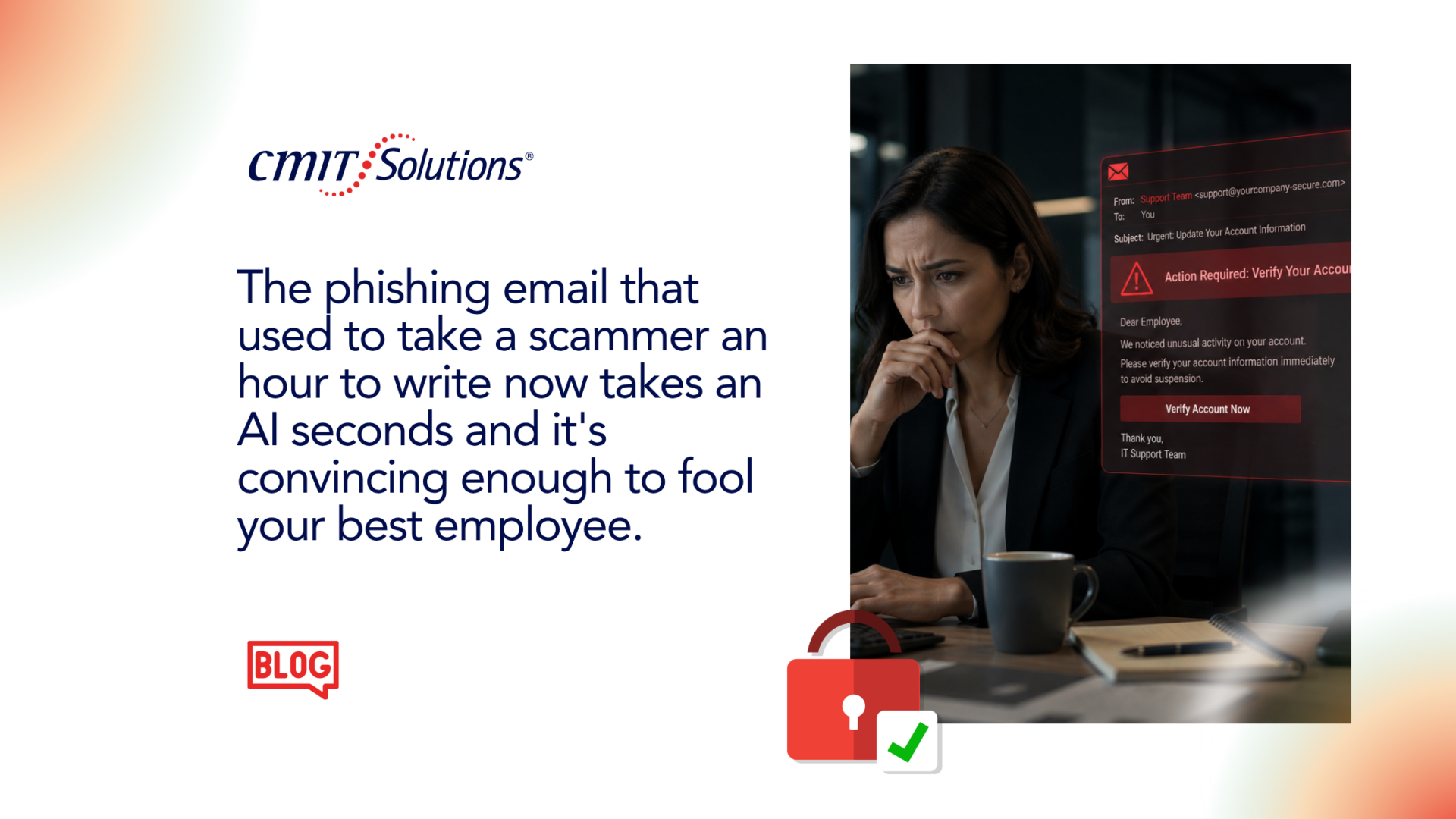
Cybercriminals have always adapted quickly, but artificial intelligence has accelerated that evolution in ways most businesses are not prepared for. What once took a skilled hacker days or weeks to plan and execute can now be automated, personalized, and scaled in a matter of minutes. Phishing emails that used to be riddled with typos now read like they were written by a colleague. Voice cloning tools can mimic an executive’s voice well enough to authorize a wire transfer. Malware can rewrite itself on the fly to slip past traditional antivirus tools.
This shift is not a distant, futuristic concern. It is happening now, and small and mid-sized businesses across Central Texas are increasingly in the crosshairs, largely because attackers assume smaller organizations have weaker defenses than large enterprises. The uncomfortable truth is that many businesses are still relying on security strategies built for a threat landscape that no longer exists.
This guide breaks down how AI is changing the nature of cyberattacks, why older security approaches are struggling to keep up, and what a modern, resilient defense strategy actually looks like for growing businesses.
The organizations that adapt fastest will be the ones that stop viewing cybersecurity as a fixed set of tools installed once and forgotten. Because attackers are now using AI to continuously refine their methods, defenses need the same kind of ongoing refinement. That shift in mindset, from a static checklist to a living, evolving strategy, is often the biggest change businesses need to make before any specific tool or policy matters.
How Artificial Intelligence Is Being Weaponized by Cybercriminals
AI is not just a tool for defenders. Attackers have quietly adopted the same technologies to make their campaigns faster, cheaper, and far more convincing.
AI-Generated Phishing and Social Engineering
Phishing has long relied on volume, sending thousands of generic messages hoping a few land. AI changes that math entirely. Generative tools can now produce highly personalized messages that reference real projects, real coworkers, and realistic writing styles pulled from publicly available information.
Common AI-enhanced tactics include:
- Emails that mimic the tone and phrasing of a specific executive or vendor
- Messages timed around real events, such as a recent company announcement
- Perfectly written, error-free content that removes the usual red flags employees are trained to spot
- Rapid generation of dozens of message variations to test which ones bypass spam filters
Firms exploring guidance on different hacker types will notice that motivations vary widely, but AI has lowered the technical barrier for nearly all of them to launch convincing campaigns.
Deepfake Audio and Video
Voice cloning technology now requires only a short audio sample, sometimes just a few seconds pulled from a public video or voicemail greeting, to generate a convincing fake. Attackers have used this to impersonate executives on phone calls, instructing finance teams to process urgent wire transfers or share sensitive credentials.
Video deepfakes are following a similar trajectory, with fraudulent video calls already being used to bypass identity verification steps in some documented incidents. As this technology becomes more accessible, businesses can no longer assume that a familiar voice or face on a call guarantees authenticity.
Automated and Adaptive Malware
Traditional antivirus software relies heavily on recognizing known malicious code patterns. AI-driven malware can alter its own structure automatically, generating new variants that evade signature-based detection while still performing the same malicious function.
This adaptability means malware can:
- Change its code signature frequently to avoid detection
- Identify and exploit specific vulnerabilities in a target’s environment automatically
- Adjust its behavior based on the security tools it detects on a compromised system
Understanding these evolving tactics builds on lessons from earlier threats covered in resources on virus protection basics, where the fundamentals of malicious code detection remain relevant even as the delivery methods grow more sophisticated.
AI-Powered Reconnaissance
Before launching an attack, cybercriminals often research their target extensively. AI tools can now scrape social media, company websites, press releases, and even employee LinkedIn profiles in minutes, building a detailed profile of an organization’s structure, vendors, and key decision makers.
This automated reconnaissance makes attacks feel eerily personal, since criminals can reference real names, real projects, and real relationships to make their approach more convincing.
Why Traditional Security Defenses Fall Short
Many businesses still rely on security measures designed for an earlier generation of threats, such as basic spam filters, static firewalls, and periodic antivirus scans. These tools are not obsolete, but they are no longer sufficient on their own against AI-enhanced attacks.
Key gaps include:
- Signature-based detection struggles against malware that constantly changes its own code
- Employee training that focuses only on spotting typos and poor grammar misses AI-generated messages that have neither
- Static perimeter defenses do little against attacks that exploit human trust rather than technical vulnerabilities
- Manual monitoring cannot keep pace with the speed and volume of automated attack attempts
Businesses that continue relying solely on these older methods often discover gaps only after an incident occurs. Reviewing broader strategies for internal security threats highlights how attackers, whether external or masquerading as trusted insiders, increasingly exploit gaps that static defenses were never designed to catch.

Building a Modern, AI-Ready Cybersecurity Strategy
Defending against AI-powered threats requires a layered approach that combines advanced technology, informed employees, and clear response procedures. No single tool solves this problem on its own.
Each layer described below addresses a different part of the attack chain, from the moment an attacker begins researching a target to the steps taken after a breach is detected. Businesses do not need to implement every layer simultaneously, but understanding the full picture makes it easier to prioritize which gaps to close first based on actual risk rather than guesswork.
Advanced Threat Detection
Modern security platforms increasingly use their own AI and machine learning models to detect unusual behavior patterns rather than relying solely on known threat signatures. This allows systems to flag suspicious activity even when the specific attack method has never been seen before.
Effective detection systems typically monitor:
- Unusual login locations or times that deviate from normal user behavior
- Abnormal data transfer volumes that could indicate exfiltration
- Rapid, repeated access attempts across multiple accounts
- Communication patterns that suggest compromised credentials
Businesses investing in advanced threat detection gain the ability to catch attacks in progress rather than discovering them only after damage has already occurred.
Identity and Access Security
As AI makes impersonation easier, verifying identity has become one of the most critical layers of defense. Passwords alone are no longer enough, especially when AI tools can help attackers guess or harvest credentials at scale.
Strong identity protection includes:
- Multi-factor authentication across all critical systems and accounts
- Role-based access controls that limit exposure if one account is compromised
- Regular reviews of user permissions to remove unnecessary access
- Monitoring for credential leaks tied to the organization’s domains
Insights on identity access security explain why login security has become such a central focus for businesses across nearly every industry, not just highly regulated fields.
Employee Awareness Training
Even the most advanced technology cannot fully replace an informed workforce. Employees need training that reflects how AI-generated attacks actually look today, not outdated examples full of obvious red flags.
Updated training should cover:
- How to verify unusual requests through a separate communication channel
- Recognizing subtle urgency tactics used in AI-crafted messages
- Understanding that polished, professional writing no longer guarantees legitimacy
- Reporting procedures that make it easy and fast to flag suspicious activity
Practical steps for improve security posture often start with this kind of ongoing training, since human judgment remains one of the strongest lines of defense when properly informed.
Secure Communication Channels
Since AI-generated phishing and voice cloning both exploit trust in communication, securing the channels themselves adds another layer of protection.
- Encrypted messaging and email platforms reduce the risk of intercepted communications
- Verified call-back procedures for financial requests prevent voice cloning fraud
- Centralized communication platforms make it easier to spot anomalies across teams
Adopting secure communication systems helps reduce the number of entry points attackers can exploit while also improving day-to-day collaboration.
AI has also made it easier for attackers to intercept communications in transit rather than simply impersonating a sender. Lessons from earlier guidance on intercepted data attacks remain highly relevant, since AI tools now make it faster for attackers to identify unencrypted connections and insert themselves into a conversation without either party noticing.
Network Monitoring and Segmentation
A well-monitored network makes it far harder for attackers to move undetected once they gain initial access, which is especially important given how quickly AI-assisted attacks can spread once inside a system.
- Continuous monitoring flags unusual traffic patterns in real time
- Network segmentation limits how far an attacker can move if one system is compromised
- Automated alerts speed up response time during active incidents
Ongoing network monitoring services give businesses visibility into their environment around the clock, rather than relying on periodic manual checks that can miss fast-moving threats.

Reliable Backup and Recovery
Even with strong defenses, no system is completely immune to attack. Having a dependable backup and recovery process ensures a business can recover quickly rather than facing extended downtime or ransom demands.
Best practices include:
- Automated backups stored in multiple secure locations
- Regular testing to confirm backups restore correctly
- Clear recovery timelines documented in advance
- Isolated backup systems that cannot be reached by compromised networks
Businesses that prioritize reliable data backup put themselves in a far stronger position to recover quickly, reducing the leverage attackers have when demanding ransom payments.
Incident Response Planning
Speed matters enormously once an attack is detected. Businesses with a documented, rehearsed response plan consistently limit damage more effectively than those improvising in the moment.
A strong plan typically includes:
- Clear roles and responsibilities during an active incident
- Predefined communication templates for notifying stakeholders and, where required, regulators
- Steps for isolating affected systems quickly
- A post-incident review process to close gaps that were exploited
Guidance found in incident response planning resources applies broadly beyond the legal industry, since every business benefits from having a rehearsed plan rather than scrambling to figure out next steps mid-crisis.
Compliance and Regulatory Alignment
For businesses in regulated industries, AI-driven attacks add urgency to existing compliance obligations. Regulators are increasingly scrutinizing how organizations protect sensitive data against evolving threats.
Strong compliance practices include:
- Documented data handling and breach notification procedures
- Regular audits to confirm controls remain effective against new threat types
- Vendor risk assessments for any third party with system access
- Ongoing policy updates as regulations evolve alongside emerging threats
Working with a provider that offers compliance risk management helps businesses stay aligned with shifting requirements without dedicating significant internal resources to tracking every regulatory change.
The Real Cost of Falling Behind
Businesses often underestimate the true cost of an AI-driven attack until they experience one firsthand. The financial impact extends well beyond any ransom payment or immediate recovery expense.
Common consequences include:
- Operational downtime. Systems taken offline during an incident can halt revenue-generating work for days or even weeks
- Reputational damage. Clients and partners may lose confidence in an organization’s ability to protect sensitive information
- Regulatory penalties. Businesses in regulated industries may face fines or mandatory reporting obligations following a breach
- Legal exposure. Compromised client or employee data can lead to lawsuits, particularly when negligence can be demonstrated
- Lost productivity. Employees often spend significant time recovering data, resetting credentials, and rebuilding systems after an incident
These costs compound quickly, and unlike a one-time equipment failure, a security incident often creates ripple effects that last months. Insurance premiums frequently rise after a claim, client contracts may include stricter security requirements going forward, and rebuilding trust with affected parties can take far longer than restoring the technical systems themselves. Viewed through this lens, the investment required to build strong defenses looks considerably smaller than the potential cost of doing nothing.
Industry-Specific Considerations
AI-driven threats do not affect every industry the same way. Businesses handling financial transactions, sensitive client data, or regulated information face heightened risk and correspondingly higher expectations for protection.
- Financial services firms face increased pressure to protect transaction data, as outlined in resources on financial data protection
- Organizations with remote or field-based staff need strong controls around managing mobile devices, since mobile endpoints are frequent targets for credential theft
- Businesses across Central Texas benefit from region-specific insight found in broader discussions on safeguarding business operations, which reflect the particular mix of industries common to the area
The Role of Managed IT Services in Defending Against AI Threats
Keeping pace with AI-driven attacks requires specialized expertise and constant vigilance that few internal IT teams can maintain alone, particularly at small and mid-sized organizations already stretched thin.
A strong managed services partnership typically provides:
- Continuous monitoring and threat detection around the clock, not just during business hours
- Regular updates to security tools as new attack techniques emerge
- Coordinated incident response when something does go wrong
- Ongoing employee training tailored to current threat trends
- A predictable budget instead of unpredictable costs from emergency remediation
Businesses exploring proactive IT management often find that outsourcing this responsibility frees up internal staff to focus on core business priorities instead of chasing the latest security patch or threat alert.
Responsive support also matters enormously during an active incident. Businesses need reliable technical support that can be reached quickly, since delays during a live attack often determine how much damage ultimately occurs.
Cloud environments require their own dedicated protections as well. Adopting cloud security solutions ensures that data stored and accessed remotely receives the same level of scrutiny as systems inside a traditional office network.
Choosing the Right Cybersecurity Partner
Not every IT provider has kept pace with how quickly AI has changed the threat landscape. Businesses should evaluate potential partners carefully rather than assuming all providers offer the same level of protection.
Questions worth asking include:
- What specific tools do they use to detect AI-generated phishing and social engineering attempts?
- Can they demonstrate a track record of real client results involving security incidents or prevention?
- What certifications and industry relationships do they maintain as a certified technology partners network?
- How is pricing structured, and are there customized service plans that fit different budget levels?
- What is their average response time during an active security incident?
Local presence matters as well. Working with experienced local experts who understand the specific business landscape of Central Texas often leads to faster support and more relevant guidance than a distant, generic call center.
Businesses looking to compare options can use available budget planning tools alongside educational material found in a provider’s educational security resources library to better understand what level of protection fits their current needs.
Getting Started
CMIT Solutions of San Marcos & New Braunfels helps businesses throughout the region assess cybersecurity risks, strengthen their defenses, and prepare for the evolving threat landscape driven by artificial intelligence. Businesses that wait for a serious incident before taking action typically pay far more, both financially and in terms of lost trust, than those who invest proactively.
A practical starting point includes:
- A full security assessment to identify current gaps and vulnerabilities
- Prioritizing fixes based on which risks pose the greatest potential impact
- Rolling out updated employee training that reflects current AI-driven tactics
- Establishing a documented incident response plan before it is needed
Businesses ready to strengthen their defenses can request a consultation to walk through a full assessment of their current environment. Existing clients needing support with an active concern can also reach the team directly through current client assistance channels.
Conclusion
Artificial intelligence has fundamentally changed what businesses are up against. Attacks are faster, more convincing, and harder to detect using yesterday’s methods. Standing still is no longer a neutral choice. It is a growing liability.
By partnering with CMIT Solutions of San Marcos & New Braunfels, organizations can build a proactive cybersecurity strategy that combines managed IT services, advanced threat protection, and expert guidance to stay ahead of AI-powered cyber threats. The organizations that treat cybersecurity as an evolving, ongoing priority rather than a one-time project will be the ones best equipped to handle whatever comes next.
The pace of change in this space means that what counts as a strong defense today may look outdated within a year or two. Rather than trying to predict every future threat, the most resilient businesses focus on building flexible systems, informed teams, and trusted partnerships that can adapt as the landscape continues to shift. That adaptability, more than any single tool or policy, is what will ultimately separate businesses that weather this new era of AI-driven threats from those that fall behind.
Frequently Asked Questions
- How exactly is AI making cyberattacks more dangerous?
AI allows attackers to automate reconnaissance, generate highly personalized phishing content, clone voices, and create malware that adapts to avoid detection, all at a speed and scale that was not possible before. - Can AI-generated phishing emails really be indistinguishable from real ones?
Yes, modern AI tools can produce grammatically flawless, contextually accurate messages that reference real names, projects, and events, making traditional red flags like typos far less reliable.
- What is voice cloning and how is it used in scams?
Voice cloning uses AI to replicate a person’s voice from a short audio sample, allowing attackers to impersonate executives or colleagues convincingly during phone calls to authorize fraudulent transactions. - Are small businesses really targeted by AI-powered attacks?
Yes, in many cases small and mid-sized businesses are targeted more often because attackers assume they have weaker security controls and fewer resources to detect and respond to threats. - Can antivirus software alone protect against AI-driven malware?
Not reliably. AI-driven malware can alter its own code to avoid signature-based detection, which means businesses need behavior-based monitoring in addition to traditional antivirus tools. - How can employees be trained to spot AI-generated phishing attempts?
Training should focus on verifying unusual requests through separate communication channels, recognizing urgency tactics, and understanding that polished writing no longer guarantees legitimacy. - What is multi-factor authentication and why does it matter more now?
Multi-factor authentication requires a second verification step beyond a password, making it significantly harder for attackers to gain access even if credentials are stolen or guessed using AI tools. - How quickly can an AI-driven attack spread through a network?
Automated attacks can move through unsegmented networks within minutes, which is why continuous monitoring and network segmentation have become essential defensive measures. - What should a business do if it suspects a deepfake scam attempt?
Verify the request through a separate, known communication channel, such as calling a confirmed phone number directly, before taking any requested action, especially financial transactions. - Is it worth investing in AI-based security tools to fight AI-driven attacks?
Yes, many modern security platforms use machine learning to detect unusual behavior patterns, which is often more effective against adaptive threats than older signature-based tools alone. - How often should incident response plans be updated?
Plans should be reviewed at least annually, or immediately after any significant change in technology, staffing, or threat landscape, to ensure procedures remain relevant and effective. - Can regulatory compliance help protect against AI-driven threats?
Compliance frameworks often require strong access controls, monitoring, and breach response procedures, which naturally strengthen a business’s overall resilience against evolving attack methods. - What role does backup and recovery play in AI-related attacks?
Reliable backups reduce the leverage attackers have during ransomware incidents and allow a business to restore operations quickly instead of facing extended downtime or paying a ransom. - How can a business tell if a managed IT provider is prepared for AI-driven threats?
Ask specifically what tools and processes they use to detect AI-generated phishing, voice cloning, and adaptive malware, since not all providers have updated their approach to match current threats. - Are remote and mobile employees more vulnerable to AI-driven attacks?
Yes, remote endpoints often fall outside traditional network protections, making device management and secure access policies especially important for distributed teams. - What is network segmentation and why does it matter here?
Segmentation divides a network into isolated sections, limiting how far an attacker can move if one part of the system is compromised, which is critical against fast-spreading automated threats. - How much does upgrading cybersecurity defenses typically cost?
Costs vary based on current infrastructure and business size, but many providers offer scalable plans that allow businesses to strengthen defenses in manageable phases rather than all at once. - Can AI attacks target industries beyond finance and technology?
Yes, virtually every industry handling sensitive data or financial transactions, including healthcare, legal, construction, and nonprofit sectors, has become a target for AI-enhanced attacks. - What is the first step a business should take to improve its defenses?
Start with a full security assessment to identify current vulnerabilities, then prioritize fixes based on which risks pose the greatest potential impact to operations and data. - How often should employee security training be refreshed?
Training should be refreshed at least quarterly, since attack tactics evolve quickly and infrequent training often leaves employees unprepared for the latest techniques being used.