Cybersecurity Awareness Month and Your Compliance Obligations
Run a clinic, a hotel, or a manufacturing business? Sooner or later, an auditor, an insurer, or a big customer is going to ask you to prove yoursecurity, not just describe it.
Most businesses are doing more than they can show on paper. Here are the seven things that usually come up, and what being ready looks like.
Written policies that match what you actually do
You’ll want an acceptable use policy, a password and access policy, a policy for personal phones and laptops, and a plan for what happens if something goes wrong. They can be short. What fails a review is a policy written for some other company, usually because it was downloaded and never edited.
Proof that multi-factor authentication is turned on
Saying you use it isn’t enough. You need a report showing which accounts have it and which don’t.Cyber insurance applications ask about this more and more, and they want to see it on email, remote access, and admin accounts.
A record of updates
Which updates were installed, on which computers, and when. This is the one businesses most often can’t produce. The updates happened, but nobody kept a record. Amanaged setup tracks this automatically.
Proof your backups work
A history of which backups succeeded and which failed, plus a note of the last time someone tested a restore and how long it took. Therestore test is what really counts, because it’s the only proof your backup will work when you need it.
A current list of who has access to what
Review it regularly and remove anyone who has left. If you hire seasonal staff or run shifts, this list grows fast: last summer’s seasonal hire, the employee who changed roles, the shared login for a system nobody uses anymore. Going through it once a quarter is enough.
Training records
Who had security awareness training, when, and what it covered. If you run practice phishing emails, what matters is whether results improve over time, not any single test.
A one-page emergency contact list
Who to call inside the business, who to call at your IT provider, your cyber insurance company and policy number, and your lawyer. Keep a printed copy, because if you ever need it, you may not be able to open a file.
What this looks like for your industry
Clinics and practices in San Marcos, New Braunfels, and Kyle:HIPAA expects a documented risk analysis, training records, access controls, and agreements with any vendor that handles patient data. The risk analysis is the one most often overdue.
Hotels, restaurants, and shops that take card payments:PCI-DSS requirements grow with how many cards you process, and the self-assessment questionnaire is the usual place to start. Keeping payment systems on their own network, away from guest Wi-Fi and back-office computers, does most of the heavy lifting.
Manufacturers and suppliers around Seguin and New Braunfels: the pressure usually shows up as a customer security questionnaire rather than a regulation. The questions overlap heavily with the list above, so pulling it together once pays off again and again.
What we can and can’t help with
CMIT Solutions of San Marcos and New Braunfels supports HIPAA-aware practices and helps businesses line up their technology with PCI-DSS and customer security requirements. We document what we do and give you proof you can use in a review. If you’re asked for something outside what we provide, we’ll tell you upfront, because finding out during an audit is much worse.
Where to start
Pick the three things on this list you couldn’t hand over today, and put a date next to each one. That will do more for you this month than a newsecurity tool nobody set up.
1. Why is paperwork the hardest part of security for regulated businesses? +
Many businesses are doing the right things but struggle to prove it when asked. Auditors, cyber insurers, and larger clients often want written policies, reports, and supporting evidence rather than verbal assurances.
2. Why is October a good time to review compliance? +
Cybersecurity Awareness Month provides a natural reminder to review policies, security controls, and documentation. Because the deadline is self-imposed, businesses can identify gaps and fix them before an audit, insurance renewal, or client review creates pressure.
3. Who might ask a business to prove its security practices? +
Auditors, cyber insurance carriers, regulators, and larger clients may all ask for evidence of security practices. Manufacturers and suppliers may also receive detailed security questionnaires from customers or business partners.
4. What is the best first step toward being audit-ready? +
Start by identifying three documents, reports, or controls you could not produce today and assign a deadline to each one. Steady progress on clear gaps is often more useful than buying another security tool that is never properly configured.
5. Which written policies should a business have? +
Common policies include an acceptable use policy, password and access policy, device policy covering company and personal devices, and an incident response plan. Additional documents may be required depending on your industry or contractual obligations.
6. Do security policies need to be long? +
No. A short policy that accurately describes how your business operates is usually more useful than a lengthy template copied from somewhere else. The important part is that the document matches your real processes and responsibilities.
7. What should an incident contact list include? +
An incident contact list should include internal decision-makers, your IT provider, cyber insurance carrier and policy information, legal counsel, and any other critical contacts needed during a cybersecurity incident.
8. Why should the incident contact list be printed? +
A cybersecurity incident may make email, cloud storage, or other systems unavailable. Keeping a secure printed copy helps ensure important contact information remains accessible during an outage or security event.
9. What counts as evidence of multi-factor authentication? +
A report showing which accounts have MFA enabled and which do not is stronger evidence than simply stating that the business uses MFA. It also makes gaps in coverage easier to identify.
10. Which accounts do insurers want covered by MFA? +
Cyber insurance applications commonly ask whether MFA protects important systems such as email, remote access, administrator accounts, and other sensitive services. Exact requirements vary by insurer and policy.
11. What is an access review? +
An access review is a current list of users and the systems, files, or information they can access. Reviewing that list regularly helps identify departed employees, former contractors, unnecessary administrator access, and outdated shared accounts.
12. Why do seasonal or shift-based businesses struggle with access? +
Seasonal hiring, changing roles, temporary workers, and shared systems can cause accounts to accumulate quickly. Without regular reviews, old accounts and unnecessary permissions may remain active long after they are needed.
13. What training records should a business keep? +
Keep records showing who completed security awareness training, when it occurred, and what topics were covered. For phishing simulations, tracking performance over time is usually more useful than focusing on one individual result.
14. Why is a patch record so often missing? +
Updates may be installed without a centralized record showing which patches were applied, which devices received them, and when the work happened. Without that documentation, it can be difficult to prove that systems are being maintained consistently.
15. How does managed IT help with patch records? +
Managed patching and monitoring tools can automatically record update status across devices. That means patch evidence is available when an auditor, insurer, or customer asks for it without someone manually compiling the information.
16. What proves that backups actually work? +
Useful evidence includes backup job history showing successes and failures, along with a record of the most recent test restore and how long recovery took.
17. Why does a test restore matter? +
A successful backup job does not automatically prove that the information can be recovered. A test restore confirms that usable data can be restored and gives the business a better idea of how long recovery may actually take.
18. What does HIPAA expect from clinics and practices? +
HIPAA-covered organizations should maintain appropriate administrative, technical, and physical safeguards. Important areas include documented risk analysis, workforce training, access controls, policies, and business associate agreements with applicable vendors.
19. What does PCI DSS mean for hotels, restaurants, and retail businesses? +
PCI DSS requirements depend on how card payments are processed and other factors. Many businesses begin with the appropriate self-assessment questionnaire, and network segmentation can help separate payment systems from guest Wi-Fi and other business systems.
20. How can an IT provider help with compliance requests? +
An IT provider can document the technology controls it manages and provide reports or other evidence that may be useful during audits, insurance reviews, and client security assessments. A good provider should also clearly identify requests that fall outside its services so you can address those gaps before a formal review.
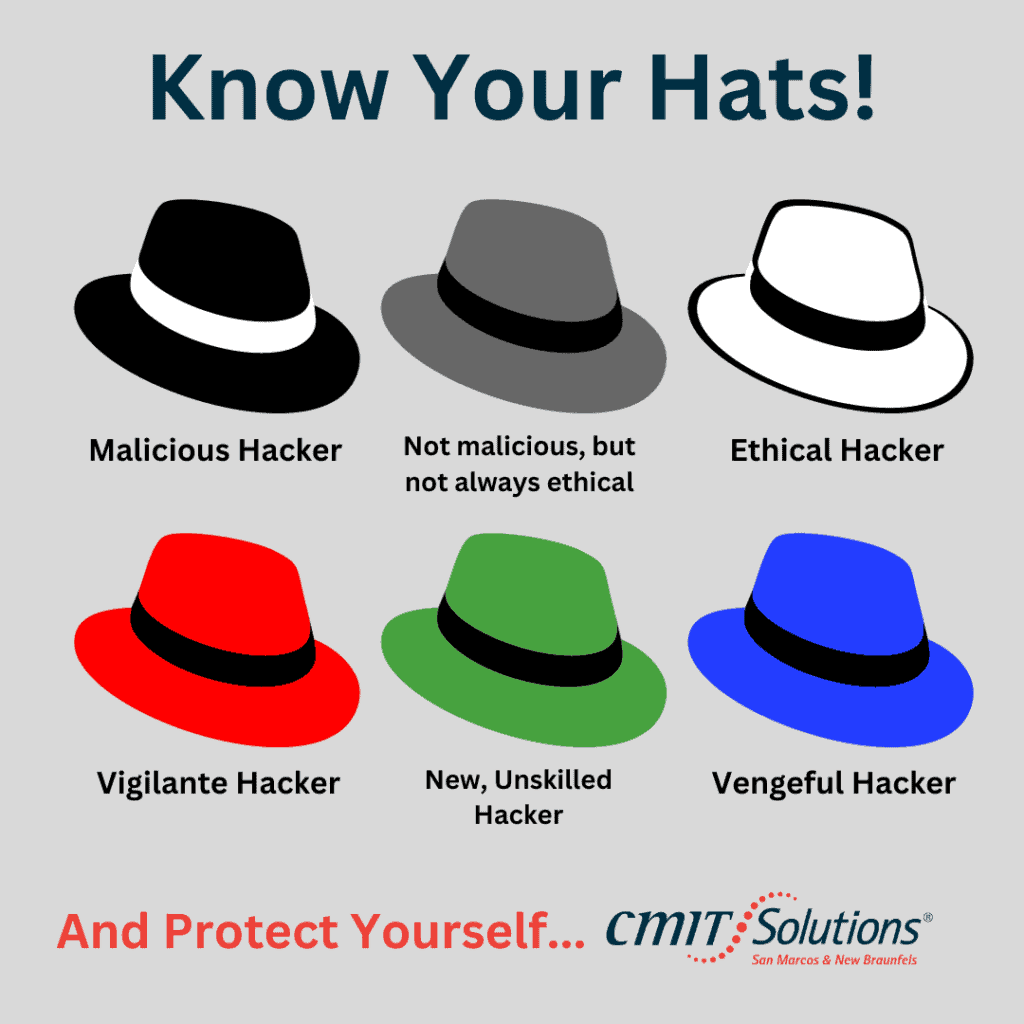
Do you ever wonder who is behind all those cyberattacks that steal private information or cause mayhem online? Well, there are many different types of hackers out there, from black hats to red hats and everything in between.