What Our San Marcos and New Braunfels Clients Actually Say
Most businesses that call us were sent by someone they already trust. So here are three local clients, a clinic, a law firm, and a historic hotel, in their own words.
Fastest Labs
Vanessa Dean runs Fastest Labs of New Braunfels, where stalled software means sensitive patient work stops. She had already spent hours, across more than one day, with the software vendor’s support team.
“I sat with the support staff for that technology for hours, even days at a time, and then finally called CMIT and they fixed it literally within 30 minutes.”
Vanessa Dean, Fastest Labs Fastest Labs has since brought us in to support a second clinic.
Davidek Law Firm PLLC
Dirk R. Davidek is Director of Operations at Davidek Law Firm in New Braunfels. When systems go down, billable work stops, but client deadlines don’t.
“They are right on top of everything, very responsive. If we have any issue at all, they get it taken care of really quickly.” Dirk R. Davidek, Davidek Law Firm PLLC
The Faust Hotel
Brandi White manages a historicboutique hotel in New Braunfels with a restaurant, bar, and brewery attached. We have been their IT provider for eight years.
“They maintain all of ourbackups, all of ourfirewalls, and anything that we need that is IT related. They’re always just a phone call away and they’re our ‘go-to’.” Brandi White, The Faust Hotel
Ask for references
If you’re choosing an IT partner, ask to talk to their clients. Ask how problems were handled and what the first few months were like. You’ll learn more from that than from any list of services.
And if Cybersecurity Awareness Month has you looking at your own setup, a free 30-minute assessment is a good place to start. We’ll show you where things stand today and what we’d improve first.
Read more local reviews at cmitsolutions.com/sanmarcos-tx-1047/client-reviews/, or call (830) 515-4151 to talk with our team.
1. Why do client reviews matter when choosing an IT provider? +
Client reviews show what happens after the contract is signed. They can reveal how responsive the provider is, how well the team communicates, whether promises are followed through, and how problems are handled in real situations.
2. What should I ask an IT provider’s references? +
Ask how quickly issues were handled, how the provider communicated during problems, what onboarding was like, and whether support improved over time. One of the most useful questions is whether the client would choose the same provider again.
3. Is a long-term client relationship a good sign? +
Generally, yes. A long relationship can indicate that the provider has continued to deliver value, adapt to changes, and maintain trust. Expanding the relationship to additional offices or services can be another positive sign.
4. How can I tell whether a testimonial is genuine? +
Look for a real name, organization, role, and specific details about the experience. Public testimonials with clear attribution are generally more useful than anonymous statements with no context.
5. What does a managed IT provider actually do? +
A managed IT provider takes ongoing responsibility for areas such as technical support, system monitoring, maintenance, cybersecurity, backups, updates, and technology planning. The goal is to prevent problems where possible and respond quickly when issues occur.
6. How is managed IT different from calling someone when something breaks? +
Break-fix support reacts after something fails. Managed IT is continuous, with monitoring, maintenance, security, and ongoing support designed to catch issues earlier and provide more predictable service and costs.
7. Why can vendor support alone fall short? +
Software vendors usually focus on their own product. When an issue involves multiple applications, devices, networks, accounts, or configurations, a broader IT provider can investigate how the whole environment works together.
8. What does responsive IT support mean in practice? +
Responsive support means requests are acknowledged quickly, someone takes ownership, and the issue is either resolved or clearly updated without requiring repeated follow-up from the client. Ask prospective providers how they measure response and resolution times.
9. Why do clinics need specialized IT support? +
Clinics depend on reliable access to systems while handling sensitive patient information. Downtime, security gaps, and access problems can interrupt care and create compliance risk, so IT support needs to account for both operational and security requirements.
10. What IT concerns are most important for law firms? +
Law firms depend on confidentiality, availability, secure access, dependable backups, and fast support. Technology problems can interrupt billable work and affect client trust, making reliability and cybersecurity especially important.
11. What does IT support look like for a hospitality business? +
Hotels, restaurants, and similar businesses often rely on reservations, payment systems, wireless networks, guest connectivity, point-of-sale systems, and other connected technology. They need secure networks, dependable backups, and support that is easy to reach when problems affect operations.
12. Can one IT provider support different types of organizations? +
Yes, provided the provider adapts its approach to each organization’s needs. A clinic, law firm, professional office, and hospitality business may all require reliable IT, but their compliance requirements, workflows, risks, and priorities can be very different.
13. Why are backups important for every business? +
Backups provide a recovery path after hardware failure, accidental deletion, ransomware, or other disruptions. A backup should also be monitored and tested so the business knows the data can actually be restored when needed.
14. What does a firewall do? +
A firewall controls traffic between your network and other networks, including the internet. It can help block unauthorized connections and enforce security rules, but it also needs proper configuration, updates, and monitoring to remain effective.
15. What is Cybersecurity Awareness Month? +
Cybersecurity Awareness Month is observed each October and encourages individuals and organizations to review online safety and cybersecurity practices. Businesses often use it as a reminder to assess their current protections and identify gaps.
16. Why is October a good time to review IT security? +
October provides a natural checkpoint before year-end. Reviewing security controls, backups, access, risks, and responsibilities at this point can leave time to address important gaps before the next busy period.
17. What happens during a free 30-minute IT assessment? +
A short IT assessment is an opportunity to discuss your current technology environment, recurring problems, security concerns, and business priorities. The goal is to identify practical opportunities to improve reliability, security, and day-to-day performance.
18. Do I need to switch IT providers to get an assessment? +
No. An assessment can simply help you understand your current position. You can use the findings to decide whether improvements are needed and whether changing providers would actually offer meaningful value.
19. How do I know when it is time to change IT providers? +
Warning signs can include slow responses, recurring unresolved issues, unclear communication, poor documentation, unexpected costs, and a sense that nobody is taking responsibility for the overall technology environment.
20. What should I look for in a local IT partner? +
Look for responsive support, clear communication, relevant industry experience, strong client references, long-term relationships, practical cybersecurity knowledge, and a willingness to explain recommendations in plain language. A strong local IT partner should understand both your technology and how your business actually operates.
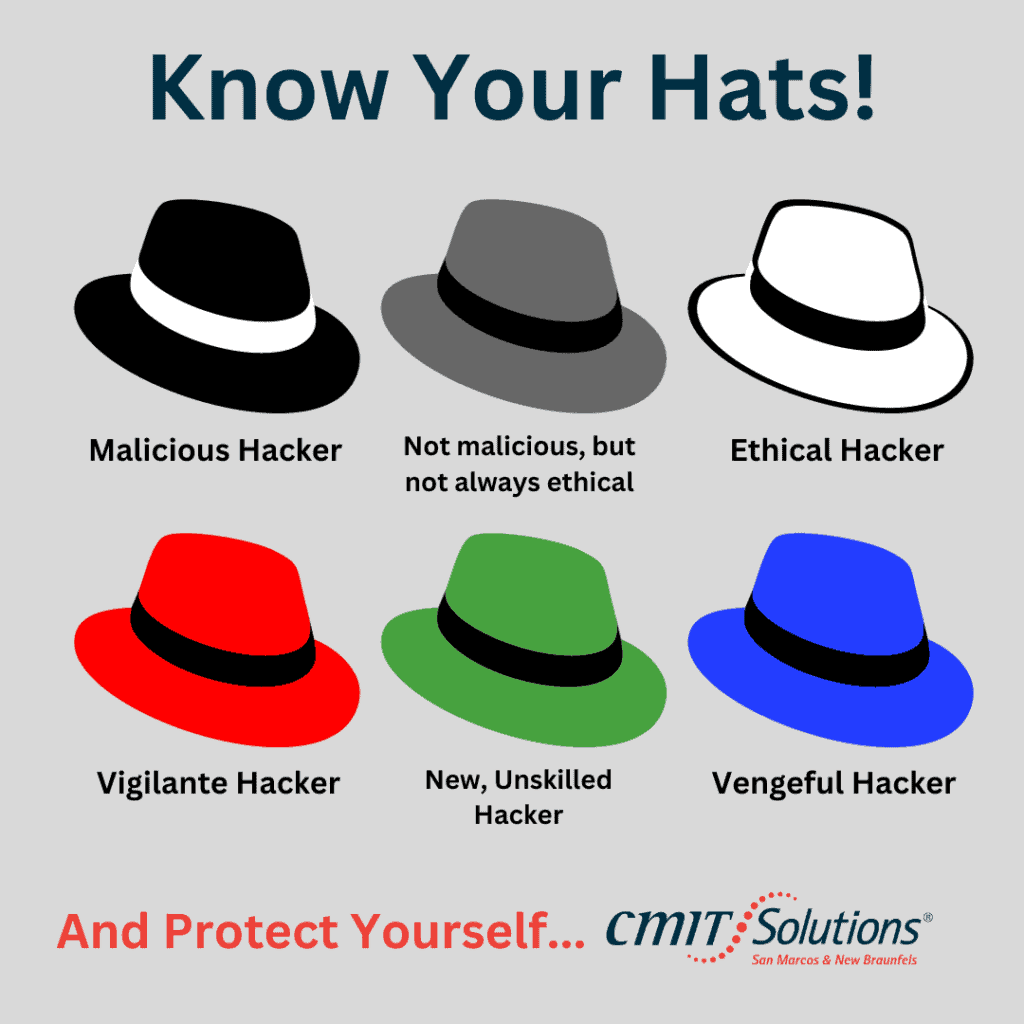
Do you ever wonder who is behind all those cyberattacks that steal private information or cause mayhem online? Well, there are many different types of hackers out there, from black hats to red hats and everything in between.