
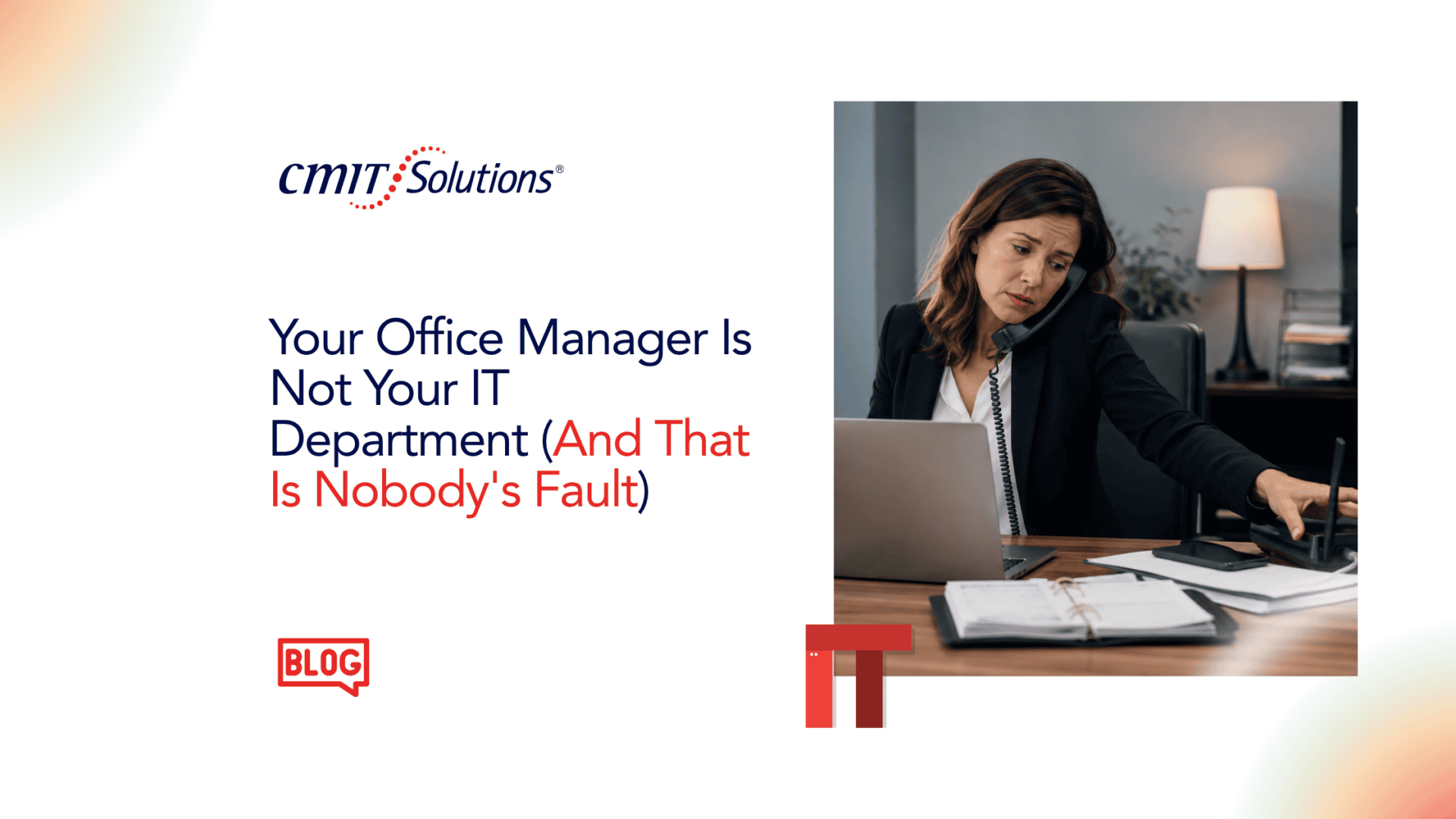
It started with one password reset
Nobody called a meeting and decided that the person who runs your front office would also run your technology. There was no job posting for it. No title change. No conversation.
Somebody just needed a password reset one Tuesday, and the person closest to the problem figured it out. Then it was the printer. Then setting up the new hire’s laptop. Then the phone system, the shared drive, and that one integration somebody configured two years ago that nobody has touched since. Every single request was small. Every one of them was faster to handle than to explain to someone else. And now, a few years and a dozen new employees later, you have a person whose actual job is operations spending a real slice of every week on technology nobody trained them for.
If that sounds like your business, we want to say something plainly before anything else. Nobody made a mistake here.
What actually happened is that you grew
When there were eight of you, the informal arrangement worked fine. Eight people generate a handful of technology questions a month. One capable person with good instincts and a search engine can absolutely handle that on top of their real job.
The trouble is that technology work does not scale in a straight line with headcount. It compounds. Twenty-five people are not three times the support load of eight. They are considerably more, because twenty-five people means more devices, more accounts, more software, more vendors, more logins to keep track of, more people who need access to more things, and more places where two systems have to be persuaded to talk to each other.
Somewhere on that growth curve, the arrangement quietly stopped working. It rarely announces itself. There is no single day when the printer question becomes an infrastructure question. It just gets heavier, week over week, until the person carrying it is behind on the work they were actually hired to do.
That is a capacity problem. It is not a competence problem, and the difference is worth being precise about, because the people in this situation almost always blame themselves.
How to tell the difference
A competence problem looks like someone doing a job badly. A capacity problem looks like someone doing a job well right up until there is more of it than one person can hold. The signs are usually operational rather than technical:
- Onboarding a new hire takes days longer than it should, because the setup steps live in one person’s head instead of in a documented process.
- Projects your operations lead owns keep sliding, and the reason is always something technology-shaped.
- Nobody can say with certainty when your backups were last tested, or by whom.
- When your accidental IT person takes a real vacation, small problems wait for them to get back.
- Software renewals arrive as surprises rather than as line items somebody planned for.
None of those are failures of skill. They are all the same failure of arithmetic. One person, finite hours, a workload that grew past both.

The part that usually goes unmeasured
Most businesses in this position can tell you what they spend on technology. Far fewer can tell you what the arrangement costs them, because the largest line item never shows up on an invoice.
It is the work your operations person did not get to. The report that went out at the last possible hour. The process improvement that has been on the list since spring. The client follow-up that slipped a week. Those hours were spent. They were just spent on the wrong thing, and they were the hours you were paying for in the first place.
The second unmeasured cost is concentration. When one person holds all the context, the context is not written down anywhere. That is fine right up until the day it is not.
Getting help is not the same as replacing anybody
This is where the conversation stalls in a lot of businesses, and we understand why. If the person who has been holding your technology together hears that you are bringing in an IT company, it is easy for that to sound like a verdict on them.
It is not, and the good version of this arrangement does not work that way.
Most of the growing businesses we work with keep their internal person exactly where they are. What changes is the load. The routine work comes to us: monitoring, patching, backups, account and password management, new-hire setup, the ticket queue, and the vendor calls nobody enjoys making. Your person keeps the institutional knowledge, keeps the relationships, and gets their calendar back.
Some businesses want us to take the whole thing, which is what our managed IT services cover. Others want a co-managed arrangement where we carry the depth and the volume while their person stays the first point of contact internally. Both are normal. Which one fits depends on your size, your team, and how much of the job your internal person actually wants to keep.
Why this comes up so often around New Braunfels and Seguin
We see this pattern all over New Braunfels, Seguin, San Marcos, and Kyle, and around here it usually looks a little different. It is often a family-owned business where the technology job has been passed around for years. It went from the founder to a son-in-law to whoever on staff was best with computers, and each handoff came with a little less context than the one before it.
That history is not a problem to be embarrassed about. It is just history, and it means nobody currently holding the job ever got a clean start with it.
Being local matters more here than it sounds. When something needs hands on it, somebody drives over. When your team has a question, they are talking to neighbors who already know your environment rather than to a queue that starts from zero every time.

A straightforward conversation, no obligation
If any of this landed a little too accurately, the next step does not have to be a decision. It can just be a conversation.
CMIT Solutions of San Marcos & New Braunfels offers a free thirty-minute IT assessment. We will look at how technology is actually being handled in your business right now, tell you plainly what we see, and give you a straight read on your options. No pressure, no long-term contract, and no obligation to do anything at all with what you learn.
Request Your Free IT Assessment
Frequently Asked Questions