“Technology is a useful servant but a dangerous master.” – Christian Lous Lange. Artificial intelligence is no exception. While AI is revolutionizing how we work — boosting efficiency, accuracy, and creativity — it’s also introducing new risks that businesses can’t afford to ignore. From external threats like deepfakes and AI-powered scams to internal challenges such as unclear usage policies and data mishandling, AI’s power cuts both ways.
This week, we’re breaking down three emerging AI risks — and how your business can stay protected while using AI responsibly.
AI-Generated Scam Calls
In a story reported on October 20th, a mother in Buffalo NY received a chilling call no parent ever wants to hear; it was her son’s voice, pleading for help and claiming he’d been kidnapped. The voice sounded exactly like him. But something didn’t add up. The family quickly checked her son’s phone location and confirmed by calling his own cell that he was exactly where he was supposed to be.
That’s when the truth set in — the voice on the line wasn’t her son at all. It was an AI-generated clone, engineered by scammers to sound real, trigger fear, and pressure victims into paying before they could verify what was happening.
Why It Matters
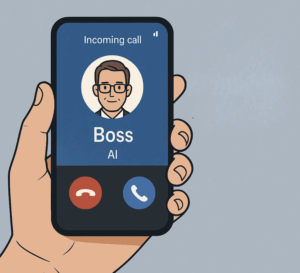
AI voice cloning and generative audio tools make it easier than ever for attackers to impersonate trusted contacts. What started as a scam targeting a worried parent could just as easily fool an employee — a voice that sounds exactly like your boss calling with an urgent request. Traditional cues like caller ID or familiar numbers are no longer enough; when someone sounds real, the sense of authenticity is dangerously high.
How to Stay Safe
- Be cautious with your voice: Avoid posting long voice clips or detailed voicemail greetings — and don’t engage with unknown callers who might be recording you. Scammers only need a few seconds of audio to clone your voice.
- Pause before you act: If a call feels off — even if it sounds familiar — hang up and verify through a known number or secondary channel before responding.
- Educate your team: Make staff aware of voice-cloning scams and establish “safe words” or callbacks for sensitive situations.
Fake Invoices and AI-Created Documents
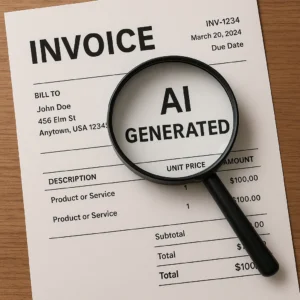
Just as AI can convincingly mimic a familiar voice, it can now forge documents with the same level of realism. Businesses are now seeing a sharp rise in fraudulent expense receipts and fake invoices created via AI, as reported by Financial Times on Sunday (Oct. 26). Software provider AppZen found that AI-generated receipts recently accounted for about 14% of fraudulent document submissions, up from near zero the previous year.
Another noted a fintech company flagged more than $1 million of fraudulent invoices within just 90 days (PYMNTS). These documents are extremely realistic — mimicking logos, signatures, paper textures and detailed line-items. Modern large-language models (for example, GPT-4) have drastically lowered the time and skill needed to produce them. Where fraudsters once had to design convincing fakes by hand, they can now generate polished, believable invoices and receipts in seconds with a few well-crafted prompts.
Why It Matters
Businesses stand to lose real money if they aren’t cautious about what they approve. AI-generated invoices and expense receipts can slip through routine reviews, especially when they appear to come from trusted vendors or employees. Without a healthy dose of skepticism — and clear verification steps — even one fraudulent payment can lead to costly losses and damaged trust.
How to Stay Safe
- Require direct vendor verification: Before paying a new vendor or changed details (bank account, address), call a known vendor number and confirm the details.
- Use metadata and anomaly detection: Leverage software that checks hidden metadata, image origin, unusual invoice patterns or changes from normal vendor behavior.
- Maintain expense and invoice policies: Make it clear what documentation is acceptable, and train employees on the risk of sleek-looking fake documents.
AI Use Policies and Data Leaks
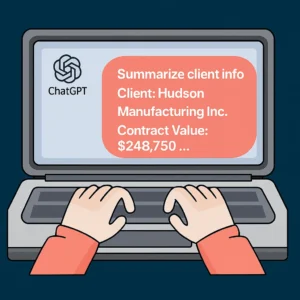
Alongside external threats like fake invoices and cloned voices, AI is also creating internal risks through everyday employee use. A study by TELUS Digital found 57 % of employees admit to inputting sentsitive information into AI assistants. The most common types of data shared include personal details like names and emails (31%), confidential product or project information (29%), and customer records (21%). This growing risk underscores the need for clear guidelines and employee training — yet only 24% of employees say their company provides mandatory AI training, and nearly half don’t know whether any AI policies even exist (TELUS Digital).
Why It Matters
Generative AI tools make it easier than ever for employees to paste sensitive corporate data (client names, contract values, financial figures, internal strategy) into chatbots or image-generation apps — often without any oversight. Once that data is outside controlled systems, the risk of leak, misuse or exposure increases significantly. Without policy, training, and monitoring, the convenience of AI becomes a vulnerability.
How to Stay Safe
- Draft and enforce a clear AI-use policy: Define which AI tools are approved, specify what data may not go into free or unvetted tools, and communicate acceptable vs. prohibited usage.
- Provide mandatory training: Ensure all employees understand how to safely use AI, what risks exist (data retention, third-party access, false content), and how the policy applies to them.
- Review and update: AI is evolving fast. Regularly revisit your AI policy, risk-assess new tools, and update your guidance accordingly.
The Bottom Line
AI is reshaping cybersecurity — making scams faster, fakes more convincing, and data exposure easier than ever. But with the right mix of awareness, policy, and verification, businesses can stay one step ahead.
At CMIT Solutions of Northern Westchester & Putnam, we help local businesses build layered defenses that protect against evolving AI-powered threats — from phishing prevention and network security to employee training and policy guidance. Need help reviewing your cybersecurity posture or AI-use policy? Schedule a free consultation today or call us at (203) 443-1646