
Accounting firms are no longer just financial advisors. They are data vaults. From tax records and payroll data to financial forecasts and client identities, accounting firms hold some of the most sensitive business information in the ecosystem. And in 2026, that makes them a primary target for cyberattacks.
The problem is not awareness. Most firms know cybersecurity matters. The gap is in execution. Firms are still relying on outdated systems, fragmented tools, or reactive IT setups that cannot keep up with modern threats. This is why demand for accounting IT support in Orange County has sharply increased, especially among small to mid-sized firms that cannot afford a breach.
Why Accounting Firms Are Prime Targets in 2026
Cybercriminals are not attacking randomly anymore. They are targeting industries where data equals money. Accounting firms sit at the center of that equation.
They handle:
- Direct financial access and transaction data
- Personally identifiable information (PII)
- Corporate financial records
- Tax filings and compliance documentation
A single breach does not just expose data. It opens doors to fraud, identity theft, and financial manipulation. In Orange County, where many firms operate with lean teams, attackers often exploit weak IT infrastructure rather than breaking advanced systems.
This is where cybersecurity solutions near me Orange County searches have surged. Firms are actively looking for localized, fast-response security partners who understand their environment.
The Biggest Cybersecurity Risks Accounting Firms Face
The threats in 2026 are more sophisticated, but the entry points are often simple.
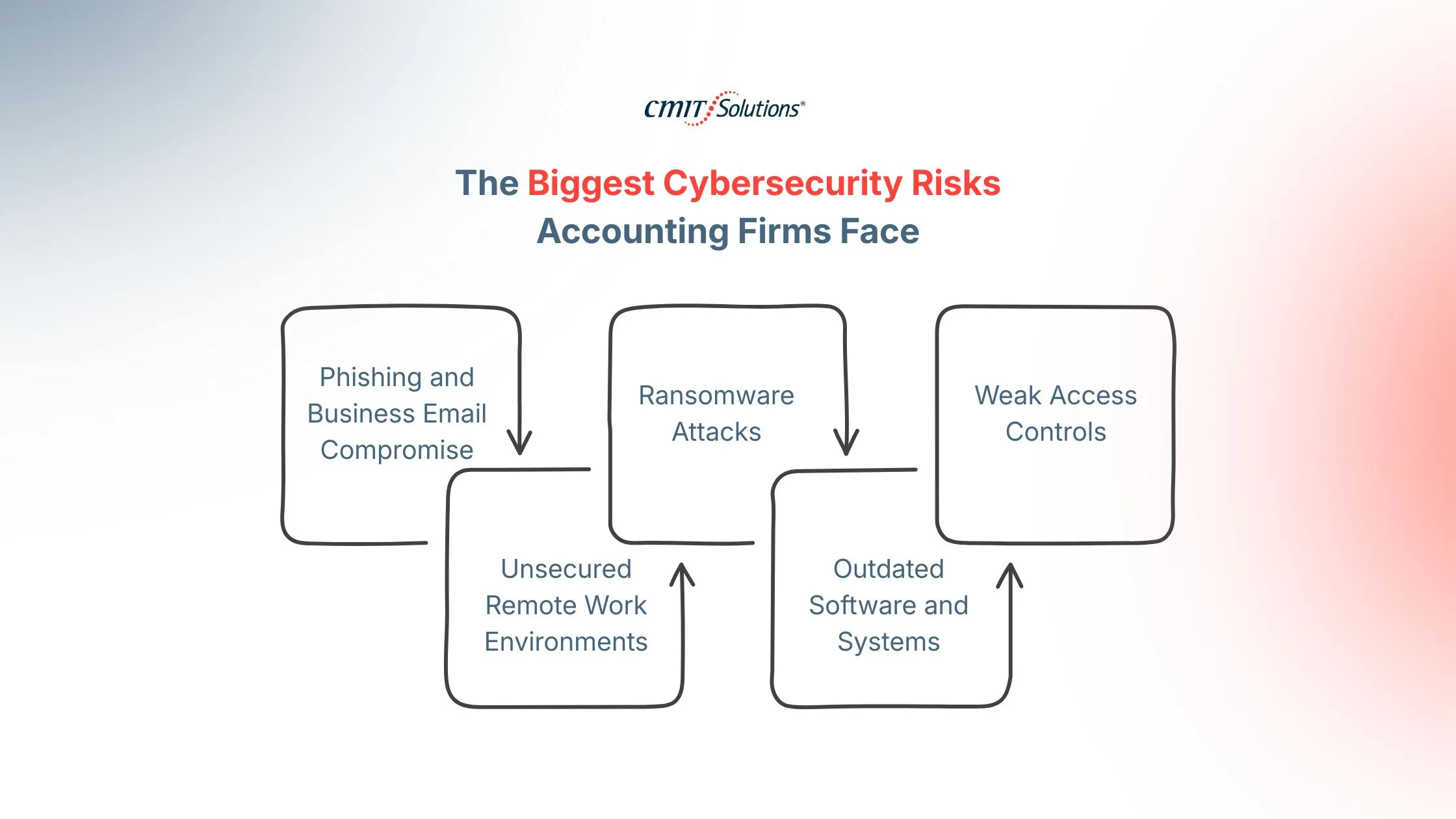
1. Phishing and Business Email Compromise
Attackers are targeting accounting professionals with highly personalized emails that mimic clients, vendors, or internal stakeholders. One click can expose login credentials or trigger fraudulent transactions.
2. Ransomware Attacks
Accounting firms are ideal ransomware targets because downtime is expensive. Especially during tax season. Attackers encrypt systems and demand payment, knowing firms cannot afford delays.
3. Weak Access Controls
Many firms still lack proper role-based access systems. Employees have more access than they need. This increases both internal risk and external vulnerability.
4. Unsecured Remote Work Environments
Remote and hybrid setups have expanded attack surfaces. Without proper endpoint security, employees working from home can unknowingly expose firm systems.
5. Outdated Software and Systems
Unpatched systems are one of the easiest ways for attackers to gain access. Firms relying on legacy accounting tools or delayed updates are at higher risk.
Where Most Accounting Firms Get It Wrong
The biggest mistake is treating cybersecurity as a one-time setup. Installing antivirus or firewall systems is not enough. Security needs to be continuous, monitored, and adaptive. Yet many firms still rely on:
- One-time IT setup with no ongoing monitoring
- Internal teams without cybersecurity specialization
- Basic tools instead of layered security frameworks
- Reactive support that only responds after incidents
This is why firms are shifting toward an IT services and cybersecurity provider model instead of piecing together multiple vendors.
The Rise of AI-Driven Threats and Why Firms Must Respond
Cyber threats are evolving with AI. Attackers are now using automation to scale attacks and personalize them. At the same time, firms are adopting tools like the Orange County accounting AI phone system to automate client communication and workflows.
While these systems improve efficiency, they also introduce new risks if not properly secured. AI-driven systems need:
- Secure integrations with existing IT infrastructure
- Controlled data access and permissions
- Monitoring to detect unusual behavior patterns
Without proper oversight, automation can amplify vulnerabilities instead of solving them.
What a Secure Accounting IT Infrastructure Should Include
A strong cybersecurity foundation is not one tool. It is a coordinated system. An experienced accounting IT support Orange County provider typically builds:
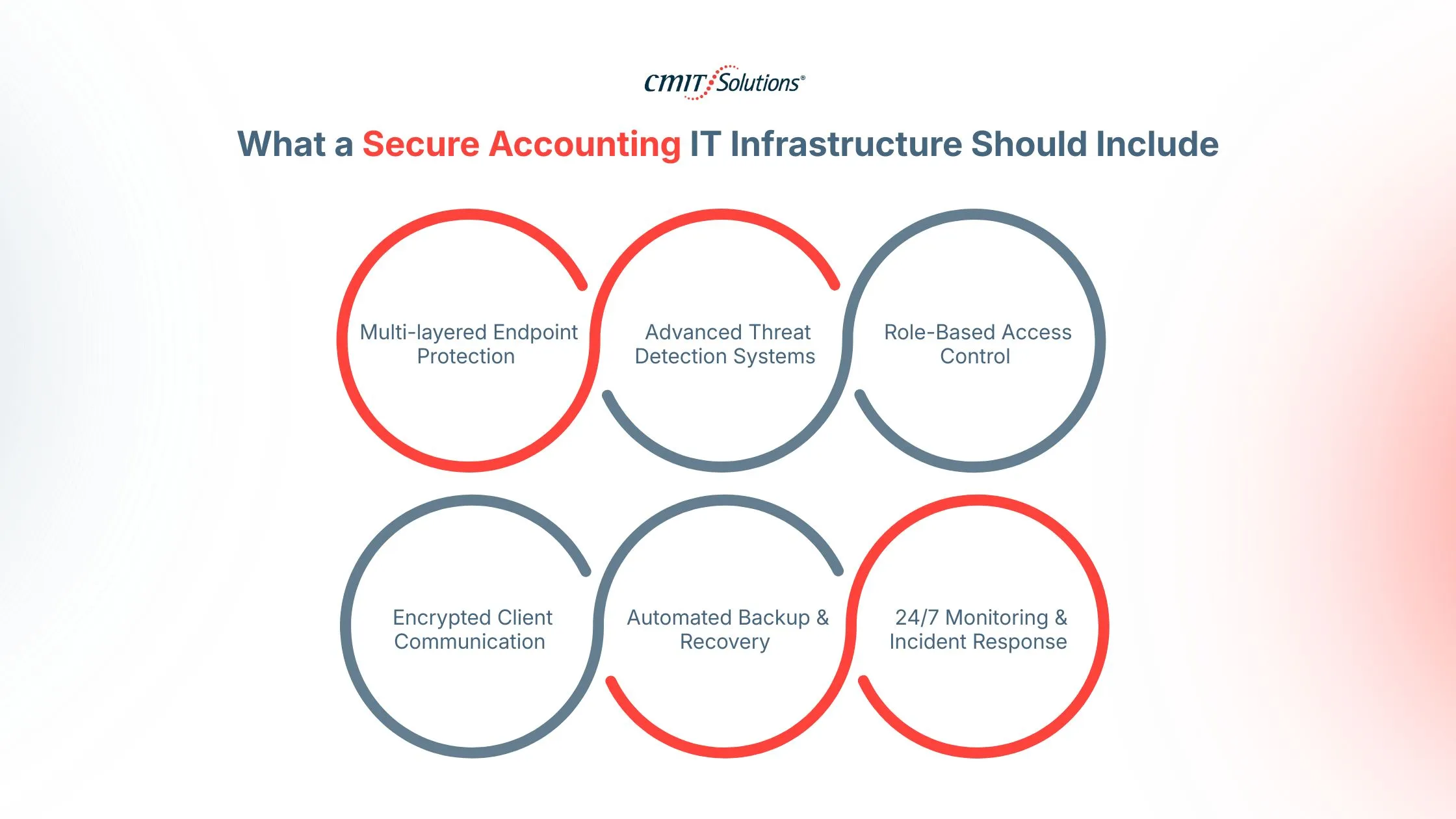
- Multi-layered endpoint protection across all devices
- Advanced threat detection systems beyond basic antivirus
- Role-based access controls to limit data exposure
- Encrypted communication systems for client interactions
- Automated backup and disaster recovery systems
- Continuous monitoring and incident response frameworks
The goal is simple. Reduce risk at every layer instead of relying on a single line of defense.
Why Local Expertise Matters in Cybersecurity
Many firms consider remote or offshore IT solutions to reduce costs. But cybersecurity is not just technical. It is contextual. Working with providers familiar with cybersecurity Anaheim and local compliance requirements ensures:
- Faster on-site support when needed
- Better understanding of regional regulations
- Real-time response during incidents
- Tailored solutions for local business environments
This is why Anaheim cybersecurity companies are increasingly preferred by accounting firms that prioritize reliability over cost-cutting.
Proactive vs Reactive Security: The Cost Difference
The real cost of cybersecurity is not in prevention. It is a failure. Here’s how the two approaches compare:
Reactive Security (Traditional Approach)
- Issues are addressed after they occur
- No continuous monitoring
- Higher downtime during incidents
- Increased financial and reputational risk
Proactive Security (Managed IT Approach)
- Threats are detected early or prevented
- Systems are monitored 24/7
- Faster incident response
- Lower long-term risk and cost
For accounting firms, where trust is everything, proactive security is not optional.
Key Signs Your Accounting Firm Is at Risk
Many firms assume they are secure because nothing has happened yet. But risk often exists quietly. Watch for these warning signs:
- No clear visibility into system activity or logs
- Employees using personal devices without security controls
- Lack of structured backup and recovery plans
- No regular security audits or vulnerability testing
- Dependence on outdated software or unsupported systems
If even two or three of these exist, your firm is already exposed.
Choosing the Right Cybersecurity Partner in Orange County
Not all IT providers understand accounting workflows or compliance requirements. When evaluating cybersecurity solutions near me Orange County, look for:
- Experience with accounting and financial systems
- Strong cybersecurity frameworks, not just basic IT support
- Clear response protocols for incidents
- Transparent reporting and monitoring dashboards
- Scalable solutions as your firm grows
The right partner does not just secure your systems. They enable your firm to operate confidently.
Final Take: Cybersecurity Is Now a Business Function
In 2026, cybersecurity is not an IT issue. It is a business decision. Accounting firms that invest in structured, proactive systems are not just protecting data. They are protecting client trust, operational continuity, and long-term growth.
Those relying on outdated or fragmented setups are operating with invisible risk that can surface at any time. If your current setup cannot clearly answer how your systems are monitored, protected, and recovered during an attack, then it is already a liability. Working with a trusted accounting IT support Orange County provider or an experienced IT services and cybersecurity provider ensures your firm is not just compliant, but resilient. Because in accounting, security is not a backend function. It is the foundation of trust.
FAQs
1. Why do accounting firms in Orange County need cybersecurity services?
Accounting firms handle sensitive financial and client data, making them prime targets for cyberattacks. Professional cybersecurity services help prevent breaches, protect client information, and ensure compliance with financial regulations.
2. What should accounting IT support in Orange County include?
A reliable accounting IT support provider should include 24/7 monitoring, endpoint protection, secure backups, email security, multi-factor authentication, and fast incident response to protect against modern cyber threats.
3. How can small accounting firms prevent ransomware attacks?
Small firms can prevent ransomware by implementing multi-layer security, regular backups, employee phishing training, and continuous monitoring through a trusted IT services and cybersecurity provider.
4. How do I choose the right cybersecurity provider near me in Orange County?
Look for a provider with experience in accounting systems, proactive monitoring, fast response times, compliance knowledge, and scalable solutions tailored for small and mid-sized firms.
5. How can I secure my accounting firm’s IT systems today?
Start with a professional security assessment. A local IT support provider can identify vulnerabilities, strengthen protection, and build a secure, compliant IT environment for your firm.