
Artificial intelligence has quickly moved from an emerging technology to an everyday business tool. Employees are using generative AI platforms to write emails, summarize documents, analyze spreadsheets, create presentations, research prospects, generate code, and automate repetitive tasks. For small and midsize businesses, AI tools for small business can improve productivity without requiring major technology investments.
But there is another side to rapid AI adoption.
Every new AI tool introduced into a business can create another place where company information is entered, processed, stored, or shared. When employees start using these tools without clear policies or security oversight, businesses can unintentionally expose sensitive information. That makes AI cybersecurity risks for small businesses an increasingly important issue.
For Orange County SMBs, adopting AI safely does not mean avoiding the technology. It means understanding where the risks exist and putting practical security controls around how AI is used.
Why AI Changes the Cybersecurity Risk for Small Businesses
Most businesses already manage cybersecurity risks across email, cloud applications, employee devices, passwords, networks, and third-party vendors. AI adds another layer.
An employee can copy information from an internal document and paste it into a generative AI platform within seconds. Teams can connect AI applications to business systems. Employees can create accounts for new AI tools without IT approval. AI-generated emails, documents, and code can also introduce inaccurate or unsafe information into normal workflows. The problem is not necessarily AI itself. It is uncontrolled AI adoption. This is one reason AI security for small businesses needs to become part of the broader cybersecurity strategy rather than being treated as a separate technology initiative.
1. Sensitive Business Data Can End Up in AI Tools
One of the biggest data security risks of AI comes from what employees enter into AI platforms. Consider the information employees work with every day:
- Customer records and personally identifiable information
- Contracts and confidential documents
- Financial information
- Internal reports
- Proprietary business information
- Employee records
- Credentials or technical information
An employee trying to save time might paste some of this information into an AI tool to summarize, rewrite, analyze, or categorize it. Once information leaves an organization’s controlled environment, the business needs to understand how that AI provider processes, retains, and protects it. This is why AI data privacy risks should be addressed before teams widely adopt generative AI tools.
Businesses should establish clear rules defining what employees can and cannot share with AI platforms.
2. “Shadow AI” Can Create Security Blind Spots
Many organizations are already familiar with shadow IT, where employees adopt applications or software without approval from IT.
AI has created a similar problem: shadow AI. An employee finds an AI application that makes a task easier, creates an account, and starts using it. The business may have no visibility into the application, what information is being shared, what permissions have been granted, or whether the vendor meets the organization’s security requirements.
Multiply that behavior across an entire company and the security environment becomes difficult to manage. Shadow AI risks are particularly important for SMBs because smaller businesses may not have dedicated security teams continuously reviewing new applications. Creating an approved list of AI tools can significantly reduce this exposure.
3. Cybercriminals Can Use AI to Make Phishing More Convincing
AI is not only helping legitimate businesses work faster. Attackers can use the same technology. Traditional phishing emails sometimes contained obvious warning signs, including poor grammar, unusual wording, or generic messages. Generative AI makes it easier to create polished and highly personalized communications.
Attackers can potentially use publicly available information about an organization, its employees, leadership team, vendors, or customers to create more believable phishing messages. This changes the way businesses need to think about employee cybersecurity awareness.
Employees should verify unusual requests even when an email appears professional and contextually accurate. Financial requests, password resets, account changes, sensitive documents, and urgent executive requests deserve additional scrutiny. AI makes strong security processes more important because employees can no longer rely solely on spotting badly written phishing emails.
4. AI Accounts Can Become Another Identity Security Problem
Every business application introduces another identity that may need to be secured.
AI platforms are no different.
If employees create accounts using weak or reused passwords, organizations may introduce additional opportunities for account compromise. The risk becomes greater when AI applications connect with cloud storage, email, CRM platforms, development environments, or other business systems. Strong identity management should therefore be part of AI cybersecurity best practices.
Businesses should consider controls such as multi-factor authentication, approved business accounts, appropriate user permissions, access reviews, and removing access when employees leave the organization. The goal is to make AI applications part of the existing security framework instead of allowing them to operate outside it.
5. AI Outputs Should Not Automatically Be Trusted
Generative AI can produce convincing answers even when the underlying information is incorrect.
That creates another category of business risk. Employees may use AI-generated information in client communications, internal reports, technical configurations, software code, financial analysis, or decision-making. Without appropriate review, incorrect outputs can create operational or security problems. This becomes particularly important when AI is used for technical tasks. AI-generated code or configurations should be reviewed and tested before they are introduced into production systems. Employees should also understand that an AI-generated answer is not automatically a verified answer.
Human review remains an important security control.
6. AI Can Expand Third-Party Risk
Most SMBs already depend heavily on third-party technology providers. AI adoption expands that ecosystem further. Before approving an AI platform, businesses should understand basic questions such as:
What information will the platform access? How is business data handled? Can administrators control user access? What security features are available? Can the tool integrate with sensitive company systems? What happens to company information after it is submitted? These questions are part of broader vendor risk management and small business data protection.
Businesses do not need an overly complicated approval process for every new application. But someone should be responsible for understanding what a tool can access before it becomes part of everyday operations.
What Should Orange County SMBs Do Before Expanding AI Use?
The answer is not to block every AI platform. Instead, organizations need a practical framework that allows employees to benefit from AI services while protecting business information.
For companies developing an AI governance strategy for small businesses, a useful starting point includes:
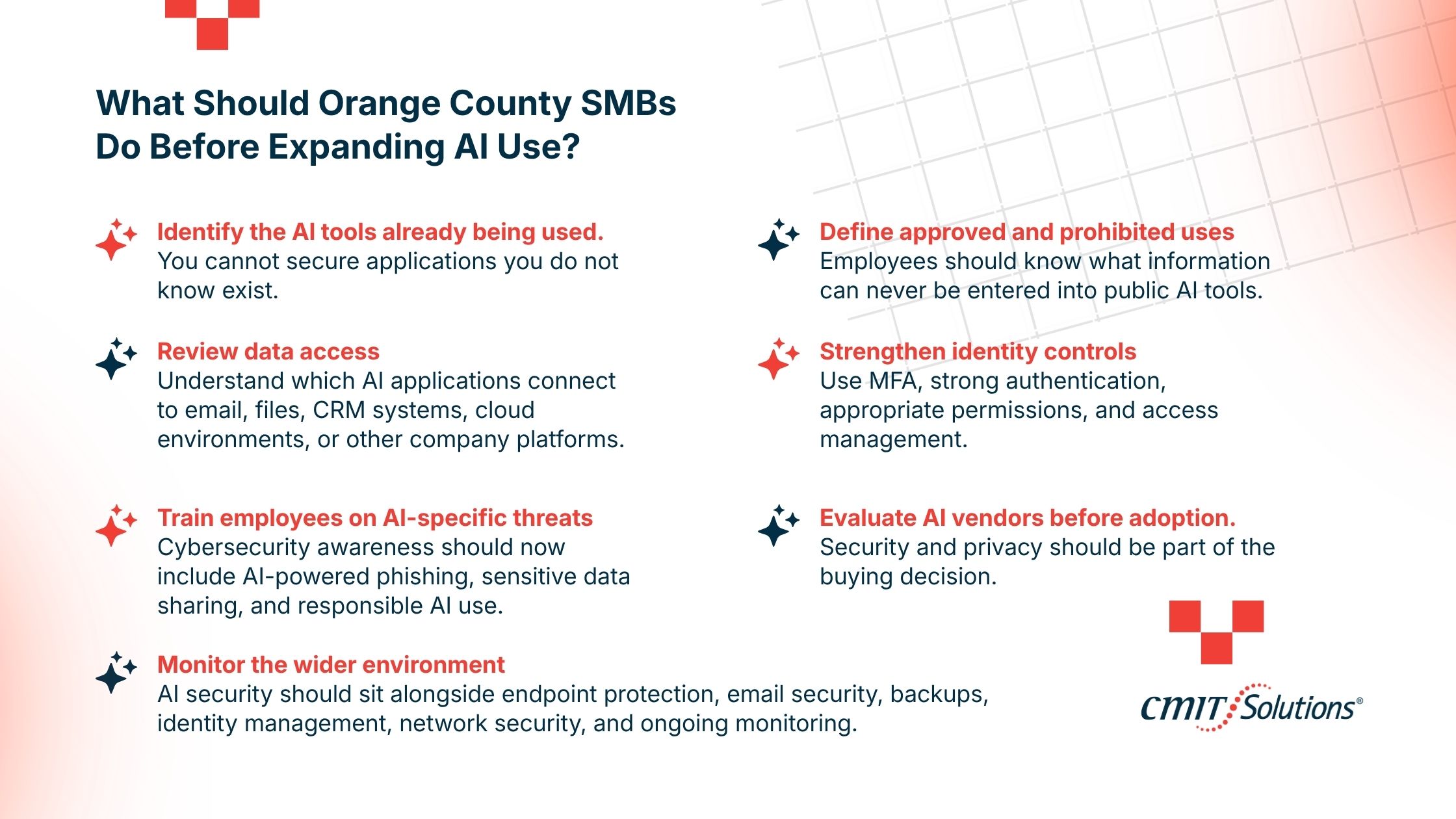
These controls help turn AI adoption from an unmanaged cybersecurity variable into a governed business capability.
AI Security Is Part of Cybersecurity, Not a Separate Project
The businesses getting the most value from AI will not necessarily be the ones adopting the largest number of tools. They will be the ones that know where AI is being used, what information it can access, and how that usage fits within their broader security environment. For many SMBs, that requires looking beyond individual AI applications and evaluating the complete technology environment.
CMIT Solutions of Anaheim West helps businesses evaluate cybersecurity risks, strengthen their IT environments, and build practical security measures around the technologies their teams use every day. For organizations looking for cybersecurity for small businesses in Orange County, this can include reviewing current security controls, identifying gaps, strengthening employee and identity security, and helping businesses prepare for new risks created by technologies such as AI.
Concerned about how AI adoption may be affecting your company’s security? Contact CMIT Solutions of Anaheim West to discuss your current IT and cybersecurity environment. Get a free 30-minute cybersecurity assessment to review AI usage, data protection, identity security, and other potential risks.
Frequently Asked Questions
What are the biggest AI cybersecurity risks for small businesses?
Some of the biggest AI cybersecurity risks include employees sharing sensitive information with AI tools, unauthorized AI applications, insecure accounts, AI-powered phishing, excessive application permissions, third-party data exposure, and employees relying on inaccurate AI-generated outputs.
Is ChatGPT a cybersecurity risk for businesses?
The technology itself is not automatically a cybersecurity threat. ChatGPT security risks for businesses can arise when employees enter confidential information without understanding how the tool should be used or when organizations have no policies governing generative AI use. Businesses should establish clear rules around sensitive data and approved AI platforms.
What is shadow AI?
Shadow AI refers to employees using AI tools or applications without the knowledge or approval of the organization or IT team. It can create security blind spots because the company may not know what information is being shared or what systems an application can access.
How can small businesses use AI securely?
Businesses can improve AI security for small businesses by creating AI usage policies, approving specific tools, restricting sensitive data sharing, using MFA, reviewing application permissions, training employees, evaluating vendors, and incorporating AI applications into existing cybersecurity monitoring.
Do Orange County SMBs need managed cybersecurity services for AI?
Not every business needs the same level of support. However, managed cybersecurity services in Orange County can help SMBs that do not have dedicated internal security resources assess their technology environment, identify security gaps, manage access, train employees, and develop security controls as AI adoption grows.


