
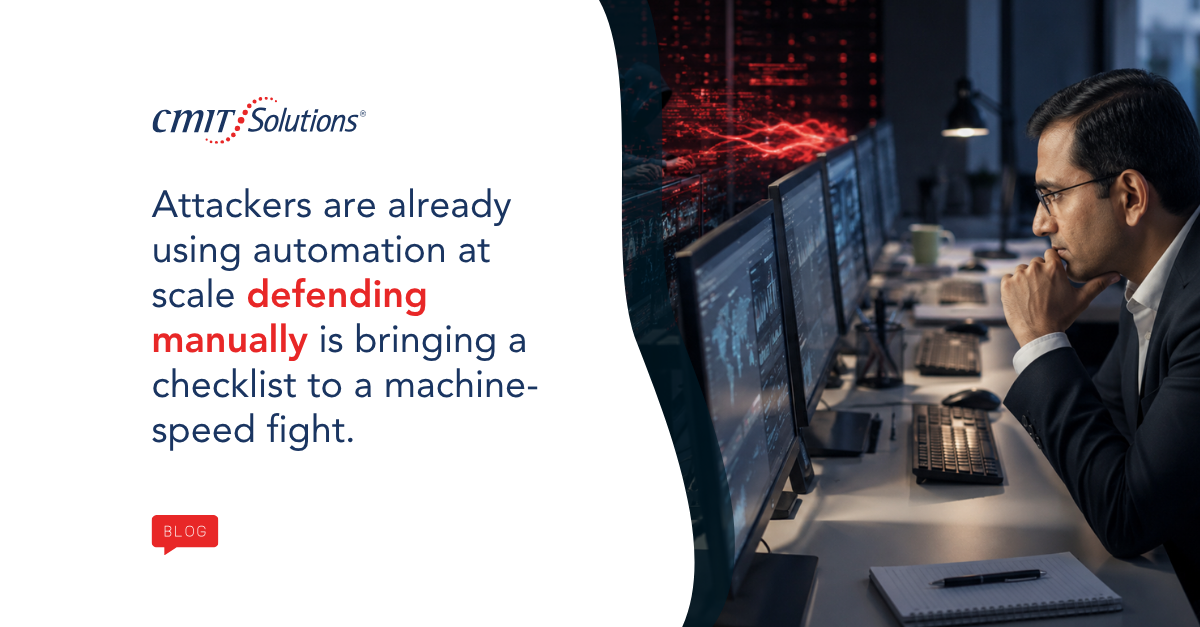
Cybersecurity used to be a problem you could approach with a checklist. Install antivirus. Set up a firewall. Train employees not to click suspicious links. Renew licenses annually. For most small and mid-sized businesses, that approach felt like enough, because the threat landscape moved slowly enough for reactive defenses to keep pace.
That era is over. Attackers now use artificial intelligence to craft phishing emails that bypass traditional filters, automate credential-stuffing attacks across thousands of accounts simultaneously, and adapt malware in real time to evade signature-based detection tools. The volume of attacks has increased, the sophistication has increased, and the speed at which incidents escalate from initial access to full network compromise has compressed from days to hours.
The response to an AI-powered threat landscape is AI-powered defense. For growing businesses across Central Texas, that means understanding what AI-driven cybersecurity actually looks like in practice, how it differs from traditional security tools, and how to build it into an IT environment that supports operations rather than complicating them. CMIT Solutions of Austin East as the local IT and cybersecurity partner helping businesses adopt AI-powered security.
Our East Austin IT support team works with growing businesses across industries, and the common thread in every serious security conversation right now is the same: the tools that protected businesses five years ago are not adequate against the threats businesses face today.
What AI Is Actually Doing on the Attacker’s Side
Before getting into defensive AI, it helps to understand how AI is being used offensively, because the threat model shapes the response.
Phishing at scale and with precision. Traditional phishing emails were easy to spot because they were generic and poorly written. AI-generated phishing content is grammatically perfect, contextually relevant, and often personalized using publicly available information about the target. An attacker can now generate hundreds of tailored phishing emails targeting specific employees at specific companies in the time it previously took to write one. This matters because phishing remains the most common entry point for ransomware and business email compromise attacks.
Automated vulnerability scanning. AI tools allow attackers to scan entire IP ranges for known vulnerabilities at a speed no human team could match. A misconfigured server, an unpatched software version, or an exposed remote desktop port that might have gone unnoticed for months in a slower threat environment can be discovered and exploited within hours of appearing online.
Adaptive malware. Traditionally, security tools detect malware by comparing code against a database of known malicious signatures. AI-powered malware can modify its own code structure in real time to avoid matching those signatures, making detection by traditional antivirus essentially impossible.
Credential stuffing and account takeover. AI tools automate the process of testing stolen credentials against hundreds of services simultaneously. Credentials from a data breach at one company are automatically tested against banking portals, cloud platforms, and business applications. Without multi-factor authentication, this process succeeds silently and at scale.
Understanding these attack vectors makes it clear why AI-powered defense is not a luxury upgrade. It is the appropriate response to an AI-powered offense. Our layered cybersecurity services are built around this threat model, incorporating tools and monitoring approaches that can actually keep pace with modern attack techniques.

What AI-Powered Defense Actually Looks Like
AI-powered cybersecurity for growing businesses is not a single product. It is a set of capabilities that, when properly integrated, create a security posture that can detect, respond to, and contain threats far faster than traditional tools allow.
Behavioral Detection Instead of Signature Matching
The most important shift in AI-powered security is the move from signature-based detection to behavioral detection. Signature-based tools ask: does this code match a known malicious pattern? Behavioral tools ask: does this activity match the way normal, legitimate processes behave?
This matters enormously in practice. When a new ransomware strain is released, traditional antivirus tools have no signature for it yet and will not detect it. A behavioral AI tool watching the same attack would see that a process is suddenly accessing and modifying thousands of files in rapid succession, which is not how legitimate software behaves, and would flag or block the activity immediately.
This capability is what modern endpoint detection and response tools deliver. Rather than relying on a database of known threats, they build a baseline of normal activity for each device and user and use AI to identify deviations from that baseline in real time.
Automated Threat Response
Speed is critical in cybersecurity incidents. The longer an attacker has access to a network, the more damage they can do. In a ransomware scenario, the period between initial access and full network encryption can be measured in hours if the attacker moves efficiently.
AI-powered security tools can respond in seconds rather than hours:
- Automatically isolating an infected device from the network the moment suspicious behavior is detected
- Blocking a login attempt that looks like credential stuffing before access is granted
- Revoking a session token when it exhibits behavior inconsistent with the normal user’s pattern
- Alerting security teams with full context about what happened and what has already been done to contain it
This automated response capability is what makes the speed difference between a contained incident that costs a few hours of investigation and an uncontrolled breach that costs weeks of recovery. Our data backup services sit alongside this detection and response layer as the fallback when prevention does not fully succeed.
AI-Enhanced Email Security
Email remains the primary attack surface for growing businesses. AI-powered email security goes significantly beyond traditional spam filtering:
- Analyzing the writing patterns of known senders and flagging messages that appear to impersonate them even when the email address looks legitimate
- Detecting business email compromise attempts by identifying unusual requests, such as a finance team member suddenly receiving a wire transfer instruction from an executive email address they have not previously communicated with
- Scanning links at click time rather than at delivery time, catching malicious URLs that were clean when the email arrived but were changed to point to malicious content after delivery
- Identifying social engineering patterns in email content that traditional keyword-based filters miss
For industries where high-value transactions happen over email, this layer of protection is no longer optional. Our identity security guide covers how identity and communication security work together as a front door that attackers consistently target.
Continuous Network Monitoring and Anomaly Detection
Traditional network monitoring looks at connectivity and performance. AI-powered network monitoring looks at behavior: which systems are communicating with which other systems, how much data is moving between them, whether communication patterns match established baselines, and whether any device is attempting to access resources it has never accessed before.
This behavioral network monitoring is what catches lateral movement, the process by which an attacker who has compromised one device attempts to spread to other systems on the network before activating ransomware or exfiltrating data. Lateral movement generates behavioral anomalies that AI can detect, even when the tools the attacker is using appear legitimate.
Our network security management services incorporate continuous monitoring as a standard component, not a periodic audit.
Why Growing Businesses Specifically Need AI-Powered Security
There is a common misconception that AI-powered cybersecurity is only relevant for large enterprises with sophisticated IT teams. The opposite is closer to the truth. Growing businesses are disproportionately targeted and disproportionately harmed by cyberattacks for several reasons:
- They hold valuable data, including client records, financial information, and intellectual property, but typically have fewer security controls than enterprises
- They lack dedicated security staff, meaning that threats which a security operations center at a large company would detect and contain often go undetected for days or weeks in a smaller environment
- They are more likely to be in the supply chain of larger organizations, making them an attractive indirect attack path
- They have less financial resilience to absorb the cost of recovery from a major incident
AI-powered security tools address the staffing gap directly. Capabilities that would require a team of security analysts monitoring systems around the clock at an enterprise can be delivered to a growing business through managed security services powered by the same AI technology. The protection scales without requiring the business to hire a security team. CMIT Solutions of Austin East helps businesses deploy AI-powered cybersecurity solutions that scale with their growth
Our managed IT services programs incorporate AI-powered security tooling as part of a managed service relationship, so growing businesses get enterprise-grade detection and response capability without enterprise-grade IT overhead.
Industry-Specific Considerations
AI-powered cybersecurity has different implications across industries, both in terms of the threat profile and the compliance requirements that shape what defenses are necessary.
Healthcare and Medical Practices
Healthcare is one of the most targeted industries for ransomware, and the combination of sensitive patient data and life-critical operations creates maximum pressure to pay when an attack succeeds. AI-powered behavioral monitoring is particularly valuable in healthcare environments because it can detect abnormal access to patient records, such as a single user account suddenly accessing thousands of records it has no clinical reason to access, which is a pattern consistent with a data exfiltration attempt.
Law Firms and Legal Services
Law firms hold attorney-client privileged communications that are high-value targets for competitive intelligence gathering. AI-powered email security is especially important in legal environments because business email compromise attacks frequently target legal fee payments and trust account transactions, which involve large sums and time-sensitive deadlines that create pressure to act without full verification.
Financial Services and Investment Firms
Financial services firms face both the highest-value targets for fraud and some of the most specific regulatory requirements for security controls. AI-powered anomaly detection is increasingly expected, not just recommended, by regulators and examiners who understand that manual monitoring cannot keep pace with modern threat volume.
Construction and Engineering
Construction and engineering firms are targeted for business email compromise on high-value project payments and for intellectual property theft of proprietary designs and project bids. AI-powered email security and behavioral monitoring on devices that hold project files are the two highest-value additions to a typical construction or engineering IT environment.
Nonprofits and Education Organizations
Nonprofits and schools often operate with IT budgets that have not kept pace with the threat environment. AI-powered security is particularly valuable here because it delivers detection and response capability that these organizations could not staff themselves. The compliance angle also matters: organizations handling student, donor, or beneficiary data face increasing scrutiny around data protection practices.
Real Estate Firms
Real estate transactions involve large wire transfers, sensitive client financial information, and a high volume of time-pressured communication that creates exactly the conditions attackers exploit with AI-generated phishing and business email compromise. Our real estate IT guide covers how AI is changing both the threat and the defense landscape for real estate businesses specifically.
Compliance and AI Security
Across regulated industries, AI-powered security is increasingly not just a best practice but a compliance expectation. Regulators and auditors who understand the modern threat environment are raising the bar on what constitutes adequate security controls, and the gap between those expectations and what traditional security tools can deliver is widening.
Specific compliance considerations where AI security is relevant include:
- HIPAA security rule requirements for monitoring access to protected health information, where AI-powered access anomaly detection provides the kind of continuous monitoring that manual approaches cannot
- Financial services regulatory expectations for detecting and responding to unauthorized access attempts in near real time
- Cyber insurance underwriting requirements that increasingly ask specifically whether behavioral detection and automated response tools are in place
- Government contract security frameworks that require evidence of active monitoring rather than just perimeter defenses
Our compliance support services help businesses map these requirements to specific AI security capabilities and build the documentation needed to demonstrate compliance. Our IT strategy planning services tie compliance planning into the broader technology roadmap so security investments address regulatory requirements alongside operational ones.

What AI Security Does Not Replace
AI-powered cybersecurity is a powerful addition to a security posture, but it does not eliminate the need for foundational controls. It is most effective when layered on top of a security foundation that includes:
- Tested, immutable backups that can survive a ransomware attack even when prevention fails
- Multi-factor authentication on all remote access and cloud accounts
- Network segmentation that limits how far a threat can spread even when detection is delayed
- Employee training that reduces the success rate of phishing attempts that reach inboxes
- A written incident response plan that governs what happens when a threat is detected
AI tools can detect threats faster and respond more quickly, but they work within an environment. That environment needs to be structured to contain threats and recover from them, not just detect them. Our business continuity planning and network infrastructure services work alongside AI security tooling to build that complete environment.
Our computer security basics guide covers the foundational layer that AI security builds on top of.
How to Evaluate AI Security Vendors and Managed Services
Not all security products marketed as AI-powered are equal. When evaluating AI security tools or managed services that incorporate them, growing businesses should ask:
- Does the tool use behavioral detection or signature-based detection, or both?
- How quickly does the tool detect and respond to a threat once activity begins?
- What does automated response look like, specifically what actions can the tool take without human intervention, and what requires human approval?
- How does the tool handle false positives, and what is the process for reviewing flagged activity that turns out to be legitimate?
- What visibility do we have into what the tool is detecting and doing?
- How does the managed service provider’s team interact with the AI tools during and after an incident?
Our industry certifications reflect the vendor relationships that underlie our AI-enhanced security services. Our client outcomes show how these tools perform in real Central Texas business environments.
Building Toward AI-Powered Security: A Practical Starting Point
Most growing businesses do not move to full AI-powered security in a single step. A practical progression typically looks like:
Step 1: Close foundational gaps first. AI detection tools are most effective when foundational controls are in place. Multi-factor authentication, tested backups, and network segmentation should be baseline requirements before adding more sophisticated tooling.
Step 2: Replace traditional endpoint antivirus with behavioral EDR. Endpoint detection and response tools are the most impactful single upgrade for most businesses and provide immediate improvement in detection capability for ransomware and novel malware.
Step 3: Add AI-powered email security. Given that email is the primary attack surface, upgrading from basic spam filtering to AI-powered email protection addresses the highest-volume threat vector.
Step 4: Implement continuous network monitoring. Behavioral network monitoring catches lateral movement and anomalous activity that endpoint tools alone would miss.
Step 5: Build toward managed detection and response. A managed detection and response service that combines AI tooling with human analyst oversight provides the 24/7 coverage that growing businesses cannot staff internally.
Our managed IT packages cover different entry points into this progression depending on where a business currently stands. Our IT cost tools help model the investment against the documented risk.
How We Can Help
At CMIT Solutions of Austin East, we provide AI-powered cybersecurity and managed IT services that help growing Central Texas businesses stay protected against modern threats.
- AI endpoint protection
- fully managed IT
- regulatory compliance management
- backup and recovery services
- network monitoring services
- technology roadmap planning
- cloud security services
- team communication security
- service tier options
Book a free consultation to understand where AI-powered tools would have the most impact on your current security posture. Existing clients can reach us through the client support portal.
Frequently Asked Questions