Fully Managed vs Co-Managed: Which Fits a Business Your Size
Two ways to solve the same problem
We have spent this month on one situation: the person at your business who ended up handling technology without ever being asked to, and what happens when the company grows past what that arrangement can carry.
This last post is about the two ways out, because there are two, and a lot of businesses assume there is only one.
Fully managed, in plain terms
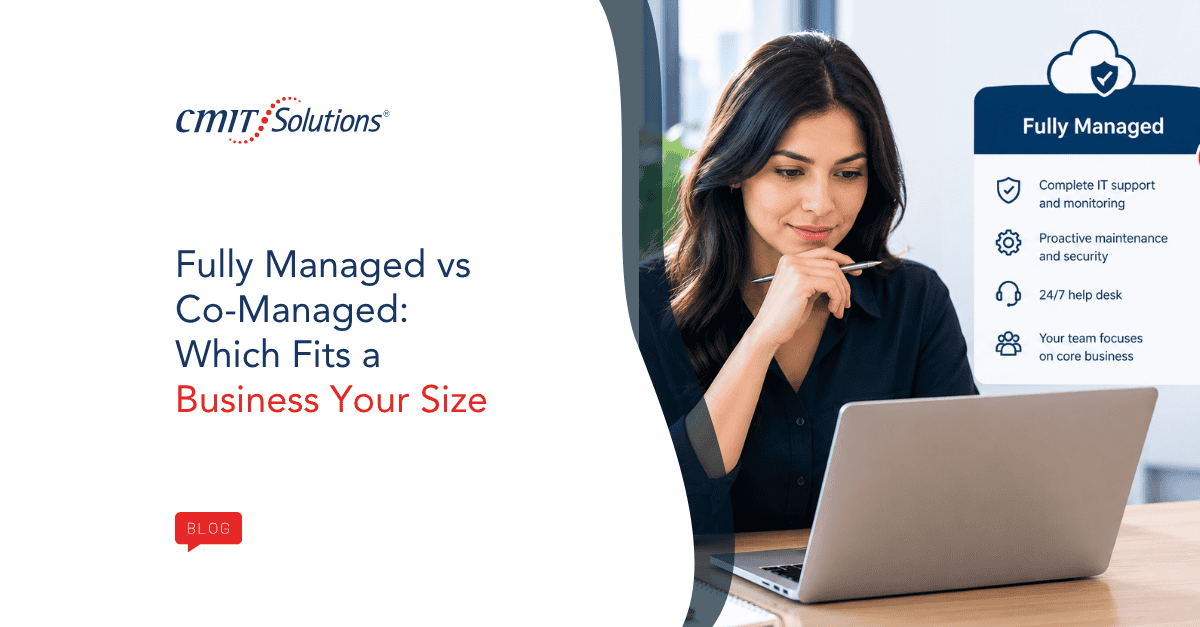
We handle technology. All of it, or close to it.
Monitoring, updates,backups, the help desk your staff call when something stops working, account setup and removal, hardware and software purchasing, vendor wrangling, and the planning conversation about what needs doing next year. Your team has a number to call and someone answers it. Ourmanaged IT services page lays out the full scope.
This tends to fit organizations with nobody internal whose job includes technology, where the current arrangement is somebody’s unpaid second job, and where leadership would rather stop thinking about this category entirely. That describes most professional services firms and nonprofits we work with.
Co-managed, in plain terms
You keep somebody internal. We work alongside them.
The split varies and is agreed rather than assumed. A common arrangement has us carrying the continuous load, meaning monitoring, patching, backups, after-hours cover, and the routine ticket volume, while your person stays the internal face of technology, keeps the institutional knowledge, and handles what needs somebody who knows the business. When a project comes along that is bigger than one person, we bring the additional hands, and the longer-term planning side sits under ourIT guidance service.
This tends to fit organizations that already have someone doing technology work in a real and acknowledged way, where the constraint is depth or hours rather than the absence of a person, and where the internal person genuinely wants to keep part of the job.
How to tell which one you are
The instinct is to decide by headcount, and headcount is the least reliable guide available. We have seen fifteen-person organizations that are clearly co-managed and sixty-person organizations that are clearly fully managed.
Three questions do a better job.
Does anyone’s actual job description include technology? Not “everybody knows Priya handles the computers.” Whether it is written down, resourced, and reviewed. If it is not, you are probably looking at fully managed, whatever the org chart implies.
What is the constraint you are trying to fix? If the problem is that nobody has the specialist knowledge, co-managed adds depth alongside someone who stays. If the problem is that the person carrying this is already underwater and needs the load gone rather than shared, co-managed can quietly make it worse by adding coordination to an already full plate. Reliablenetwork management and steadycybersecurity coverage matter under either model, so this question is really about who owns them day to day.
What does the person themselves want? This gets asked least and matters most. Some people enjoy the technology part and would be genuinely sorry to lose it. Others have been waiting years for somebody to take it away and have never felt able to say so. It is worth asking them directly and privately, and it is worth believing the answer.
Nobody is being replaced
Worth stating plainly, since it is the fear that stalls this decision more than any other.
In our experience the internal person is rarely the obstacle once they understand what is actually on offer. What they are usually afraid of is that a provider will arrive, declare everything wrong, and make them look bad in front of leadership. That fear is reasonable and it happens. It is also not how a decent arrangement starts, and if you are evaluating providers it is a fair thing to ask them about directly.
The part that takes the pressure off
Here is what we most want you to take from this post: the choice is not permanent, and you should be deeply suspicious of any arrangement that requires it to be.
Businesses move between these models regularly and in both directions. An organization on fully managed hires an operations person who turns out to be capable and interested, and the arrangement shifts. A co-managed client loses their internal person and needs us to absorb the whole thing for a while. Growth changes the answer. So does a single hire.
That is why we do not do long-term contracts. Not as a promotion, but because tying a business into a multi-year commitment for a decision that should be revisited as circumstances change is not a good arrangement for the client, and an arrangement that only works while the client is locked in is not much of an arrangement.
It also matters for whoever holds your job next. If you are an operations lead or an executive director, some of what you sign becomes your successor’s inheritance. Being able to say you did not commit them to anything they cannot change is worth something, and it is the kind of detail a board notices.
Where the month lands
Four weeks of posts, and one argument underneath all of them. Growth is what broke your old way of handling technology. Nothing was neglected and nobody failed. The arrangement simply stopped fitting, quietly, somewhere along the way. We covered thetrue cost of that arrangement earlier this month, along with theIT mistakes that tend to come with it.
Fully managed and co-managed are both reasonable answers. The wrong answer is continuing by default because the decision never made it onto anyone’s agenda.
Talk it through, no obligation
CMIT Solutions of Austin East works with growing businesses acrossEast Austin, Round Rock, Pflugerville, Manor, Elgin, Cedar Park, and Bastrop. Our free thirty-minute IT assessment includes a straight conversation about which model actually fits you, and we are perfectly willing to tell you that neither is worth doing yet. OurIT support team can also walk you through ourIT packages beforehand if you want to see the options first.
Frequently Asked Questions
1. What is the difference between fully managed and co-managed IT services?+
Fully managed IT means an outside provider handles most or all of the company’s technology needs. Co-managed IT means the provider works alongside an internal employee or IT team and shares responsibility based on an agreed division of work.
2. What is included in fully managed IT services?+
Fully managed IT services can include monitoring, software updates, backups, help desk support, account setup and removal, cybersecurity, hardware and software purchasing, vendor coordination, network management, and long-term technology planning.
3. Who is fully managed IT best suited for?+
Fully managed IT often works best for organizations that do not have an internal employee whose primary responsibility is technology. It can be especially useful when IT has become a secondary responsibility for an operations manager, office manager, executive, or another employee.
4. What are co-managed IT services?+
Co-managed IT services allow an internal IT person or team to continue handling part of the technology environment while an outside provider supplies additional expertise, monitoring, support, tools, or staffing.
5. Who is co-managed IT best suited for?+
Co-managed IT is generally a good fit for organizations that already have an internal technology resource but need additional capacity, specialized expertise, after-hours coverage, cybersecurity support, or help with larger projects.
6. How are responsibilities divided in a co-managed IT arrangement?+
The responsibilities should be clearly agreed upon based on the organization’s needs. An outside provider might handle monitoring, patching, backups, cybersecurity, and routine support while the internal employee manages business-specific technology needs and institutional knowledge.
7. Is company size the best way to choose between fully managed and co-managed IT?+
No. Headcount alone does not determine which model is appropriate. A smaller company may need co-managed support if it already has an internal IT professional, while a larger organization may still benefit from fully managed services if nobody internally owns technology.
8. How can a business determine whether fully managed IT is right for it?+
Start by asking whether anyone’s actual job description includes responsibility for technology. If IT is being handled informally by someone with another full-time role, fully managed services may be the more appropriate option.
9. How can a business determine whether co-managed IT is right for it?+
Co-managed IT may be appropriate when the business already has someone who is officially responsible for technology but needs additional expertise, capacity, tools, monitoring, or support.
10. Can co-managed IT reduce the workload of an internal IT employee?+
Yes. A co-managed provider can take responsibility for repetitive or continuous tasks such as monitoring, updates, backups, routine tickets, and after-hours support. This can allow the internal employee to focus on higher-value projects and business-specific priorities.
11. Can co-managed IT make an employee’s workload worse?+
It can if responsibilities are poorly defined. If an already overloaded employee is expected to manage the provider in addition to their existing workload, the arrangement may create more coordination rather than reducing pressure. Clear ownership is essential.
12. Does outsourcing IT mean replacing an existing employee?+
Not necessarily. Many managed and co-managed IT arrangements are designed to support existing employees rather than replace them. The goal is often to remove work they do not have the time, resources, or specialist knowledge to manage effectively.
13. What should businesses ask their internal IT person before choosing a provider?+
Ask which responsibilities they want to keep, which tasks consume too much time, where they need additional expertise, and whether they would prefer technology responsibility to remain part of their role at all.
14. What should a managed IT provider handle day to day?+
Depending on the agreement, a managed IT provider may handle help desk requests, network monitoring, cybersecurity, updates, backups, user accounts, vendor issues, device management, documentation, and ongoing technology maintenance.
15. How does cybersecurity work under fully managed and co-managed IT?+
Cybersecurity can be supported under either model. In a fully managed arrangement, the provider may take primary responsibility for security monitoring and maintenance. In a co-managed environment, those responsibilities can be divided between the provider and internal IT staff.
16. How does network management fit into managed IT services?+
Network management includes monitoring, maintaining, documenting, and troubleshooting the systems that connect users, devices, applications, and cloud services. It can be handled entirely by the provider or shared with an internal IT resource.
17. Can a business switch from fully managed IT to co-managed IT later?+
Yes. A business may move to co-managed IT after hiring an internal technology professional or expanding its internal capabilities. The support model can change as the organization grows and its staffing needs evolve.
18. Can a business move from co-managed IT to fully managed IT?+
Yes. If an internal IT employee leaves, responsibilities change, or the organization decides it no longer wants to maintain internal technology ownership, the provider can potentially take over more of the environment.
19. Why is flexibility important in a managed IT agreement?+
Technology needs can change because of growth, staffing changes, new systems, cybersecurity requirements, or organizational priorities. A flexible arrangement makes it easier to adjust the level of support when those circumstances change.
20. How can CMIT Solutions of Austin East help determine the right IT support model?+
CMIT Solutions of Austin East can review the organization’s current IT responsibilities, internal resources, technology environment, cybersecurity needs, support requirements, and future plans. This can help determine whether fully managed IT, co-managed IT, or the current internal arrangement is the best fit.