Cybersecurity budgeting for 2027 shouldn’t be about buying more security tools. It should be about making smarter investments in the areas that reduce your organization’s biggest risks. The threat landscape continues to evolve. Vulnerability exploitation is now the leading way attackers gain access to organizations, AI is accelerating attacks, ransomware remains a serious operational threat, and compromised identities continue to play a major role in successful attacks.
For SMBs with limited IT and cybersecurity resources, that makes prioritization especially important. So where should your cybersecurity dollars go first?
7 Investments SMBs should prioritize for their 2027 IT budget
1. Identity Security
Your employees’ identities are one of your organization’s most valuable security assets—and one of the most attractive targets for attackers.
Sophos found that 67 percent of ransomware victims in its 2026 research said their ransomware incident was also their most significant identity attack.
For 2027, SMBs should prioritize:
- Multi-factor authentication
- Strong administrator controls
- Least-privilege access
- Conditional access policies
- Password managers
- Privileged access management
- Monitoring for suspicious login activity
 Bottom line: Protecting identities should be foundational to your cybersecurity strategy—not an optional layer.
2. Managed Detection and Response
Even the strongest preventive controls can’t guarantee that an attacker won’t get through.
That’s why detection matters.
Managed Detection and Response (MDR) provides continuous monitoring and security expertise without requiring an SMB to build its own 24/7 security operations center.
This is particularly important as the window to respond to attacks continues to shrink. Sophos’ 2026 research found identity-based attacks dominating the incidents handled by its response and MDR teams.
For SMBs, a good MDR service should provide more than automated alerts. Look for:
- 24/7 monitoring
- Threat detection and investigation
- Endpoint detection and response
- Threat hunting
- Human analyst involvement
- Incident escalation and response
Bottom line: If no one is watching your environment when your internal team isn’t working, there’s a significant gap in your security strategy.
3. Vulnerability Management
One of the biggest cybersecurity budgeting changes for 2027 is the growing importance of vulnerability management.
According to Verizon’s 2026 Data Breach Investigations Report, 31 percent of breaches began with vulnerability exploitation, making it the leading initial access vector for the first time in the report’s history.
That means businesses need to know not only what vulnerabilities exist, but which ones attackers are most likely to exploit.
Your vulnerability management program should include:
- Asset discovery
- Vulnerability scanning
- Patch management
- External attack-surface monitoring
- Prioritization of actively exploited vulnerabilities
- Remediation tracking
Bottom line: Finding vulnerabilities isn’t enough. The goal is to identify and fix the vulnerabilities that create the greatest business risk.
4. Backup and Disaster Recovery
The goal of cybersecurity isn’t simply to prevent every attack. It’s also to make sure your business can recover when prevention fails.
The FBI’s 2025 Internet Crime Report, released in 2026, recorded more than 3,600 ransomware complaints with reported losses exceeding $32 million.
A strong recovery strategy should include:
- Automated backups
- Offsite or cloud-based copies
- Immutable or ransomware-resistant backups
- Protected backup credentials
- Documented recovery procedures
- Regular restore testing
Bottom line: Don’t just budget for backups. Budget for your ability to recover.
5. Employee Security Training
Employees remain an important part of your cybersecurity defenses—but the threats they’re expected to recognize are changing.
Phishing is no longer limited to poorly written emails. Attackers are using text messages, phone calls, impersonation and AI-generated content to make social engineering more convincing.
That means annual compliance training isn’t enough.
Security awareness training programs should cover:
- Phishing and business email compromise
- Smishing and malicious texts
- Voice phishing
- Executive impersonation
- MFA attacks
- Password security
- Safe AI use
- Data handling
- How to report suspicious activity
 Bottom line: Your employees don’t need to become cybersecurity experts. They need to know what today’s attacks look like and what to do when something doesn’t seem right.
6. AI Governance
AI belongs in the 2027 cybersecurity budget whether your organization is actively developing AI solutions or simply using ChatGPT, Microsoft Copilot or other AI tools.
The technology is moving quickly—and so are the threats.
IBM’s 2026 Cost of a Data Breach research found that in four malicious breaches were AI-enabled. Those AI-enabled breaches cost an average of $6 million.
For SMBs, AI governance doesn’t need to be complicated. Start by establishing:
- Which AI tools employees can use
- What company information can be entered into AI tools
- What data is prohibited
- How new AI applications are evaluated
- When human review is required
- Who is responsible for AI security and oversight
Bottom line: Don’t try to stop employees from using AI. Establish guardrails that allow them to use it productively without putting company data at unnecessary risk.
7. Security Assessments
Before spending more money on cybersecurity, make sure you know where your biggest gaps actually are. A security assessment can help identify weaknesses across identity, endpoints, vulnerabilities, backups, employee security, cloud environments, AI usage and incident response.
That information can then become the foundation for your 2027 cybersecurity road map.
The goal isn’t another lengthy report that sits on a shelf.
It’s a prioritized answer to three questions:
- What are we doing well?
- Where are we most exposed?
- What should we fix first?
Bottom line: Assess first. Prioritize second. Spend third.
Putting It All Together
There isn’t a single cybersecurity budget formula that works for every SMB. Your priorities should depend on your industry, technology environment, regulatory requirements, cyber insurance obligations and existing security maturity.
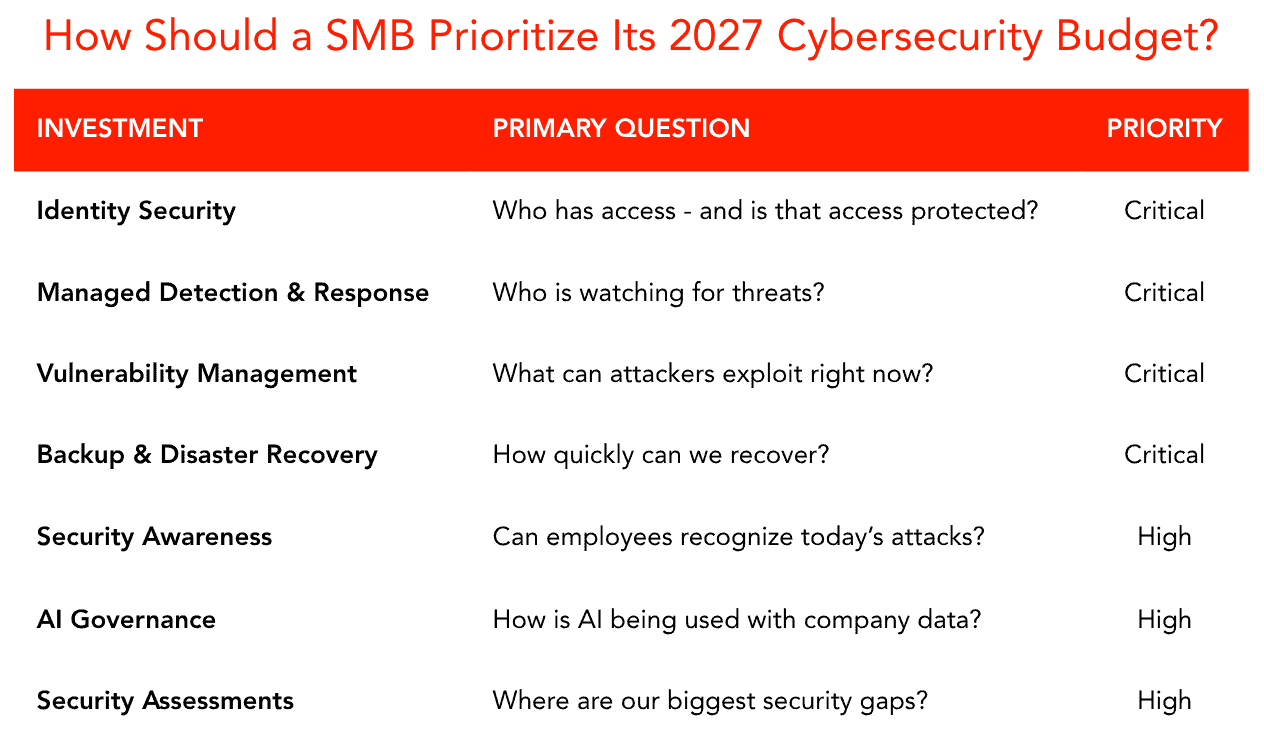
The takeaway for SMB leaders is simple: You don’t necessarily need a bigger cybersecurity budget. You need a more strategic one.