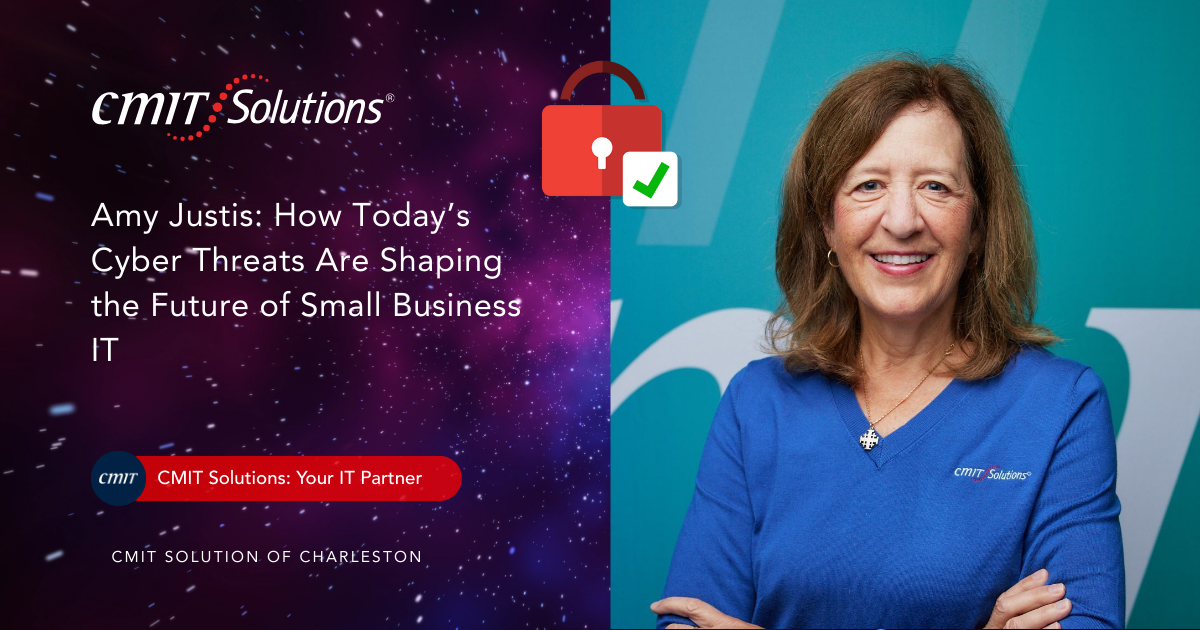
Cybersecurity is no longer a background IT concern, it is a defining business issue. For small and mid-sized businesses, cyber threats have evolved faster than most organizations can adapt, turning once-minor vulnerabilities into serious operational, financial, and reputational risks.
According to Amy Justis, President of CMIT Solutions of Charleston, the future of small business IT is being shaped not by technology trends alone, but by how cyber threats are forcing organizations to rethink strategy, resilience, and responsibility. As attackers become more sophisticated and automated, IT must evolve from reactive support into proactive, security-first leadership built on proven cyber practices.
Why cyber threats now define small business IT strategy
For many years, cybersecurity was treated as a technical add-on rather than a core business function. That mindset is no longer viable. Today’s cyber threats directly impact revenue, operations, compliance, and customer trust. Amy Justis emphasizes that IT strategy can no longer be separated from risk management.
Small businesses are increasingly targeted precisely because attackers know they often lack enterprise-grade defenses. As a result, cybersecurity considerations now shape everything from technology investments to hiring decisions, including the need for strong security strategy.
This shift means IT strategy must now:
- Be designed with security at the core
- Align technology decisions with business risk
- Support long-term resilience, not just uptime
- Protect both internal operations and customer trust
The growing sophistication of modern cyber threats
Cyber threats have evolved far beyond simple viruses or spam emails. Today’s attacks are multi-stage, automated, and often tailored to specific industries. Amy Justis notes that small businesses are no longer facing “random” threats—they are facing deliberate, targeted campaigns.
Attackers now exploit human behavior, cloud misconfigurations, and supply chain relationships, making traditional defenses insufficient. That is why foundational controls like firewall protection and modern detection capabilities are becoming non-negotiable.
Modern cyber threats are increasingly characterized by:
- Advanced social engineering tactics
- Automated and AI-driven attack tools
- Exploitation of cloud and remote work environments
- Persistent, stealthy intrusion methods
Why small businesses are no longer “too small to target”
One of the most dangerous misconceptions Amy Justis encounters is the belief that small businesses are not attractive targets. In reality, attackers see small organizations as ideal entry points due to limited resources and weaker controls.
Small businesses also serve as gateways into larger ecosystems, including vendors, partners, and customers. As a result, strengthening defenses often starts with better risk readiness and tighter controls around third-party access.
Small businesses are targeted because they often:
- Have fewer security controls in place
- Rely heavily on cloud and third-party services
- Lack dedicated cybersecurity staff
- Hold valuable customer and financial data

The shift from reactive IT to proactive cybersecurity leadership
Historically, IT teams responded after something broke. In today’s threat landscape, that approach is no longer acceptable. Amy Justis stresses that proactive cybersecurity is now a leadership responsibility—not just a technical task.
Proactive IT focuses on prevention, detection, and rapid response before damage occurs, supported by disciplined threat detection and resilient operational processes.
Proactive cybersecurity leadership requires organizations to:
- Identify risks before exploitation
- Continuously monitor systems and users
- Test defenses regularly
- Plan for incidents rather than hoping to avoid them
How ransomware and data breaches reshape IT priorities
Ransomware and data breaches are no longer rare events—they are business-altering incidents. Amy Justis explains that recovery is not just about restoring systems, but about preserving reputation, customer confidence, and operational continuity.
These threats have forced small businesses to rethink backup strategies, access controls, and incident response planning. Building resilience starts with dependable backup recovery and realistic planning for disruption.
As a result, IT priorities now include:
- Strong backup and recovery strategies
- Segmentation of critical systems
- Limiting access based on roles
- Preparing for worst-case scenarios
The human factor in cybersecurity risk
Technology alone cannot stop cyber threats. Many attacks succeed because of human error clicked links, reused passwords, or lack of awareness. Amy Justis highlights that employees are both the greatest risk and the greatest defense.
Building a security-aware culture is now essential for small business IT, reinforced by stronger identity controls like MFA security and practical training that sticks.
Reducing human-related risk requires:
- Ongoing security awareness training
- Clear policies and expectations
- Simple, secure authentication practices
- Reinforcement of accountability at all levels
Why compliance and cybersecurity are becoming inseparable
Regulatory and contractual requirements are increasingly tied to cybersecurity practices. Amy Justis points out that even small businesses now face compliance expectations from clients, insurers, and industry standards.
Cybersecurity is no longer just about protection—it’s about proving diligence. That means documenting controls and staying ready through ongoing audit readiness.
This convergence means businesses must:
- Document security policies and controls
- Maintain audit readiness
- Align IT practices with regulatory expectations
- Treat compliance as an ongoing process

The role of managed IT services in modern cyber defense
As threats grow more complex, small businesses cannot realistically manage cybersecurity alone. Amy Justis emphasizes that managed IT services provide access to expertise, tools, and monitoring that would otherwise be out of reach.
Managed services transform cybersecurity from a burden into a strategic advantage, especially when paired with structured managed cybersecurity and day-to-day operational support.
Managed IT support strengthens cyber defense by providing:
- Continuous monitoring and response
- Access to specialized security expertise
- Proactive maintenance and updates
- Scalable protection as businesses grow
How cyber threats are shaping the future of small business IT investments
Cybersecurity is now a primary driver of IT investment decisions. Amy Justis observes that businesses are prioritizing secure cloud platforms, resilient infrastructure, and long-term IT partnerships over short-term cost savings.
That shift includes investing in protected connectivity—starting with network security and expanding into ongoing performance and threat visibility through network monitoring.
Future-focused IT investments are increasingly centered on:
- Security-first architecture
- Resilient and scalable systems
- Long-term vendor partnerships
- Risk reduction rather than convenience
Amy Justis’s vision for resilient small business IT at CMIT Solutions of Charleston
As President of CMIT Solutions of Charleston, Amy Justis advocates for an IT approach that balances security, productivity, and growth. Her vision centers on empowering small businesses with enterprise-level protection while maintaining simplicity and alignment with business goals.
Cybersecurity, in this vision, becomes a foundation for confidence—not fear—supported by trusted partners and reliable support.
At CMIT Solutions of Charleston, this vision translates into:
- Proactive, security-first IT strategies
- Clear communication and education
- Tailored solutions for small businesses
- Long-term partnerships built on trust
Conclusion
Today’s cyber threats are not just shaping IT—they are reshaping how small businesses operate, compete, and grow. As Amy Justis makes clear, the future belongs to organizations that treat cybersecurity as a leadership priority rather than an afterthought.
By embracing proactive strategies, investing wisely, and partnering with trusted IT experts, small businesses can navigate an increasingly hostile digital landscape with confidence. The goal is not just to survive cyber threats—but to build resilient, secure, and future-ready businesses with strong data protection at the core.