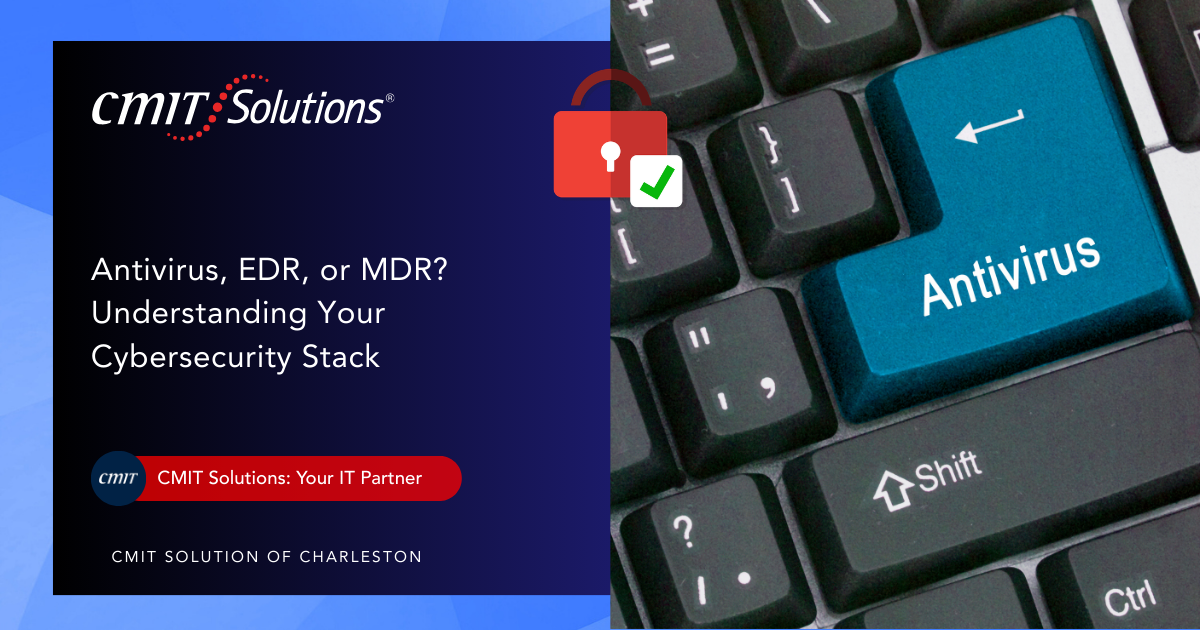
Cybersecurity is no longer about choosing a single tool to block threats. Today’s attack landscape is faster, more sophisticated, and increasingly designed to bypass traditional defenses. As a result, businesses are reevaluating their cybersecurity stacks to ensure they provide meaningful protection not just a sense of security.
Three commonly discussed components Antivirus, Endpoint Detection and Response (EDR), and Managed Detection and Response (MDR) serve very different purposes within a modern cybersecurity strategy. Understanding how these solutions differ, where they overlap, and how they work together is essential for building a resilient defense.
At CMIT Solutions of Charleston, we help businesses cut through the noise and design cybersecurity stacks that align with their operational realities, risk tolerance, and growth goals.
The Evolution of Endpoint Security
Endpoint security has evolved significantly as threats have grown more advanced. Early antivirus solutions focused on identifying known malware through signatures. While this approach provided a baseline level of protection, it was not designed for modern, stealthy attacks.
Today’s endpoints are complex, constantly connected, and often outside traditional network boundaries. This shift has driven the development of more advanced detection and response capabilities, especially as organizations prioritize stronger protection across devices through endpoint security.
This evolution reflects a growing need for endpoint security that can:
- Detect threats beyond known malware signatures
- Monitor behavior across devices and users
- Respond quickly to suspicious activity
- Adapt to evolving attack techniques
Understanding Traditional Antivirus Protection
Antivirus remains a foundational component of many cybersecurity stacks. Its primary role is to prevent known threats from executing by scanning files and processes against a database of known malicious signatures.
While antivirus is effective at blocking common malware, it was never designed to handle sophisticated or unknown threats that use legitimate tools and processes.
Antivirus solutions typically provide value by offering:
- Basic protection against known malware
- Low system overhead for endpoint devices
- Automated scanning and quarantine
- A first line of defense against common threats
The Limitations of Antivirus in Modern Environments
As cyber threats have evolved, the limitations of traditional antivirus have become more apparent. Many modern attacks do not rely on known malware signatures, allowing them to bypass basic defenses entirely.
Relying solely on antivirus can create a false sense of security while leaving organizations vulnerable to advanced threats, especially as AI-driven threats become more common.
Common limitations of antivirus include:
- Inability to detect unknown or fileless attacks
- Limited visibility into attacker behavior
- Minimal response capabilities once a threat executes
- Dependence on signature updates
What EDR Brings to the Cybersecurity Stack
Endpoint Detection and Response (EDR) tools address many of the gaps left by antivirus by focusing on behavior rather than signatures. EDR continuously monitors endpoint activity to identify suspicious patterns that may indicate an attack.
EDR provides deeper visibility into what is happening on endpoints, allowing security teams to investigate incidents and respond more effectively.
EDR enhances endpoint security by enabling:
- Continuous monitoring of endpoint activity
- Behavioral analysis to detect advanced threats
- Detailed forensic data for investigations
- Manual or automated response actions

The Operational Demands of Managing EDR
While EDR offers powerful capabilities, it also introduces operational complexity. Alerts must be analyzed, incidents investigated, and response actions taken—often requiring skilled security personnel.
Without the right resources, EDR can overwhelm internal teams and reduce its overall effectiveness. Many organizations close this gap by adopting always-on response models like digital defense strategy.
Managing EDR effectively requires organizations to address challenges such as:
- High alert volumes and false positives
- Need for specialized security expertise
- Continuous tuning and maintenance
- Around-the-clock monitoring requirements
What MDR Adds Beyond EDR
Managed Detection and Response (MDR) builds on EDR technology by combining it with human expertise and active response. MDR providers monitor endpoints continuously, investigate suspicious activity, and take action to contain threats on behalf of the organization.
This approach shifts the burden of detection and response away from internal teams while improving speed and consistency, aligning with the outcomes-focused model described in managed detection and response.
MDR delivers additional value by providing:
- 24/7 monitoring and threat detection
- Human-led investigation and validation
- Active containment and remediation
- Clear accountability for security outcomes
Comparing Antivirus, EDR, and MDR Roles
Each component in the cybersecurity stack serves a distinct role. Antivirus focuses on prevention, EDR focuses on detection and investigation, and MDR focuses on detection plus response.
Understanding these roles helps organizations avoid gaps and overlaps in their security strategy.
The functional differences between these solutions include:
- Antivirus prevents known threats at the endpoint
- EDR detects and analyzes suspicious behavior
- MDR detects, investigates, and responds to threats
- Responsibility increases from tool-based to service-based
Aligning Cybersecurity Tools With Business Risk
Not every business requires the same level of security capability. Smaller organizations may rely on antivirus and EDR, while businesses with higher risk profiles benefit from MDR’s proactive approach.
The right cybersecurity stack depends on industry, regulatory requirements, and operational complexity—especially when requirements are shaped by cybersecurity compliance and broader standards discussed in simplifying compliance.
When aligning security tools with risk, businesses should evaluate:
- Sensitivity of their data and systems
- Likelihood and impact of cyber incidents
- Internal security expertise and staffing
- Growth plans and technology adoption

Building a Layered Cybersecurity Strategy
Effective cybersecurity relies on layers, not single solutions. Antivirus, EDR, and MDR can work together as part of a defense-in-depth strategy that addresses prevention, detection, and response.
Layered security reduces the likelihood that a single failure will lead to a major incident, particularly when paired with human-focused controls like security awareness training and strong communication defenses such as email security.
A layered cybersecurity approach benefits organizations by providing:
- Multiple opportunities to stop threats
- Improved visibility across the environment
- Faster response to incidents
- Reduced overall risk exposure
Partnering for Cybersecurity Success
Technology alone is not enough to protect a business. Successful cybersecurity depends on expertise, process, and continuous improvement. Choosing the right partner ensures that security tools are implemented, monitored, and optimized effectively.
At CMIT Solutions of Charleston, we focus on outcomes not just tools helping businesses build cybersecurity stacks that evolve with their needs through trusted partnerships like leading with trust.
A trusted cybersecurity partner helps organizations:
- Design security strategies aligned with business goals
- Manage complex security technologies
- Respond effectively to incidents
- Maintain long-term resilience
Conclusion: Making Sense of Your Cybersecurity Stack
Choosing between Antivirus, EDR, and MDR is not about selecting one solution over another it’s about understanding how each fits into a comprehensive cybersecurity strategy. Antivirus provides essential baseline protection, EDR delivers visibility and insight, and MDR offers proactive detection and response.
For businesses navigating today’s threat landscape, clarity is critical. Knowing what each tool does and what it doesn’t empowers leaders to make informed decisions that protect operations, reputation, and growth.
At CMIT Solutions of Charleston, we help businesses build cybersecurity stacks that deliver real protection, not just compliance checkboxes. Whether you’re evaluating your current tools or planning your next security investment, our team is here to guide you toward a stronger, more resilient cybersecurity posture.
The right cybersecurity stack isn’t just about technology, it’s about confidence. Connect with contact us to get started.