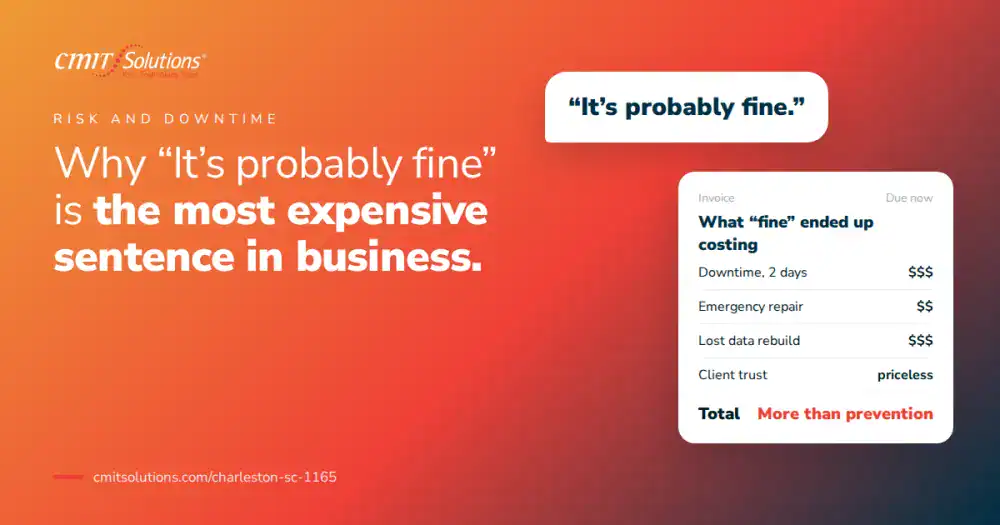
Every expensive technology failure has the same origin story. Not a sophisticated attack. Not a freak accident. Just a moment where somebody looked at a warning sign, weighed the effort of dealing with it against the effort of ignoring it, and said four words that felt reasonable at the time.
It’s probably fine.
The backup notification that failed three weeks ago. The server making a noise it did not used to make. The former employee whose account nobody disabled. The firewall running firmware from four years ago. The one workstation still on an operating system that stopped receiving patches. The vendor who has not confirmed their security posture since the contract was signed.
None of those individually feels urgent. Each one has a plausible reason to wait. And each one has, in real businesses, turned into a five figure or six figure event.
This article is about why that sentence is so expensive, why intelligent people say it constantly, and what a business can actually do to replace it with something better.
The Sentence Is Not Laziness. It Is Math Done Badly.
The instinct to defer is not carelessness. It is a cost calculation happening quickly and silently in someone’s head.
Dealing with the problem has a visible, immediate, certain cost: time, money, disruption, a conversation with a vendor, a line item somebody will question. Ignoring the problem has an invisible, delayed, uncertain cost: maybe nothing happens.
Human beings are extremely bad at comparing a certain small cost against an uncertain large one. We discount the future aggressively. We treat “unlikely” as “not going to happen.” And critically, every time we defer something and nothing goes wrong, we receive positive reinforcement for deferring.
That is the trap. The sentence works, repeatedly, right up until the one time it does not. And the single time it fails typically costs more than every deferral saved.
This is the underlying logic behind proactive IT monitoring: remove the judgment call from a human who is busy, and let a system flag the issue before anyone has the chance to rationalize it away.
What “Probably Fine” Actually Costs
Let us make the invisible side of the equation visible. When technology problems become incidents, the costs arrive in layers, and most businesses only budget for the first one.
Direct recovery costs
- Emergency response labor, usually billed at premium rates
- Replacement hardware sourced urgently rather than planned
- Forensic investigation to determine what was accessed
- Data recovery attempts, which sometimes fail
Operational costs
- Revenue that simply does not happen while systems are down
- Staff paid to wait
- Overtime to catch up afterward
- Deadlines missed, with penalties attached
Legal and compliance costs
- Regulatory notification obligations
- Penalties assessed per record affected
- Legal counsel through the response and afterward
- Credit monitoring for affected individuals
Relationship costs
- Clients who quietly do not renew
- Referral sources who stop referring
- Prospects who hear about it before you can explain it
- Employees who lose confidence in leadership
Ongoing costs
- Insurance premium increases at renewal
- Contract requirements imposed by clients who now want proof
- The remediation you deferred, now done urgently and expensively
The full picture is laid out in real downtime cost, and the numbers surprise most owners because the first layer is usually the smallest one.

Where the Sentence Shows Up Most Often
In assessments, the same categories appear again and again. Here is where “probably fine” tends to live.
Backups nobody has tested
This is the most common one, and the most costly.
A backup job is running. Green checkmarks appear in a dashboard. Everyone assumes recovery is available. Then an actual restoration is attempted and one of several things is discovered: the job has been silently failing, the backup covers files but not systems, retention was shorter than anyone realized, the restore takes eleven days rather than eleven hours, or the backup was encrypted along with everything else because it was connected to the same network.
A backup you have never restored from is a hypothesis, not a safeguard. Treating it properly is the entire point of managed backup strategy and structured business data protection planning.
Worth noting: file sync is not backup. It replicates changes, including deletions and encryption, which is covered clearly in real backup strategy.
Accounts that outlive employment
Someone leaves. Their email gets forwarded. Their laptop is returned. And their accounts across eight cloud applications, their VPN credential, their admin access to the payment processor, and the shared password they knew all remain valid.
Offboarding is one of the most reliably incomplete processes in small business operations because it is nobody’s specific job. The window between departure and deactivation is where a meaningful share of insider incidents occur.
Patching deferred “until things calm down”
Things never calm down. That is the nature of running a business.
Meanwhile, the gap between a vulnerability becoming public and being exploited at scale has compressed dramatically. Attackers scan for known weaknesses continuously and automatically. An unpatched system is not obscure. It is indexed.
The nuance here matters, because patching everything immediately is not realistic either. The useful approach is described in context driven vulnerability response, which prioritizes based on actual exposure rather than raw severity scores.
Hardware running past its life
The server is seven years old. It works. Replacing it costs real money and requires a weekend of disruption. So it stays.
Aging hardware fails in predictable ways, but not on a predictable schedule. It also tends to fail at the worst possible time, because stress increases failure probability and stress correlates with your busiest periods. Planned replacement through structured technology procurement planning costs a fraction of emergency replacement.
Software past end of support
An unsupported operating system does not stop working. It stops receiving security updates, which means every vulnerability discovered from that point forward is permanent. The transition case is made in Windows 11 business upgrade.
Network equipment that has been ignored
Routers, switches, firewalls, and access points running default configurations and original firmware are extremely common. They sit in a closet, they work, and nobody thinks about them until the day they become the entry point. Ongoing network infrastructure management treats this equipment as active infrastructure rather than furniture.
Warning signs treated as quirks
Systems talk before they fail. Slower logins. Intermittent disconnections. Storage filling faster than expected. Odd authentication attempts in a log nobody reads. These get normalized into “that’s just how it is.” The pattern is explored in IT warning signals.
The Compounding Problem
Individual deferrals are manageable. The danger is that they interact.
An unpatched server is a risk. An unpatched server plus a flat network means one compromise reaches everything. Add an untested backup and recovery is not available. Add a former employee’s active credential and the entry point is trivial. Add no monitoring and the intrusion runs for weeks undetected.
No single decision caused that outcome. Five reasonable deferrals did, and each one was defensible in isolation.
This is why incident reviews rarely find a single root cause. They find a chain, and every link in the chain was something somebody decided was probably fine. Building resilience against this is the focus of always on defense strategy.
Why Threats Punish Deferral More Than They Used To
The calculation that made deferral defensible five years ago no longer holds, for three reasons.
Attacks are automated. Being small used to offer obscurity. It no longer does, because nobody is choosing targets by hand. Scanning is continuous and indiscriminate. You are found because you are reachable, not because you are interesting.
Attacks are faster. Modern ransomware operations move from initial access to encryption in hours rather than weeks. The evolution is documented in modern ransomware tactics, and the local trend is covered in rising regional ransomware.
Attacks are more convincing. Generative tools have eliminated the obvious tells. The clumsy phishing email full of errors is gone, replaced by messages that reference real projects and mimic real writing styles, as detailed in AI enhanced phishing and AI driven threat defense.
The window in which deferral is survivable has narrowed considerably.
The Industry Versions of the Sentence
Every sector has its own phrasing, and its own specific consequence.
Healthcare: “We’re small, nobody’s targeting us.” Protected health information carries obligations regardless of size, and penalties scale with records rather than revenue. Practical requirements appear in HIPAA compliance essentials and sector specific guidance in healthcare data protection.
Legal: “Our clients trust us.” Trust is exactly what is at stake, and law firms are targeted precisely because of what they hold. See law firm phishing risk and secure legal cloud.
Financial services and accounting: “Our bank handles security.” Your bank secures the bank. Your safeguard obligations are yours, as outlined in financial data compliance and accounting firm protection.
Construction and manufacturing: “We can work on paper for a day.” Recovery is rarely a day, and schedule penalties compound quickly, a scenario examined in ransomware recovery downtime.
Retail and hospitality: “It’s just the point of sale.” Payment systems carry the strictest handling rules of any category, and outages hit revenue instantly, as covered in network downtime impact.
Nonprofits: “We don’t have anything worth stealing.” Donor records include names, addresses, giving history, and payment details. That is a complete profile. Affordable options are discussed in nonprofit managed technology.

The Insurance Problem
Cyber insurance used to be a reasonable substitute for controls. That era is over.
Carriers now require specific technical measures before binding coverage, and they verify claims against those requirements after an incident. Multifactor authentication on all remote access, endpoint detection, tested backups with offline copies, patching cadence, security awareness training, and privileged access controls are increasingly baseline expectations.
Two things follow. First, the questionnaire answer becomes a statement you will be held to. Second, “probably fine” on a control you attested to can become the reason a claim is reduced or denied entirely. The evolving requirements are covered in insurer security requirements.
Insurance is not a control. It is a financial backstop that increasingly requires controls to function.
Replacing the Sentence: A Practical System
The goal is not to eliminate judgment. It is to make deferral a deliberate, documented decision rather than a reflex. Here is how that works in practice.
Replace intuition with an inventory
You cannot assess what you have not listed. A working inventory covers:
- Every server, workstation, and mobile device, with age and support status
- Every network device, with firmware version
- Every software application, with version and vendor support window
- Every cloud service, with owner and data classification
- Every user account, with access level and last activity
- Every vendor with access to your systems or data
Most businesses discover things they forgot existed. That discovery alone justifies the exercise, and it forms the base for strategic technology guidance.
Rank by consequence, not by noise
For each item, answer two questions: how likely is failure, and what happens if it fails. The combination produces a priority order that is defensible to leadership and to auditors.
High likelihood plus high consequence gets fixed now. Low likelihood plus high consequence gets a contingency plan. High likelihood plus low consequence gets scheduled. Low plus low gets documented and monitored.
Verify instead of assume
Assumptions are where “probably fine” hides. Convert each one into a test:
- Restore a file, a system, and a full environment from backup, and record how long it took
- Attempt access with a departed employee’s credentials
- Confirm patch levels against a report rather than a memory
- Test failover before you need it
- Confirm alerts actually reach a human who acts on them
Anything you have not verified in the last quarter should be treated as unverified.
Monitor continuously rather than periodically
Human attention is not a monitoring system. Automated monitoring catches drift, failure, and anomaly without depending on somebody remembering to look. Combined with managed detection services, it converts a reactive posture into an anticipatory one.
The distinction between security layers is worth understanding, and it is explained in security stack comparison.
Make deferral a written decision
When something genuinely must wait, document three things: what is being deferred, why, and when it will be revisited. This does two things. It removes the comfortable ambiguity that lets items disappear, and it creates a record that demonstrates deliberate risk management rather than neglect.
Auditors and insurers respond very differently to a documented risk acceptance than to an unexplained gap.
Budget for maintenance as an operating cost
Technology maintenance treated as an occasional project will always lose to more urgent priorities. Treated as a recurring operating expense, it happens automatically. Predictable managed service packages exist precisely to move this cost out of the emergency category.
Plan for the failure you are trying to prevent
Prevention fails sometimes. A continuity plan determines whether that failure is an inconvenience or an existential event. It should specify recovery priorities, communication procedures, alternate work arrangements, and decision authority. The reasoning is covered in business continuity planning and preventing costly downtime.
The Hidden Advantage of Not Saying It
There is a framing problem in how businesses discuss this work. It gets positioned as insurance, as overhead, as a cost center that produces nothing. That framing is why it loses budget arguments.
Organizations that maintain their technology properly experience benefits that have nothing to do with avoiding disaster:
- Speed. Systems that work do not consume staff time in workarounds.
- Hiring. Capable people notice whether tools function.
- Sales. Enterprise clients increasingly require security evidence during procurement.
- Adoption. New capabilities deploy cleanly on healthy infrastructure and painfully on neglected infrastructure.
- Valuation. Technical debt and unresolved risk reduce what a buyer will pay.
The competitive framing is argued in security as advantage, and the modernization angle in managing technical debt.
At CMIT Solutions of Charleston, the clearest pattern across client work is this: the businesses that stopped deferring did not just avoid incidents. They got faster.
Why This Is Hard for Small Businesses Specifically
None of this is unknown to business owners. The obstacle is structural.
In a large organization, somebody’s entire job is to notice these things. In a twenty person company, the person responsible for technology is usually also responsible for operations, finance, or the thing the business actually sells. Technology attention is what remains after everything urgent is handled, which is to say very little.
That is not a character flaw. It is arithmetic. And it is the specific gap that managed IT services exists to close, by making the noticing somebody’s dedicated responsibility rather than somebody’s tenth priority. The return comparison is examined in managed versus internal IT.
Conclusion
“It’s probably fine” is expensive because it is usually true. That is what makes it dangerous. Nine times out of ten, or ninety nine out of a hundred, nothing happens, and the sentence is validated. The habit strengthens. The deferrals accumulate quietly in the background.
Then one of them is not fine, and the bill arrives all at once, carrying every deferral that preceded it.
The alternative is not paranoia and it is not spending without limit. It is replacing a reflex with a process: know what you have, understand what failure would cost, verify what you have assumed, monitor what you cannot watch personally, and when you do choose to wait, write down that you chose it.
That single shift, from unconscious deferral to deliberate decision, is the difference between a business that absorbs a bad day and one that does not recover from it.
If you are not certain which assumptions your operation is currently resting on, that uncertainty is the answer. Businesses across the Lowcountry work with our team as their Charleston technology partner to replace guesswork with verified, documented, monitored infrastructure.
Stop hoping and start knowing. Schedule a consultation with CMIT Solutions of Charleston for a clear assessment of what is working, what is waiting to fail, and what it would cost you if it did.
Frequently Asked Questions