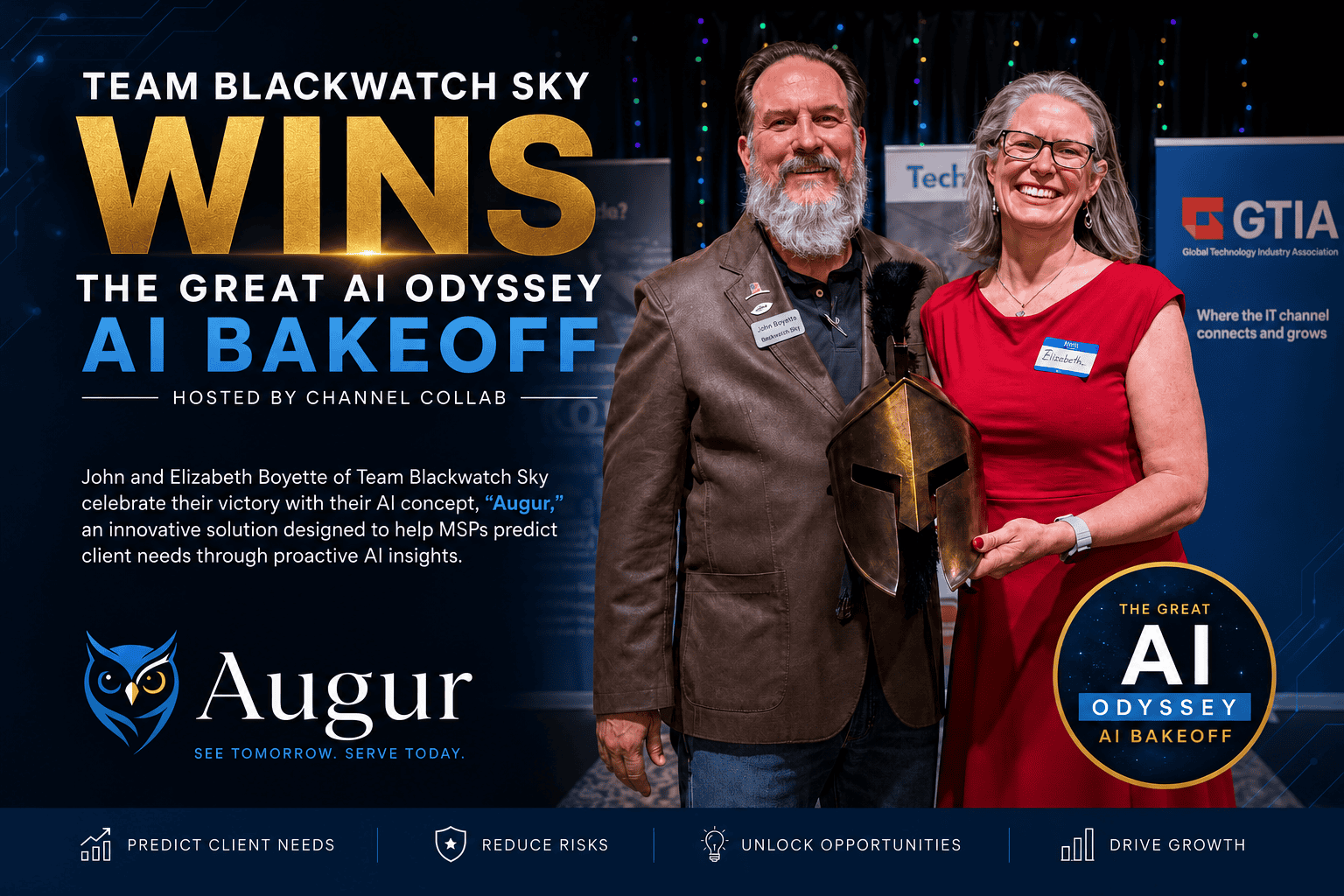
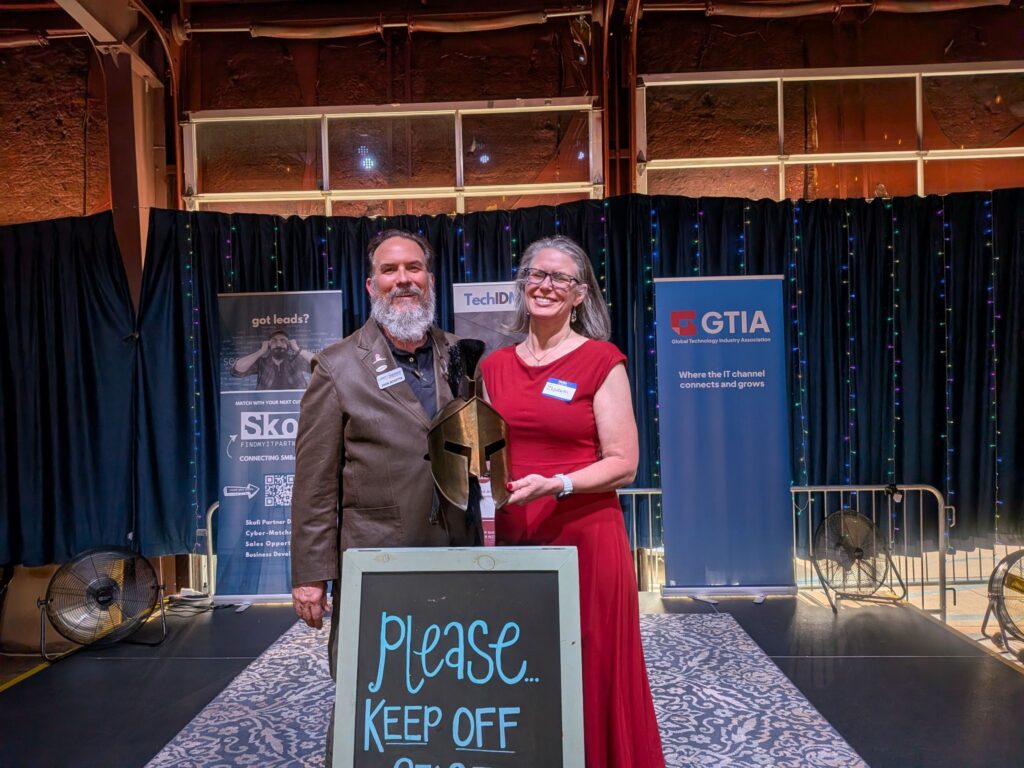
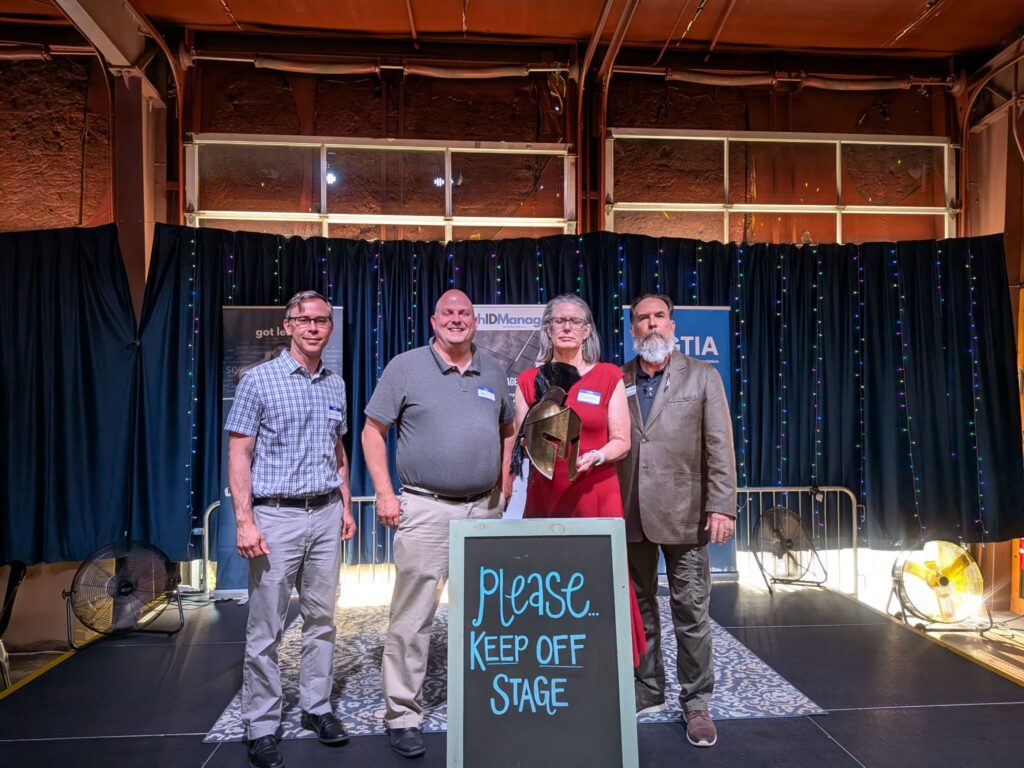
Twenty-four hours after receiving the same prompt as their closest regional competitor, John and Elizabeth Boyette stood in front of a room of MSP peers and industry judges and won the whole thing walking away with a $500 innovation grant, a trophy called the Helm of Glory, and a concept, Augur, that reframes what a managed service provider can actually be for a client.
24 hours to build · 2 teams · $500 grant · 1 Helm of Glory · 11 years in the Forerunners network
🎧 Related listen: Want the full Boyette story first? Hear John and Elizabeth tell it in their own words on Communication First: The Husband-and-Wife Team Behind CMIT Greenville Listen on pod.co →
THE STORY
A trophy for a philosophy they already lived by
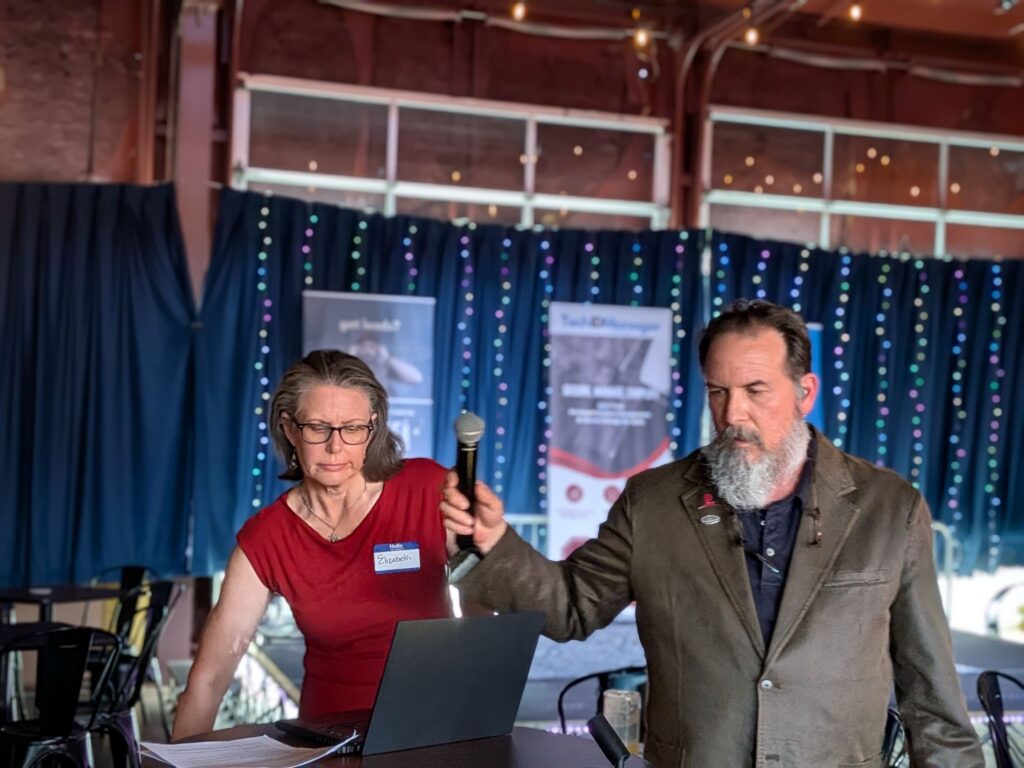
Every so often, a competition comes along that doesn’t just test a skill it validates a way of working that’s already been quietly proving itself for years. That’s what happened when John and Elizabeth Boyette, competing as Team Blackwatch Sky, won The Great AI Odyssey, an AI innovation bakeoff hosted by Channel Collab.
The premise was simple to describe and brutal to execute: two teams, one identical business challenge, twenty-four hours on the clock, and a live presentation in front of a panel of industry judges at the end. No weeks of preparation. No polished decks refined over a dozen internal reviews. Just raw thinking, real collaboration, and whatever a team could build between one Wednesday afternoon and the next.
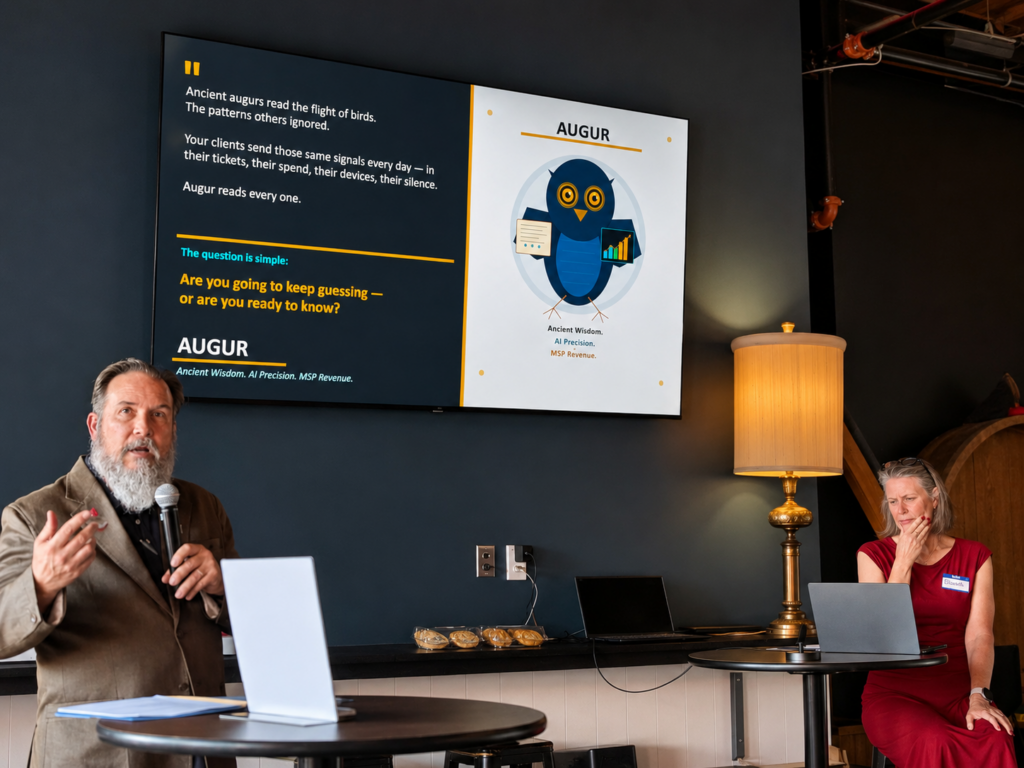
John and Elizabeth’s answer to that challenge was Augur, a concept for how MSPs can use AI to see a client’s needs coming before the client ever notices them. It won. And the story of how it came together says almost as much about the Boyettes’ partnership as it does about artificial intelligence.
Key takeaways
- The prompt was deliberately hard. “How can MSPs use AI to predict client needs?” is a question with no single right answer which is exactly what made two wildly different, both legitimate, solutions possible from two strong teams.
- Augur is about foresight, not automation. The concept wasn’t built to process support tickets faster; it was built to help an MSP see a problem before a ticket ever gets filed.
- Complementary skills won again. The same division of labor that runs CMIT Solutions of Greenville Elizabeth’s project discipline and client instincts, John’s technical depth and strategic thinking is what got Augur from blank page to finished prototype in one overnight sprint.
- Community made the moment possible. Channel Collab and GTIA (Global Technology Industry Association) built the stage; judges Martin White, Kyle Spooner, and Robert Griffin made the feedback count; Paul Hedgecock and Team Advanced Data made the competition real.
- The trophy is a footnote. For John and Elizabeth, the $500 grant and the Helm of Glory matter less than what the exercise reconfirmed: that the best technology ideas start with a real business problem, not a shiny new tool looking for a use case.
CHAPTER ONE
A challenge designed to expose real thinking
The Great AI Odyssey wasn’t built to reward whoever had the most polished slide deck. It was built to strip polish away entirely and see what was left.
At exactly 4:30 p.m. ET on a Wednesday, both competing teams received the identical business challenge at the identical moment: no early access, no advance notice, no head start for anyone. From there, the clock ran for twenty-four straight hours, and in that window, each team had to move through an entire concept-to-pitch cycle in miniature:
- Understand the business problem cold, with zero prior context to lean on
- Research realistic, genuinely usable AI-driven approaches
- Design a practical solution, not a theoretical one
- Build a working prototype or proof of concept
- Put together real presentation materials
- Present live to a panel of industry judges and defend the idea on the spot
Timeline at a glance
| Time | Milestone |
| Wed, 4:30 PM ET | Both teams receive the identical challenge simultaneously |
| Wed evening | Teams agree internally on direction; no time to start over later |
| Overnight | Concept development, prototyping, and division of labor |
| Thu, throughout the day | Refinement, testing, and presentation-building |
| Thu night | Live presentations in front of the judging panel |
| Thu, late night | Team Blackwatch Sky declared the winner with Augur |
For John and Elizabeth, this kind of pressure wasn’t unfamiliar. Running an MSP for over a decade means solving urgent problems with incomplete information and no do-overs, every single week. A 24-hour AI challenge, intense as it was, played directly to instincts they’d already been sharpening for years at CMIT Solutions of Greenville.
CHAPTER TWO
The question at the center of it all
Both teams were handed the exact same prompt to build around:
“How can MSPs use AI to predict client needs?”
It’s a deceptively simple sentence sitting at the center of one of the biggest shifts happening in managed services right now. For years, the standard model of IT support has been fundamentally reactive: something breaks, a ticket gets filed, a technician responds, and everyone moves on until the next thing breaks. It’s a model built around fixing problems after they’ve already cost a client time, money, or peace of mind.
AI opens a different possibility entirely. Instead of waiting for a server to fail or a security gap to be discovered mid-incident, artificial intelligence can spot the early warning signs the quiet patterns in operational data, the subtle shifts in system behavior that precede a failure by days or weeks. That shift, from reactive support to predictive service, is exactly the terrain John and Elizabeth chose to build on.

CHAPTER THREE
Introducing Augur
Team Blackwatch Sky’s winning concept takes its name directly from the ancient idea of foresight someone who reads the signs before the storm arrives, rather than cleaning up after it passes.
Rather than treating AI as a faster way to automate existing support tickets, a fairly obvious application at this point John and Elizabeth aimed higher. Augur was built around a more ambitious question: what if an MSP could see a client’s technology risk coming before the client ever noticed it themselves?
The concept explored how AI could analyze operational trends, client behavior patterns, and technology signals already sitting inside a typical business’s environment, then use that information to help an MSP:
What Augur set out to do
- Flag infrastructure issues while they’re still small — catching a failing drive or network bottleneck early, before it causes downtime.
- Recommend security improvements tailored to real usage patterns — instead of applying a generic checklist to every client regardless of how they actually operate.
- Identify the right moment for a technology upgrade — before aging hardware becomes a liability, not after.
- Strengthen long-term strategic planning conversations — replacing guesswork with data-informed roadmaps.
- Shift the entire client relationship from occasional troubleshooting to ongoing, proactive partnership — arguably the most ambitious part of the whole concept.
Importantly, Augur was never framed as a way to remove people from the equation. It’s the same philosophy John and Elizabeth apply to every client relationship at CMIT Solutions of Greenville: technology should sharpen human judgment, not replace it. If you want the full story behind the concept, ask them directly. It’s a lot more fun explained by the two people who built it in a single overnight sprint. And if their earlier feature on why business speak has to come before tech speak is any indication, they’ll explain it without a single unnecessary acronym.
“Clients don’t need us to sound smart. They need us to understand their business and help.” JOHN BOYETTE
CHAPTER FOUR
A formidable opponent, a well-earned win
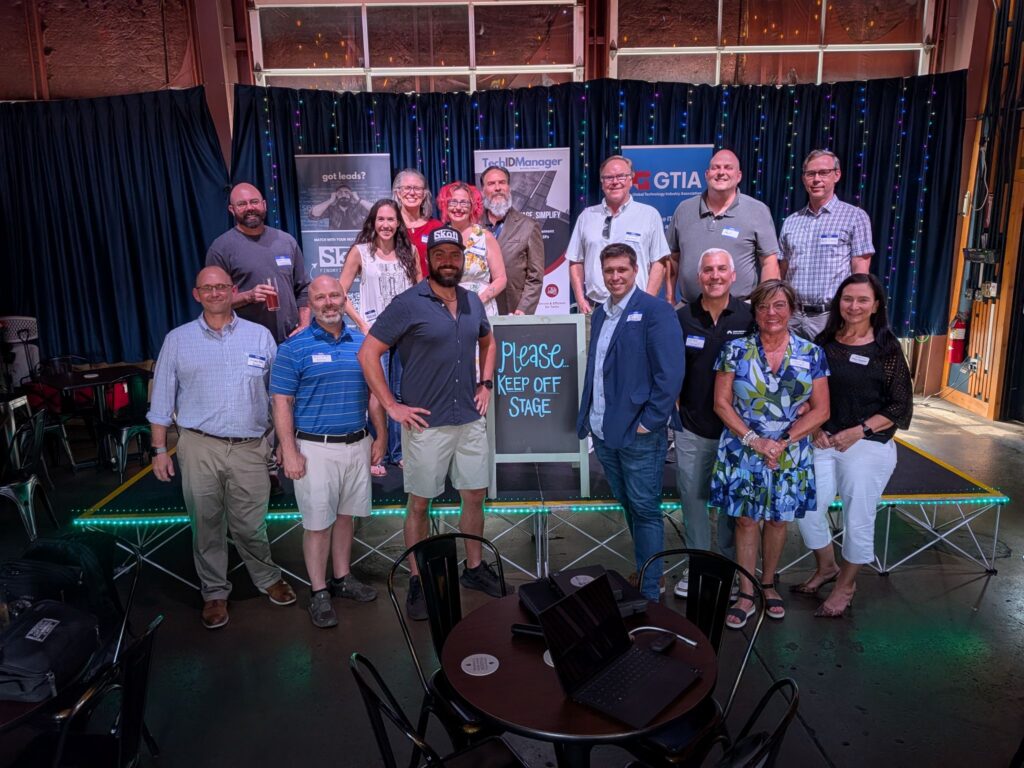
No competition story is complete without a worthy rival, and this one had one. Paul Hedgecock led Team Advanced Data through the same 24-hour gauntlet, and by every account, they brought serious energy to the final round including a presentation opener inspired by Star Wars that reportedly had people in the room grinning before a single AI concept had even been mentioned.
Two teams. One identical prompt. Twenty-four hours. Two completely different, both genuinely strong, interpretations of what “predicting client needs” could mean in practice. That’s really the point of a format like this, not just crowning a winner, but proving, in real time, how many legitimately different ways there are to solve the same hard problem well.
The judges who made it count
A competition like this only means something if the people evaluating it understand exactly what they’re looking at. Martin White, Kyle Spooner, and Robert Griffin each brought detailed, experienced feedback to both teams throughout the night, the kind of constructive critique that makes an event valuable for everyone in the room, not just the winners.
The event itself was made possible in part through continued collaboration with GTIA (Global Technology Industry Association), whose ongoing work bringing technology professionals together “meeting each other where you are,” as the community puts it helped set the stage for a format this ambitious to happen at all.
“Never say no to a client, because we have a nationwide system of hundreds of owners who will collectively figure out how to solve it.” ELIZABETH BOYETTE, ON THE ADVICE THAT STILL GUIDES HER
CHAPTER FIVE
Why winning was never really the point
Ask John and Elizabeth what they took away from the experience, and the $500 grant and the trophy come up almost as an afterthought. What they’ll actually talk about is everything that happened around the win: thinking clearly under real pressure, leaning on each other’s strengths the same way they do every day at CMIT Solutions of Greenville, exploring a genuinely new application of AI, and getting direct, unfiltered feedback from judges who’ve spent their careers in this exact industry.
There’s a bigger lesson sitting underneath the whole event, too: innovation rarely comes from a single “right” answer. Two teams were handed the identical problem and produced two entirely different, entirely legitimate solutions.
Why predictive AI matters for MSPs right now
Businesses depend on technology more heavily than at almost any point in history, and the cost of downtime, cybersecurity incidents, compliance failures, and aging infrastructure has never been higher. Done well, predictive AI can help an MSP:
- Recognize patterns hidden inside large volumes of operational data
- Catch early warning signs before a small issue becomes a full outage
- Recommend preventative maintenance before a failure, not after one
- Strengthen cybersecurity readiness by spotting unusual behavior early
- Forecast realistic hardware refresh cycles instead of guessing
- Optimize software licensing so clients aren’t overpaying for unused seats
- Support smarter, longer-term IT planning conversations with clients
Handled thoughtfully, this shift doesn’t just make an MSP more efficient it changes the entire relationship. Instead of being the company you call when something breaks, an MSP built around predictive AI becomes a genuine strategic advisor, sitting on the same side of the table as the client instead of arriving only after a crisis.
LIGHTNING ROUND
Rapid fire on AI, competition, and what’s next
⚡ What made Augur different from a typical AI pitch? It wasn’t built around automating support tickets faster. It was built around the harder, more ambitious question of whether an MSP could see a problem coming before the client noticed it at all.
⚡ AI: overhyped, under-hyped, or exactly right? Exactly right and completely transformative, when applied with a real purpose. Elizabeth points to a physical-security client who used an AI agent to cut a complex university RFP process from 40 hours of engineering labor down to just 2, with “dead on” accuracy.
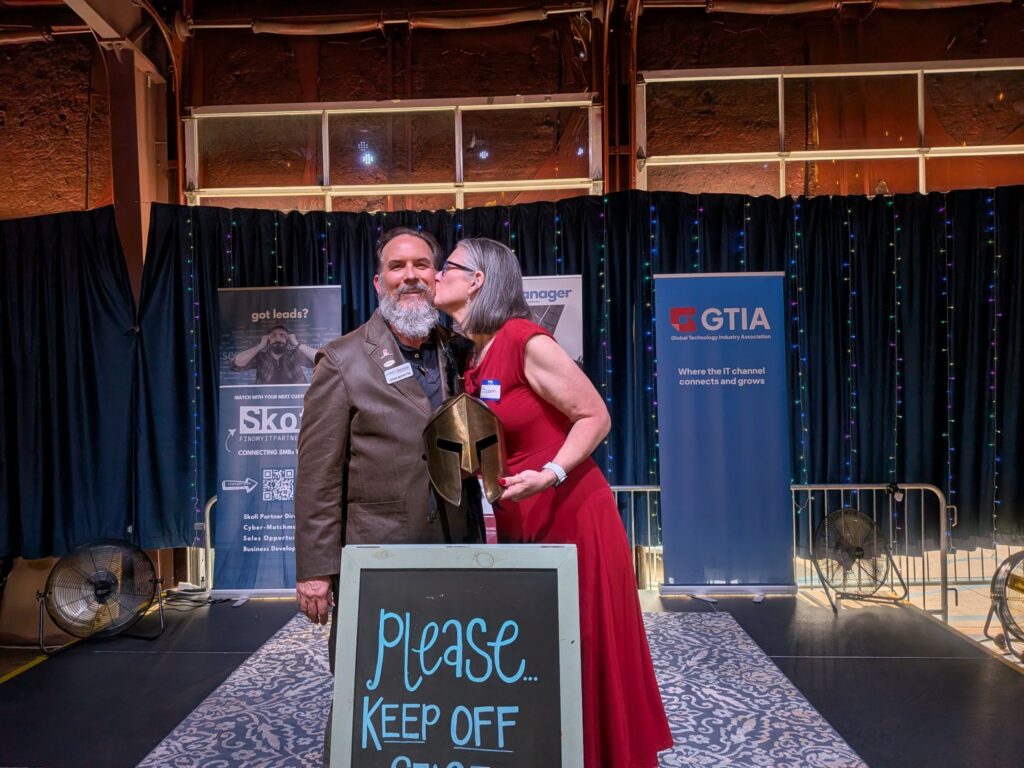
⚡ One word for how it felt to win? Validating. Not because the trophy mattered, but because it confirmed the same instincts that built CMIT Solutions of Greenville also held up under a 24-hour deadline with no safety net.
⚡ What’s next for Augur? An open question and an exciting one. Whether it becomes a formal offering, gets woven into how CMIT Solutions of Greenville already operates, or simply continues shaping how John and Elizabeth evaluate new AI tools, the thinking behind it has already outlived the competition itself.
THE PLAYBOOK
What any business owner can steal from Augur’s win
Strip away the AI-specific details, and the story of Augur reads like a field manual for building and pitching a new idea under pressure in IT or anywhere else:
- Constraints sharpen creativity, they don’t limit it. Twenty-four hours isn’t a lot of time, but the deadline forced fast, honest decision-making instead of endless second-guessing.
- Divide by strength, not by half. The same complementary-skills dynamic that runs CMIT Solutions of Greenville, one partner on concept and strategy, the other on framing and delivery is what got Augur from blank page to finished prototype overnight.
- Start with the real problem, not the flashy tool. Augur wasn’t built around a cool piece of technology looking for a use case. It was built around a genuine pain point MSPs face every day, and only afterward did the specific AI application follow.
- AI should sharpen human judgment, never replace it. Every capability behind Augur was designed to give people better information faster, not to remove them from the client relationship.
- Show up for the community, win or lose. Eleven years in the CMIT “Forerunners” mastermind group, a seat on the Franchise Advisory Council, and a Wednesday night spent competing against a fellow MSP owner are all the same instinct: get better faster by testing your thinking against smart peers.
MORE THAN ONE PIECE OF GOOD NEWS
What else is new at CMIT Solutions of Greenville
The Great AI Odyssey win landed in the middle of a genuinely busy stretch for John and Elizabeth:
Expansion into North Carolina. CMIT Solutions of Greenville is growing beyond South Carolina, with Eric Anthony, Chuck Szymczak, and Ross Feldman playing an instrumental role in helping get that expansion off the ground.
The 28th Greenville meetup July 30th. The long-running local meetup series is hitting its 28th installment, continuing a streak of consistent, in-person community building among Upstate IT professionals.
Channel Collab Growth Summit pre-day at ChannelCon. John and Elizabeth are helping host a pre-day event ahead of ChannelCon, joined by Kerry Anderson of ThreatCaptain, Joe Rojas of Start Grow Manage, Andreas Ambuehl, and Devon Stephens of Net3 Technology, Inc., focused on helping IT providers set themselves up for growth they can control in the second half of 2026.
Anyone interested in the Growth Summit, the meetup series, or Channel Collab’s broader event calendar can register directly at channelcollab.com.
THE BOTTOM LINE
Final thoughts
John and Elizabeth Boyette’s win at The Great AI Odyssey isn’t really a story about a trophy. It’s a story about what happens when a philosophy that’s already been tested for over a decade understands the real problem first, communicates like humans, and let the technology follow gets thrown into a 24-hour pressure test with no safety net. Augur passed that test in one high-stakes night. The same standard gets applied, quietly and consistently, to every client conversation CMIT Solutions of Greenville has the other 364 days of the year.
Ready to talk about predictive AI, cybersecurity, or anything in between? No tech speak. No scare tactics. Just a genuine conversation about your business’s specific risks and opportunities from the award-winning, husband-and-wife-led team at CMIT Solutions of Greenville.
Frequently asked questions
Q: Who won The Great AI Odyssey AI Bakeoff?
John and Elizabeth Boyette of CMIT Solutions of Greenville, competing as Team Blackwatch Sky, won with their AI concept, Augur.
Q: What was The Great AI Odyssey?
An AI innovation competition hosted by Channel Collab, challenging MSP professionals to build a complete AI-driven solution within a 24-hour window.
Q: What was the competition’s central challenge?
Teams were asked to answer: “How can MSPs use AI to predict client needs?”
Q: How much time did teams have?
Exactly 24 hours, starting from the moment they received the challenge at 4:30 p.m. ET on a Wednesday.
Q: What is Augur?
Augur is John and Elizabeth’s winning concept for helping MSPs shift from reactive support to proactive, predictive service by identifying client needs before problems occur.
Q: Who did they compete against?
Team Advanced Data, led by Paul Hedgecock, who delivered a strong, well-received presentation of their own.
Q: What did the winning team receive?
Team Blackwatch Sky received the $500 Channel Collab AI Innovation Grant and the symbolic Helm of Glory.
Q: Who judged the competition?
Martin White, Kyle Spooner, and Robert Griffin, who gave detailed feedback to both teams.
Q: What role did GTIA play?
GTIA (Global Technology Industry Association) supported the event as part of its broader mission of bringing technology professionals together.
Q: Does Augur replace the human side of managed IT support?
No. It was designed to strengthen the judgment of the people already managing client relationships, not replace them.
Q: Is CMIT Solutions of Greenville expanding?
Yes into North Carolina, with Eric Anthony, Chuck Szymczak, and Ross Feldman helping lead the effort.
Q: How do I hear more of John and Elizabeth’s story?
Listen to their full feature episode, Communication First, or read their franchisee feature.
Q: How do I get started with CMIT Solutions of Greenville?
Reach out directly through the contact page to start a genuine, jargon-free conversation.
EXPLORE CMIT SOLUTIONS OF GREENVILLE
Complete internal link directory
Learn more
Listen
Community & events
- Channel Collab: channelcollab.com