Running a single business location comes with its own set of technology challenges. Running five, ten, or twenty locations multiplies every one of those challenges while adding a layer of complexity most franchise owners never anticipated when they signed their first agreement. Point of sale systems need to stay in sync, security policies need to apply consistently across every site, and a network issue at one location should never be allowed to spread into a company wide outage. Yet many multi-location franchises are still managing their technology the same way a single-location business would, patching problems location by location instead of building a system designed for scale.
CMIT Solutions of Southeast Wisconsin works with franchise owners and multi-site operators across the region who are trying to solve exactly this problem, simplifying how technology is managed across locations while actually strengthening security rather than compromising it. This guide walks through the specific challenges multi-location franchises face, what a properly centralized IT strategy looks like, and how to balance consistency across locations with the flexibility each site still needs to operate efficiently.
Why Multi-Location Franchises Face Unique IT Challenges
A single business location can often get away with informal IT management, a local vendor for support, and security decisions made on the fly. That approach falls apart quickly once a business expands past one or two sites.
A few specific challenges emerge as franchises grow:
- Each new location adds its own network, devices, and potential vulnerabilities, multiplying the overall attack surface with every site added
- Inconsistent technology setups between locations make troubleshooting slower and more expensive, since no two sites look exactly the same
- Franchise brand standards often require consistent point of sale systems, security policies, and customer data handling across every location
- Local managers are rarely equipped to make informed security decisions, yet they often end up responsible for them by default
- A breach or outage at one location can quickly expose weaknesses shared across the entire franchise network if systems are not properly segmented
Many franchise owners only recognize these gaps after reviewing the broader growing business challenges that come with rapid multi-site expansion, at which point the cost of fixing inconsistent systems has already grown significantly.
The Cost of Inconsistent Technology Across Locations
When each location manages its own technology independently, small inefficiencies compound quickly across a franchise network. What might be a minor inconvenience at a single site becomes a significant operational drag when multiplied across ten or twenty locations.
Higher support costs. Troubleshooting becomes far more time consuming when every location has slightly different hardware, software versions, or network configurations, since there is no standard baseline to compare against.
Inconsistent customer experience. Point of sale slowdowns, Wi-Fi issues, or payment processing delays at one location can damage brand reputation just as much as a quality issue with the product itself.
Security gaps that spread unevenly. A location that falls behind on patching or lacks proper firewall configuration becomes a weak link that can potentially expose the entire franchise network, particularly if systems share any level of connectivity.
Difficulty scaling new locations. Opening a new site becomes far more complicated when there is no repeatable technology template to follow, forcing every launch to start from scratch.
Understanding how technology downtime impact affects a business helps illustrate why this inconsistency carries a real financial cost, not just an operational inconvenience.
What Simplified IT Management Actually Looks Like
Simplifying IT management across multiple locations does not mean removing flexibility or centralizing every single decision. It means building a consistent foundation that every location operates from, while allowing appropriate room for local needs.
A properly simplified structure typically includes:
- Standardized hardware and software. Every location runs the same core systems, making support faster and security policies easier to apply consistently.
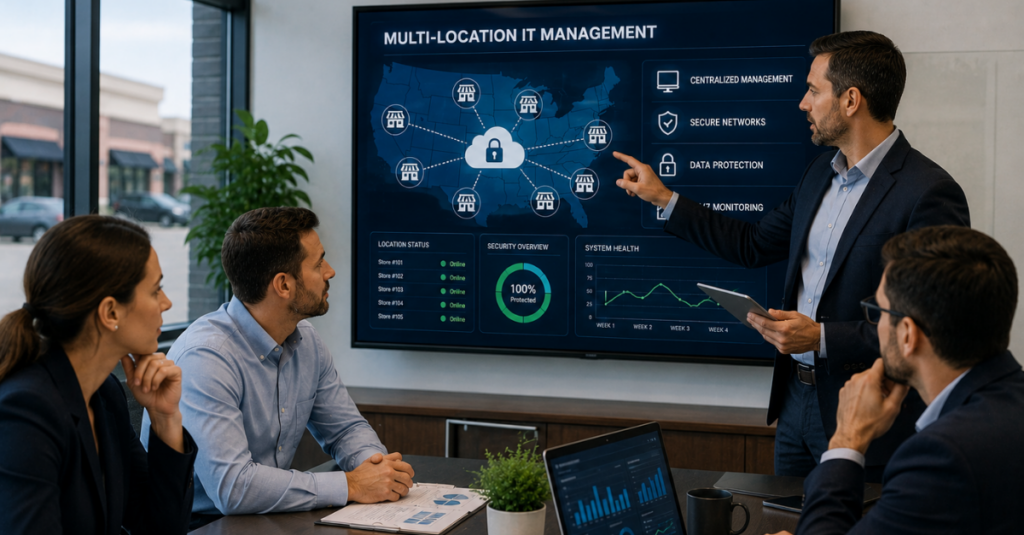
- Centralized monitoring. A single dashboard or management system provides visibility into every location’s network health and security status, rather than requiring separate checks at each site.
- Consistent security policies. Firewall rules, access controls, and data handling procedures apply uniformly across all locations, closing gaps that inconsistent local decisions tend to create.
- Repeatable deployment templates. New locations can be brought online quickly using a proven, standardized setup process rather than reinventing the approach each time.
- Clear escalation paths. Local staff know exactly who to contact and what steps to take when a technology issue arises, rather than guessing or waiting for a corporate response.
Franchises that successfully implement this approach often begin with a broader shift toward proactive technology management, moving away from reactive, location by location fixes toward a coordinated strategy applied across the entire network.
Network Standardization Across Locations
A consistent network setup is the foundation everything else depends on. Without it, security policies, monitoring tools, and support processes all become significantly harder to manage effectively.
Key elements of network standardization include:
- Uniform network equipment. Using the same routers, switches, and access points across locations simplifies troubleshooting and ensures consistent performance.
- Consistent Wi-Fi configuration. Both guest and internal networks should follow the same security standards at every location, avoiding the common mistake of treating guest Wi-Fi as an afterthought.
- Standardized bandwidth requirements. Point of sale systems, security cameras, and customer Wi-Fi all compete for bandwidth, and a standardized approach prevents any single location from being under-provisioned.
- Centralized network management solutions that provide visibility across every site from a single point of control, rather than requiring separate logins and monitoring for each location.
As franchise networks grow, many are also exploring how Wi-Fi 7 connectivity improvements could support faster, more reliable performance across high traffic locations, particularly those relying heavily on cloud based point of sale and inventory systems.
Centralized Security Without Sacrificing Local Speed
One of the biggest misconceptions among franchise owners is that strong centralized security automatically slows down local operations. In reality, a properly designed system improves both security and day to day speed by removing the guesswork local staff would otherwise face.
Centralized identity and access management. Employees across locations can be granted or revoked access instantly from a single system, rather than requiring manual updates at each site individually.
Consistent endpoint protection. Every device, whether a point of sale terminal, back office computer, or manager’s laptop, runs the same security software, monitored centrally through managed cybersecurity solutions rather than location specific tools.
Uniform patch management. Updates and security patches roll out on a consistent schedule across every location, closing the gap that inconsistent local IT decisions often create.
Zero trust principles applied network wide. Many multi-location businesses are moving toward a zero trust framework that verifies every access request regardless of location, rather than assuming trust based on which site a device happens to be connecting from.
This kind of centralized approach actually reduces the burden on local managers, who no longer need to make security decisions they were never properly equipped to handle in the first place.
Cloud Solutions for Multi-Location Consistency
Cloud based systems have become the backbone of most successful multi-location technology strategies, allowing franchises to maintain consistency without requiring identical physical infrastructure at every site.
Benefits of a cloud centered approach include:
- Centralized data access. Sales, inventory, and customer data can be accessed and analyzed across all locations from a single platform, supported by a reliable cloud services platform built to handle multi-site demands.
- Simplified software updates. Cloud based applications update automatically across every location simultaneously, eliminating the inconsistency that comes with manually updating software site by site.
- Scalability for new locations. Adding a new site becomes far simpler when core systems already live in the cloud rather than requiring new physical servers at every location.
- Cost predictability. Many franchises find that cloud cost optimization strategies help keep multi-location cloud spending predictable as the network continues to grow.
Working with a provider offering dedicated cloud support solutions ensures these systems remain properly configured as the franchise expands and business needs evolve over time.
Data Backup and Disaster Recovery Across Multiple Sites
A single location losing access to its data is a serious problem. A franchise network experiencing the same issue across multiple sites simultaneously, whether through ransomware or a regional outage, can be catastrophic without a properly designed recovery strategy.
Key considerations for multi-location backup and recovery include:
- Centralized backup management. Rather than relying on individual locations to manage their own backups, a centralized system ensures consistency and makes it far easier to verify that every site is actually protected.
- Location specific recovery priorities. Not every location needs to be restored in the same order during a widespread incident, and a clear recovery plan should define which systems and sites take priority.
- Redundant connectivity. Locations relying entirely on a single internet connection are vulnerable to a complete operational stop if that connection fails, making backup connectivity an important part of overall resilience.
Reliable reliable data backup practices applied consistently across every location remove the guesswork franchise owners would otherwise face when trying to confirm every site is actually protected.
Compliance Considerations for Franchise Networks
Franchise businesses often handle payment card data, customer information, and sometimes health related data depending on the industry, all of which come with specific compliance obligations that must be met consistently across every location.
A few areas deserve particular attention:
- Payment card industry standards. Point of sale systems across every location must meet consistent security requirements, since a single non-compliant site can create liability for the entire franchise network.
- Data handling consistency. Customer information should be collected, stored, and protected the same way at every location, rather than left to local interpretation.
- Documentation across sites. Compliance documentation should be centrally maintained and easily accessible, rather than scattered across individual location files.
Franchise owners working through these requirements often benefit from centralized compliance management support that applies a consistent standard across every location rather than requiring each site to interpret requirements independently, a challenge covered in more detail in resources exploring how compliance made simple can actually be achieved for growing organizations.
Vendor and Point of Sale System Management
Franchise networks often work with multiple vendors across payment processing, inventory management, and point of sale systems, and coordinating these relationships across many locations adds another layer of complexity.
Practical steps to simplify vendor management include:
- Standardizing on a single point of sale platform across all locations rather than allowing individual sites to select their own systems
- Maintaining a centralized vendor contact list with clear escalation procedures for technical issues affecting multiple locations
- Reviewing vendor security practices consistently, since a vulnerability in a shared point of sale platform can affect every location using it simultaneously
- Coordinating IT procurement services centrally to ensure new hardware and software purchases meet consistent standards across the franchise network
Employee Training Across Multiple Locations
Technology consistency means very little if employees at different locations receive inconsistent training on how to use and protect that technology. A centralized approach to training helps close this gap.
Consider the following practices:
- Standardized onboarding materials covering security basics, point of sale usage, and escalation procedures for every new hire regardless of location
- Regular phishing simulation exercises applied consistently across all sites, rather than only at corporate headquarters
- Clear procedures for reporting suspicious activity that every location manager understands and follows the same way
- Ongoing refresher training scheduled centrally to ensure consistency does not erode over time as staff turnover occurs
This consistency directly supports the kind of downtime reduction strategies franchise owners rely on, since well trained employees are far less likely to trigger the kind of incidents that lead to costly outages.
Recognizing When Your Franchise Technology Needs an Upgrade
Many franchise owners continue operating with fragmented, location by location technology simply because things have not broken yet. A few warning signs suggest it may be time for a more centralized approach.
- Each location seems to have its own version of hardware, software, or security tools
- Support tickets take noticeably longer to resolve because every location requires a different troubleshooting approach
- There is no single dashboard showing the health and security status of every location at once
- New location openings consistently take longer than expected due to technology setup delays
- Local managers frequently make independent security decisions without any centralized oversight
Reviewing the common IT upgrade signs that apply broadly across growing businesses often reveals that many of these same issues are amplified significantly once a business operates across multiple locations rather than just one.
Supporting Remote Management and Oversight
Franchise owners and regional managers rarely sit inside a single location full time, making remote visibility into technology performance and security status essential rather than optional.
A properly designed system should support:
- Remote monitoring of network health, security alerts, and system performance across every location from a single interface
- Secure remote access for managers and support staff who need to troubleshoot issues without physically visiting each site
- Infrastructure genuinely built to support remote work infrastructure demands, rather than systems adapted quickly during a transitional period and never properly hardened afterward
Many franchise networks are also beginning to explore how AIOps adoption trend developments can further reduce the manual effort required to monitor dozens of locations simultaneously, using automated systems to flag issues before they escalate into something that affects daily operations.
Choosing the Right IT Partner for a Growing Franchise Network
Not every IT provider has experience managing technology across multiple locations, and choosing the wrong partner can leave a franchise network just as fragmented as managing everything independently.
Qualities worth evaluating include:
- Proven experience supporting managed IT services across multiple sites, not just single-location businesses
- A trusted MSP provider relationship built around consistent communication and predictable response times across every location
- Familiarity with standardizing business productivity tools and communication platforms across a growing organization
- A unified communications platform approach that keeps every location connected consistently, regardless of size or location
- Support for expert cybersecurity support applied uniformly, rather than treating security as an afterthought at newer or smaller locations
- Willingness to evaluate an AI readiness assessment as franchise networks consider how automation and AI driven tools might improve efficiency across multiple sites
A partner offering genuine Wisconsin IT support with real experience across regional multi-site businesses can make the difference between technology that scales smoothly and technology that becomes more fragile with every new location added.

Building Reliable Infrastructure That Scales With Growth
Franchise networks rarely stay the same size for long, and technology built only for the current footprint tends to become a bottleneck the moment expansion accelerates. Planning infrastructure with future growth in mind saves significant cost and disruption later.
A few principles worth following include:
- Design for the next five locations, not just the current ten. Systems that only comfortably support existing locations often require costly rework once expansion picks up pace.
- Avoid one-off solutions. Every custom exception made for a single location adds long term complexity that compounds as the network grows.
- Prioritize documentation. Detailed records of network configurations, vendor contracts, and security policies make onboarding new IT partners or staff significantly easier as the organization scales.
- Revisit infrastructure decisions periodically. What worked for five locations may not comfortably support twenty, making periodic reviews an important part of long term planning.
This kind of forward thinking planning reflects the broader push toward reliable infrastructure needs that growing organizations across the region are increasingly prioritizing, recognizing that infrastructure decisions made early have a lasting impact on how smoothly future growth actually unfolds. Many franchise networks are also part of a broader shift, joining other counties moving proactive organizations that have already made this transition successfully.
Franchises considering a genuine long term strategic technology partnership rather than a series of individual vendor relationships often find this approach pays off significantly as the network continues to expand into new markets. Coordinating productivity tool solutions across every location as part of this broader strategy also helps ensure staff at every site are working from the same consistent set of tools, regardless of when a particular location joined the network.
Conclusion
Multi-location franchises do not need to choose between simplicity and security. A properly designed, centralized technology strategy actually strengthens both, reducing the operational burden on local managers while closing the security gaps that inconsistent, location by location decisions tend to create. The franchises that get ahead of this shift are the ones building standardized systems now, rather than waiting until fragmented technology becomes a liability that is far more expensive to fix.
The most successful multi-location operators tend to share a common trait: they treat technology as a core part of their operational strategy rather than a background utility handled separately at each site. When network standardization, centralized security, cloud infrastructure, and employee training all work together as a single coordinated system, franchise owners gain something that fragmented, location by location management can never provide, which is genuine confidence that every site is protected and performing consistently, regardless of how many locations the network eventually grows to include.
Franchise ownership already comes with enough variables to manage, from staffing to inventory to customer experience. Technology should not be one more thing pulling attention in a dozen different directions at once. A centralized, well maintained system frees up time and resources to focus on what actually drives growth, while quietly ensuring that security and consistency are handled in the background.
If your franchise network is still managing technology location by location, it may be worth taking the time to schedule a consultation to explore what a more centralized, consistent approach could look like across your entire organization.
Frequently Asked Questions