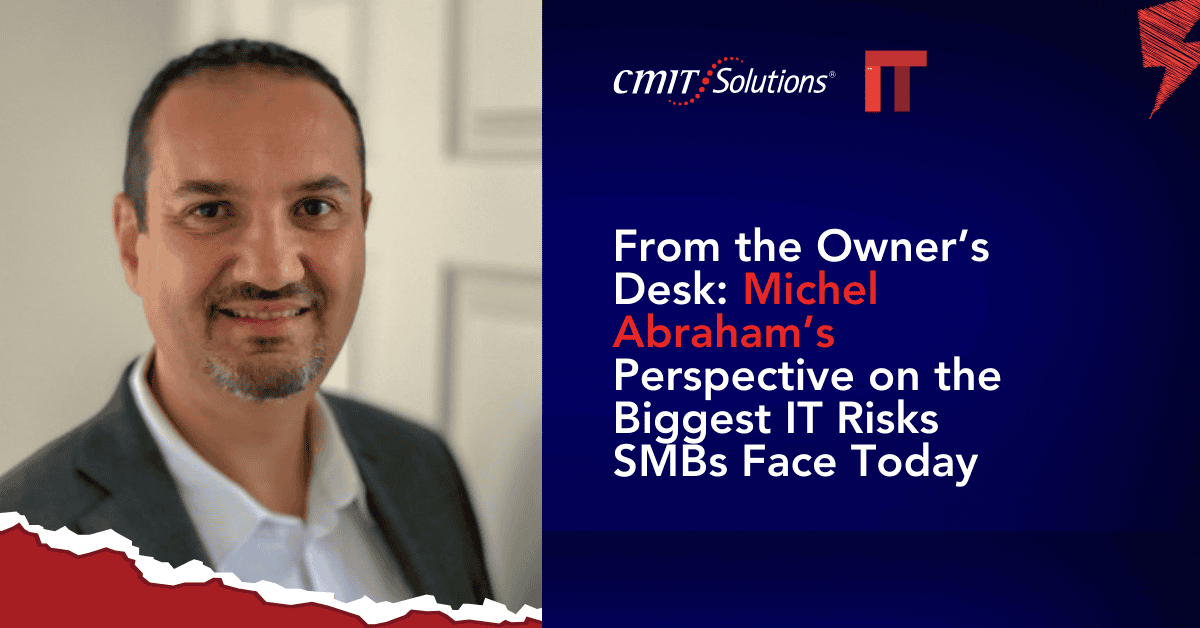
As the President of CMIT Solutions of Long Beach, I’ve had countless conversations with small and mid-sized business owners who believe their biggest risks are market competition, staffing challenges, or rising costs. While those concerns are valid, there is another category of risk that often goes underestimated until it causes real damage IT risk.
Today’s SMBs rely on technology for nearly every function of their business. That reliance creates opportunity, but it also creates exposure. The most serious IT risks I see are not always dramatic cyberattacks or system failures. More often, they are slow-building issues caused by outdated strategies, fragmented systems, and assumptions that “it won’t happen to us.”
Below are the biggest IT risks SMBs face today, based on what I see every day working directly with business leaders in our community.
Treating Cybersecurity as an IT Issue Instead of a Business Risk
One of the most common mistakes SMBs make is viewing cybersecurity as a technical problem rather than a business risk. When security is delegated solely to IT without executive involvement, critical decisions are often made without understanding their broader impact.
Cyber incidents affect revenue, reputation, operations, and customer trust. When leadership is disconnected from security strategy, businesses are left reactive instead of prepared.
From my perspective, this risk becomes clear when businesses fail to recognize that cybersecurity touches every part of the organization:
- Financial stability and operational continuity
- Customer and client trust
- Legal and contractual obligations
- Employee accountability
- Long-term business resilience
Overconfidence in Outdated or Incomplete Security Measures
Many SMBs believe they are protected because they have antivirus software, a firewall, or basic backups. While these tools are important, they are no longer sufficient on their own.
Threats have evolved, but many SMB security strategies have not. Overconfidence in outdated protections creates a false sense of security that leaves businesses exposed.
I often see this risk surface when businesses rely on:
- Single-layer security approaches supported by beyond antivirus
- Tools that are not actively monitored supported by understanding MDR, EDR, and SIEM
- Infrequent updates or patching supported by outdated OS
- Assumptions that size equals invisibility supported by cyber threats
- Lack of visibility into real-time threats supported by AI security
Growing IT Complexity Without Strategic Oversight
As businesses grow, their technology environments often become more complex. New software is added, vendors change, and systems evolve often without a clear strategy guiding those decisions.
This complexity increases the likelihood of misconfigurations, security gaps, and inefficiencies that quietly undermine the business.
From an owner’s perspective, unmanaged complexity becomes a serious risk when:
- Systems do not integrate properly supported by cloud sprawl
- No one has full visibility into the IT environment supported by cybersecurity metrics
- Security responsibilities are unclear supported by shadow IT
- Troubleshooting becomes time-consuming supported by IT downtime
- Costs increase without clear value supported by subscription trap

Underestimating the Risk of Human Error
Technology alone cannot protect a business. Employees interact with systems, data, and communication tools every day, making human behavior one of the most significant risk factors.
Phishing emails, weak passwords, and accidental data sharing remain common entry points for security incidents.
What concerns me most is not mistakes themselves but the lack of preparation that allows those mistakes to cause real harm.
This risk is most apparent when businesses lack:
- Ongoing security awareness training supported by security awareness
- Clear policies for handling sensitive information supported by digital workplace
- Strong access controls supported by zero trust
- Easy ways to report suspicious activity supported by cyberattack wake-up call
- Leadership reinforcement of security best practices supported by human error
Inadequate Planning for Downtime and Disruptions
Every business will experience disruption at some point—whether from cyber incidents, system failures, or unexpected events. The risk lies not in the disruption itself, but in being unprepared for it.
I’ve seen SMBs assume backups alone are enough, without considering how quickly systems can be restored or how long operations can realistically be down.
This risk becomes critical when businesses lack:
- Tested backup and recovery plans supported by ransomware resilience
- Clear roles during an incident supported by ransomware recovery
- Defined recovery timelines supported by disaster recovery
- Communication plans for staff and clients supported by proactive IT
- Confidence in their ability to resume operations supported by backup is not enough
Remote Work Expanding Access Without Proper Controls
Remote and hybrid work have become permanent for many SMBs, but access controls have not always kept pace. Employees now access systems from home networks, personal devices, and multiple locations.
Without strong identity and access management, this flexibility increases exposure.
From what I see, this risk grows when businesses allow:
- Password-only remote access supported by from passwords to passkeys
- Shared credentials supported by digital identity management
- Limited visibility into remote activity supported by remote access
- Unmanaged devices accessing systems supported by endpoint security
- Inconsistent access policies supported by shift from VPNs to zero trust
Compliance Risks That Are Easy to Overlook
Many SMBs assume compliance only applies to large enterprises or regulated industries. In reality, more businesses are affected by data protection, privacy, and contractual security requirements than ever before.
Non-compliance often isn’t intentional—it happens when businesses don’t realize how their technology choices impact obligations.
This risk shows up when businesses lack:
- Clear documentation of IT policies supported by IT audits
- Consistent access controls supported by managed compliance
- Audit-ready reporting supported by compliance audits
- Awareness of industry expectations supported by cybersecurity compliance
- Alignment between IT and compliance needs supported by compliance puzzle
Relying on Too Many IT Vendors Without Clear Accountability
Vendor sprawl is a growing issue for SMBs. Multiple vendors managing different pieces of IT often leads to finger-pointing when something goes wrong.
Without a single point of accountability, risks fall through the cracks.
From my experience, this becomes a serious issue when:
- No one owns the overall IT strategy supported by your IT provider
- Security responsibilities are fragmented supported by beyond the firewall
- Vendors do not communicate with each other supported by multi-cloud management
- Costs are difficult to track supported by tech debt
- Issues take longer to resolve supported by managed IT

Delaying IT Decisions Until Problems Become Emergencies
One of the biggest risks I see is hesitation. SMB leaders are busy, and IT decisions often get postponed until something breaks or a security incident occurs.
Unfortunately, emergency decisions are almost always more expensive and disruptive than proactive planning.
This risk is evident when businesses:
- Operate in reactive mode supported by transforming IT support
- Delay system upgrades supported by windows 10 support ends
- Ignore early warning signs supported by small gaps big breaches
- Lack long-term IT planning supported by 2026 technology roadmap
- Make decisions under pressure supported by real threat behind ransomware
Not Treating IT as a Long-Term Investment
The final risk is viewing IT as a cost center rather than a strategic investment. Businesses that only spend on IT when necessary often struggle to scale, secure operations, or adapt to change.
In contrast, businesses that invest thoughtfully in IT gain stability, efficiency, and confidence.
From the owner’s desk, I see the difference clearly when businesses:
- Align IT with business goals supported by driving growth
- Invest in proactive management supported by proactive IT
- Plan for growth and risk supported by future-proofing
- Measure outcomes, not just costs supported by technology roadmap
- Treat IT as a business enabler supported by Michel Abraham
Final Thoughts from the Owner’s Desk
The biggest IT risks SMBs face today are not always obvious, and they rarely announce themselves in advance. They develop quietly through assumptions, shortcuts, and deferred decisions until they reach a breaking point.
At CMIT Solutions of Long Beach, my goal is to help business owners identify and reduce these risks before they disrupt operations, damage trust, or limit growth. When IT is approached strategically, it becomes a source of strength rather than uncertainty.
If you’re unsure where your business stands, that uncertainty itself is a sign worth paying attention to. The right conversations and the right guidance can make all the difference.