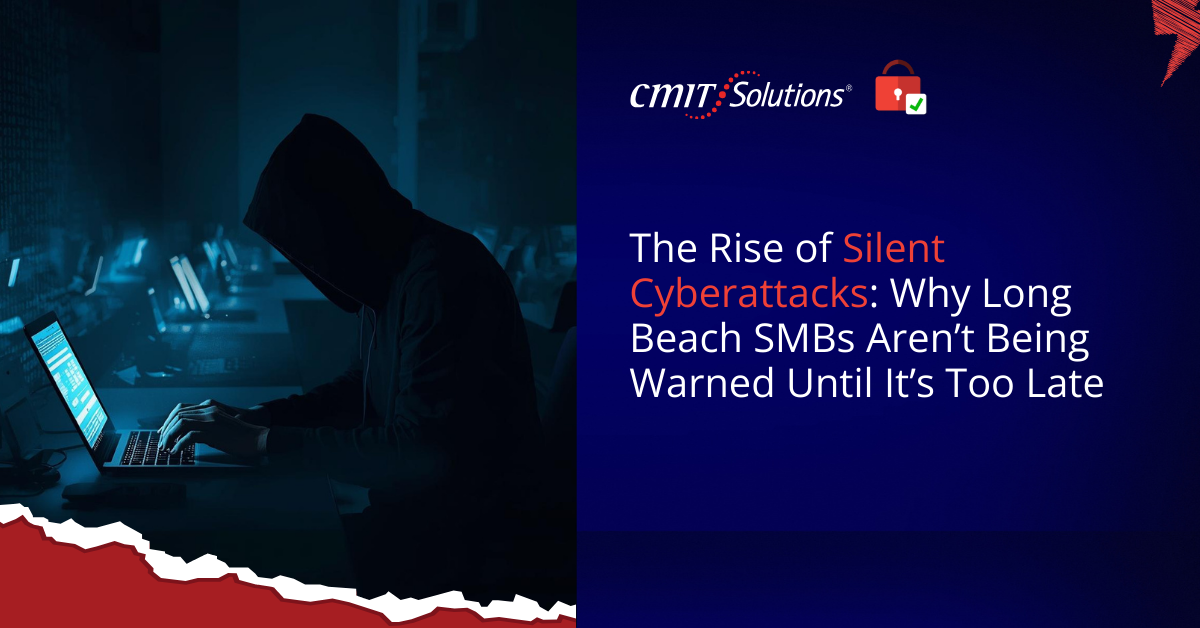
Cyberattacks don’t always announce themselves with flashing screens or locked systems. In fact, some of the most damaging attacks facing small and midsize businesses today happen quietly without alarms, without obvious disruption, and without immediate consequences.
For many businesses in Long Beach, the first sign of a cyber incident isn’t an alert from IT. It’s a financial discrepancy, a compliance issue, a customer complaint, or a system failure weeks or even months after the breach actually occurred.
These are silent cyberattacks. And they are quickly becoming one of the most dangerous threats to growing businesses.
Why modern cyberattacks no longer look like “attacks”
The public image of cybercrime is outdated. While ransomware still grabs headlines, attackers are increasingly choosing stealth over speed.
Today’s cybercriminals prioritize:
- Gaining long-term access instead of causing immediate disruption
- Blending into normal user behavior
- Avoiding alerts and automated detection
- Observing business operations to identify valuable data
This evolution is intentional. Loud attacks trigger responses. Silent attacks generate sustained access and profit especially as AI-driven threats become more adaptive and difficult to detect.
For SMBs without continuous monitoring, these attacks often remain invisible until real damage has already occurred.
Why Long Beach SMBs are especially vulnerable to silent threats
Small and midsize businesses rely on a mix of cloud tools, remote work systems, vendors, and legacy technology to stay competitive. Over time, these environments grow complex and fragmented.
Common risk factors include:
- Limited in-house cybersecurity expertise
- IT environments built reactively instead of strategically
- Infrequent security assessments
- Overreliance on “set it and forget it” tools
As systems expand, many organizations unknowingly introduce shadow IT unauthorized applications and services that create blind spots attackers actively seek out.

Silent threats thrive in these gaps because they don’t exploit obvious weaknesses. They exploit overlooked ones.
The most common forms of silent cyberattacks
Silent attacks don’t follow a single pattern. They blend into everyday business activity, making them harder to identify.
Credential misuse and account takeovers
Stolen usernames and passwords allow attackers to log in as legitimate users. Without advanced detection, this activity often appears normal especially for organizations still relying solely on passwords instead of preparing for next-generation authentication.
Unauthorized access through trusted tools
Collaboration platforms, cloud services, and remote access tools are designed for convenience. When misconfigured, they expose sensitive data through insecure cloud file sharing practices that don’t immediately trigger alerts.
Long-dwell malware
Some malware is designed to remain dormant, quietly collecting data or maintaining backdoor access. These threats often overlap with insider threat scenarios, making them even harder to detect without behavioral monitoring.
Why businesses don’t get warned in time
Most SMBs rely on security tools designed to detect obvious failures, not subtle anomalies.
Typical detection gaps include:
- Antivirus tools focused only on known signatures
- Firewalls that aren’t regularly reviewed or updated
- Alerts that go unseen after business hours
- Logs that are collected but never analyzed
Modern attackers design their methods to bypass these controls. That’s why many organizations are shifting away from perimeter-only defenses and toward Zero Trust security models that assume threats already exist inside the environment.
The real business impact of delayed detection
When a cyberattack goes unnoticed, the consequences compound over time.
Silent cyberattacks often lead to:
- Prolonged data exposure without clear timelines
- Compliance violations discovered during audits
- Financial losses tied to fraud or operational disruption
- Legal and contractual complications
- Erosion of customer and partner trust
Without a clear understanding of when or how a breach occurred, organizations struggle to recover especially when business continuity plans haven’t been designed for stealthy incidents.
Why traditional security approaches fall short
Many businesses believe they’re protected because they’ve invested in security tools. The issue isn’t always the technology—it’s the lack of visibility and response.
Common shortcomings include:
- Security tools operating in isolation
- No centralized monitoring
- Inconsistent patching and updates
- Undefined incident response procedures
This is why more organizations are moving toward proactive IT strategies that focus on early detection, continuous oversight, and prevention instead of reaction.

How proactive monitoring changes the outcome
The difference between a contained incident and a major breach often comes down to timing.
With proactive monitoring, businesses can:
- Detect abnormal login behavior early
- Identify unauthorized access attempts
- Stop lateral movement before damage spreads
- Respond in real time instead of weeks later
Instead of discovering problems after the fact, organizations gain the ability to act before attackers reach critical systems.
How CMIT Solutions of Long Beach helps businesses stay ahead of silent threats
At CMIT Solutions of Long Beach, we help SMBs uncover risks that don’t announce themselves.
Our approach focuses on:
- Identifying hidden vulnerabilities across your IT environment
- Implementing continuous monitoring and threat detection
- Improving visibility into systems, users, and devices
- Aligning cybersecurity with compliance and business goals
- Reducing risk without disrupting productivity
Silent cyberattacks don’t knock. They slip in quietly and wait. The key to stopping them is building protection that works behind the scenes.
Conclusion: Don’t wait for silence to become damage
Cyber threats no longer rely on disruption to succeed. The most dangerous attacks are the ones you don’t see until it’s too late.
By improving visibility, adopting proactive monitoring, and aligning security with business operations, Long Beach SMBs can reduce risk and regain control.
If you’re unsure whether your current security strategy would detect a silent attack, contact us to schedule a conversation with CMIT Solutions of Long Beach and take the first step toward protection that doesn’t wait for alarms to sound.