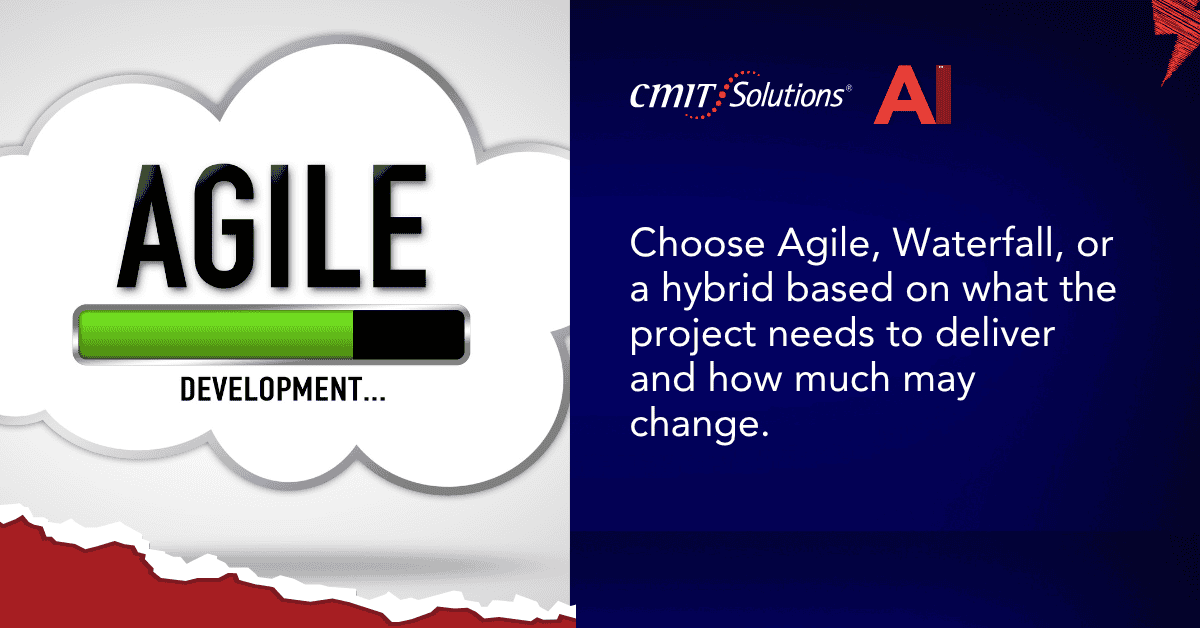
Every software or technology project starts with a decision that shapes everything downstream: how will the work actually get managed? Agile and Waterfall get discussed like a permanent rivalry, but the truth is neither one is universally right. The correct answer depends on your project’s complexity, your team’s structure, your industry’s regulatory requirements, and how much uncertainty exists at the start.
CMIT Solutions of Long Beach works with growing businesses across healthcare, finance, construction, and professional services on technology projects ranging from custom software builds to full system migrations, and the same question comes up constantly: which development methodology should we actually use? Too often, businesses pick a methodology because it’s trendy or because a previous employer used it, rather than because it fits the specific project in front of them.
This guide breaks down how Agile, Waterfall, and hybrid approaches actually work, when each one makes sense, and how to choose confidently instead of guessing.
Why Methodology Choice Matters More Than Most Businesses Realize
Choosing the wrong development approach doesn’t just slow a project down, it can derail it entirely. A rigid Waterfall process applied to a project full of unknowns leads to expensive rework when requirements inevitably shift. An unstructured Agile process applied to a project with strict compliance deadlines can spiral into scope creep with no clear delivery date.
This decision connects to a much broader pattern many SMBs struggle with: the gap between how a project is planned and how it’s actually managed once real complexity sets in. It echoes the same technology growth struggles businesses run into when their processes don’t scale alongside their ambitions. Getting the methodology right at the start is significantly cheaper than course-correcting halfway through a project.
What Is Waterfall Development?
Waterfall is a linear, sequential approach where each project phase must be completed before the next begins. Requirements are gathered upfront, followed by design, development, testing, and deployment, each in its own distinct stage.
Core characteristics include:
- Detailed requirements documented before any development begins
- Clear, fixed milestones and deliverables at each phase
- Limited flexibility to change direction once a phase is complete
- Strong emphasis on documentation and formal sign-offs
- Predictable timelines and budgets, assuming requirements don’t change
Waterfall works best when a project’s requirements are well understood from the outset and unlikely to change significantly. It’s a natural fit for projects with strict regulatory documentation needs, where every phase needs to be auditable and traceable.
What Is Agile Development?
Agile is an iterative approach where work happens in short cycles, often called sprints, with continuous feedback and adjustment throughout the project rather than locking in requirements upfront.
Core characteristics include:
- Requirements evolve based on ongoing feedback rather than being fixed at the start
- Work is broken into small, testable increments delivered every few weeks
- Cross-functional teams collaborate closely and adjust priorities regularly
- Emphasis on working software over extensive documentation
- Flexibility to respond to changing business needs mid-project
Agile works best when requirements are likely to evolve, when speed to market matters, or when stakeholders want to see and react to progress incrementally rather than waiting until the end of a long development cycle.
What Is a Hybrid Approach?
A hybrid methodology blends elements of both, typically using Waterfall’s structured planning and governance for high-level phases while applying Agile’s iterative development within each phase. This has become increasingly common because most real-world projects don’t fit neatly into either extreme.
A typical hybrid structure might look like:
- Waterfall-style upfront planning, budgeting, and requirements gathering
- Agile sprints for the actual development and testing work
- Waterfall-style formal sign-off and documentation at major milestones
- Agile-style retrospectives and adjustments between phases
Hybrid approaches are particularly common in regulated industries where compliance demands documentation and formal approval gates, but the underlying development work still benefits from iterative flexibility.
Key Factors That Should Drive Your Decision
Rather than starting with “which methodology do we prefer,” the better starting question is “what does this specific project actually need.” A handful of factors consistently determine the right fit.
Requirement Stability
If requirements are well-defined and unlikely to change, such as a compliance-driven system upgrade with fixed regulatory specifications, Waterfall’s structure reduces risk. If requirements are likely to evolve as the project progresses, Agile’s flexibility prevents costly rework.
Project Complexity and Uncertainty
Highly complex projects with many unknowns benefit from Agile’s ability to test assumptions early and adjust course before too much investment has been made. Simpler, well-scoped projects can move efficiently through a Waterfall process without needing constant iteration.
Stakeholder Involvement
Agile requires consistent, ongoing stakeholder engagement throughout the project. If your business can’t commit to regular review cycles and feedback sessions, a Waterfall approach with defined checkpoints may be more realistic.
Regulatory and Compliance Requirements
Industries with strict documentation and audit requirements often need Waterfall’s formal sign-off structure, or a hybrid approach that layers Agile development within a Waterfall governance framework. This connects directly to why compliance has become a competitive advantage rather than a background requirement, since clients and partners increasingly expect documented, auditable processes.
Timeline Pressure
If a business needs to get a working product to users quickly and can accept iterative improvement afterward, Agile typically delivers value faster. If a hard deadline exists with no room for phased delivery, Waterfall’s predictability can be an advantage.
Team Structure and Location
Agile thrives with co-located or tightly coordinated cross-functional teams. Distributed teams across multiple time zones sometimes find Waterfall’s clearer handoff points easier to manage, though well-run hybrid remote teams can succeed with either approach given the right tools.
Industry-Specific Guidance
Healthcare Technology Projects
Healthcare projects involving patient data or clinical systems often require the documentation rigor of Waterfall or a hybrid model, particularly given the strict requirements outlined in healthcare providers upgrading their systems to protect patient information. However, Agile sprints within that governance structure allow development teams to test and validate features incrementally rather than waiting until the very end to discover a design flaw.
Financial Services and CPA Firms
Financial technology projects typically involve strict security and compliance checkpoints, making a hybrid approach common. Firms should weigh this decision alongside broader technology risk reviews, since a poorly managed development process can itself introduce security gaps if testing and review cycles aren’t built in properly.
Construction and Engineering Firms
Projects connecting field operations with office systems often benefit from Agile’s flexibility, since real-world field feedback frequently reveals requirements that weren’t obvious during initial planning. This mirrors the same construction IT friction many firms face when systems are designed without enough input from the people actually using them day to day.
Law Firms
Legal technology projects, particularly those touching client confidentiality or case management, often lean toward hybrid models that maintain strict documentation while still allowing iterative refinement of user-facing features based on attorney and staff feedback.
Nonprofits
Nonprofits with limited budgets often benefit from Agile’s incremental delivery, since it allows a project to launch with core functionality and expand over time rather than requiring the full budget upfront, similar to how nonprofits improve cybersecurity without major budget increases by prioritizing incrementally.
Common Misconceptions About Agile and Waterfall
“Agile means no planning.” This is one of the most persistent myths. Agile still requires planning, it just happens continuously throughout the project rather than entirely upfront. Sprint planning, backlog grooming, and roadmap sessions are all structured planning activities within an Agile framework.
“Waterfall means no flexibility at all.” While Waterfall is more rigid than Agile, well-managed Waterfall projects still include change control processes for handling necessary adjustments, they’re just more formal and less frequent than Agile’s continuous iteration.
“Hybrid is just indecision.” A properly designed hybrid approach isn’t a compromise born of indecision, it’s a deliberate structure that matches governance requirements to Waterfall’s strengths while matching development work to Agile’s strengths.
“Agile is always faster.” Agile often delivers initial working functionality faster, but that doesn’t automatically mean the total project timeline is shorter. Complex projects with poorly managed scope can actually take longer under Agile if there’s no discipline around prioritization.
“Methodology choice doesn’t matter if the team is skilled enough.” Even highly skilled teams underperform when the methodology doesn’t match the project’s actual constraints, particularly around compliance documentation or stakeholder availability.
A Practical Framework for Choosing
Rather than debating methodology in the abstract, walk through this scoring exercise for your specific project.
Step 1: Rate requirement stability. On a scale of high to low, how well-defined and unlikely to change are your project requirements?
Step 2: Rate regulatory documentation needs. Does this project require formal audit trails, sign-offs, or compliance documentation at each stage?
Step 3: Rate stakeholder availability. Can key stakeholders commit to regular review cycles throughout the project, or only at defined milestones?
Step 4: Rate timeline flexibility. Is there room for phased delivery, or does the business need a complete solution by a fixed date?
Step 5: Rate team structure. Is the team co-located and cross-functional, or distributed across multiple departments and locations?
Projects scoring high on requirement stability, regulatory needs, and limited stakeholder availability tend to fit Waterfall. Projects scoring high on uncertainty, flexibility needs, and stakeholder engagement tend to fit Agile. Most real-world enterprise projects land somewhere in the middle, which is exactly why hybrid approaches have become so common.

Common Project Types and Their Typical Fit
ERP implementations (such as moving to a platform like Business Central) often benefit from a hybrid approach: Waterfall-style planning and data migration phases, combined with Agile testing and refinement cycles for configuration and workflow design.
Custom software development for internal tools or customer-facing applications typically favors Agile, since user feedback during development significantly improves the final product compared to a fully specified upfront design.
Web portal builds, discussed in more detail in our guide on building enterprise portals, benefit strongly from a phased Agile approach, launching core functionality first and expanding based on real usage data.
Infrastructure migrations, such as cloud migration projects, often fit a Waterfall or hybrid model best, since infrastructure changes typically require careful sequencing and validation at each stage rather than continuous iteration.
Cybersecurity implementations, including rollouts tied to zero trust security models, often benefit from hybrid structures that maintain strict documentation for compliance while allowing iterative testing of access controls and policies.
Risks of Choosing the Wrong Methodology
It’s worth being direct about what goes wrong when the methodology doesn’t fit the project.
Applying rigid Waterfall to uncertain projects leads to expensive rework when requirements inevitably shift partway through, since changes discovered late in a Waterfall process are far more costly to implement than changes caught early.
Applying unstructured Agile to compliance-heavy projects can create documentation gaps that cause serious problems during audits, particularly for healthcare and financial services businesses subject to strict regulatory oversight.
Applying Agile without proper scope discipline leads to scope creep, where continuous iteration turns into an endless project with no clear finish line, consuming far more budget and time than originally planned.
Applying Waterfall without stakeholder buy-in to the upfront process leads to a detailed plan that stakeholders don’t actually support, resulting in requested changes mid-project that the rigid process wasn’t designed to accommodate.
These risks compound when a business is already dealing with IT vendor sprawl, since a mismatched methodology on top of a fragmented vendor environment makes coordination even more difficult.
Security Considerations Across Methodologies
Regardless of which methodology a business chooses, security cannot be treated as a phase that happens at the end of the project.
- In Waterfall projects, security requirements should be defined during the initial requirements phase and validated at every subsequent milestone, not tested only once near the end.
- In Agile projects, security testing should be built into every sprint, not saved for a final review, reflecting the same continuous vigilance emphasized in real-time threat monitoring approaches.
- In hybrid projects, security governance should follow the Waterfall structure’s formal checkpoints while the underlying Agile development incorporates ongoing testing between those checkpoints.
Access control design also matters throughout, regardless of methodology. Projects that touch sensitive systems should apply the same identity first security principles used elsewhere in the business, ensuring development and testing environments don’t become an overlooked weak point.
How to Talk to Your IT Partner About Methodology
Many business leaders aren’t development experts, and that’s fine, but it helps to ask the right questions when discussing a project with an IT partner or development team.
- Why is this specific methodology being recommended for our project?
- How will requirement changes be handled if they come up mid-project?
- What does the review and sign-off process look like at each stage?
- How will security testing be incorporated, and at what points in the process?
- What happens if the project timeline needs to shift partway through?
- How will we be kept informed of progress, and how often?
A good IT partner should be able to answer these clearly and explain why the recommended approach fits your specific project, not just default to whatever methodology they’re most comfortable with regardless of fit.

The Role of Managed IT Support in Development Projects
Choosing the right methodology is only part of running a successful technology project. The surrounding infrastructure, security, and support all need to align with whichever approach is chosen.
- Overall project oversight and ongoing technology management are typically supported through managed IT services, giving businesses a consistent point of accountability regardless of methodology.
- Productivity and collaboration tools used to manage sprints, documentation, and team communication fall under productivity applications support.
- Development and testing environments often rely on scalable cloud services, particularly for Agile projects requiring frequent deployment cycles.
- Regulatory documentation and audit requirements are supported through dedicated compliance planning, especially relevant for Waterfall and hybrid projects in regulated industries.
- Vendor and tooling decisions benefit from a structured IT procurement process, avoiding mismatched licensing or redundant development tools.
- Security testing and access management throughout the project fall under cybersecurity protections, applied consistently regardless of which methodology is in use.
- Team support during development is handled through everyday IT support, keeping technical friction low for teams working through sprints or project phases.
- Network performance for distributed or hybrid development teams depends on reliable network management.
- Data protection for project files, code repositories, and documentation relies on consistent data backup practices throughout development.
- Communication across project teams is often supported through unified communications tools, particularly important for Agile teams relying on frequent check-ins.
- Strategic alignment between the project and broader business goals benefits from ongoing IT guidance, ensuring methodology decisions support the company’s larger technology roadmap rather than existing in isolation.
CMIT Solutions of Long Beach has supported growing businesses across multiple industries in choosing and managing the right development approach for projects ranging from custom software to full infrastructure migrations. The consistent lesson: the methodology should be chosen to fit the project’s actual constraints, not selected out of habit or industry trend, and the surrounding IT foundation needs to support whichever approach is chosen.
Questions to Ask Before Committing to a Methodology
Before finalizing a development approach, it’s worth reviewing a short internal checklist:
- Have we honestly assessed how stable our requirements actually are?
- Do we understand our regulatory documentation obligations for this specific project?
- Can our stakeholders realistically commit to the review cadence the chosen methodology requires?
- Have we discussed how security testing will be incorporated at every stage?
- Is there a clear process for handling scope changes, however the methodology is structured?
- Does our IT partner have experience managing this specific type of project with this approach?
If any of these don’t have a confident answer, it’s worth spending more time in the planning conversation before locking in a methodology.
Conclusion
There’s no universally correct answer to Agile versus Waterfall versus hybrid. The right choice depends entirely on your project’s requirement stability, regulatory obligations, stakeholder availability, and timeline pressure. Businesses that treat methodology selection as a deliberate decision, rather than a default habit, consistently see smoother projects, fewer costly surprises, and better alignment between what gets built and what the business actually needed.
If your business is planning a technology project and isn’t sure which development approach fits best, the team at CMIT Solutions of Long Beach can help you evaluate your specific requirements and choose a structure that reduces risk rather than adding to it. Schedule a consultation to talk through your upcoming project and the right approach for your team.
Frequently Asked Questions