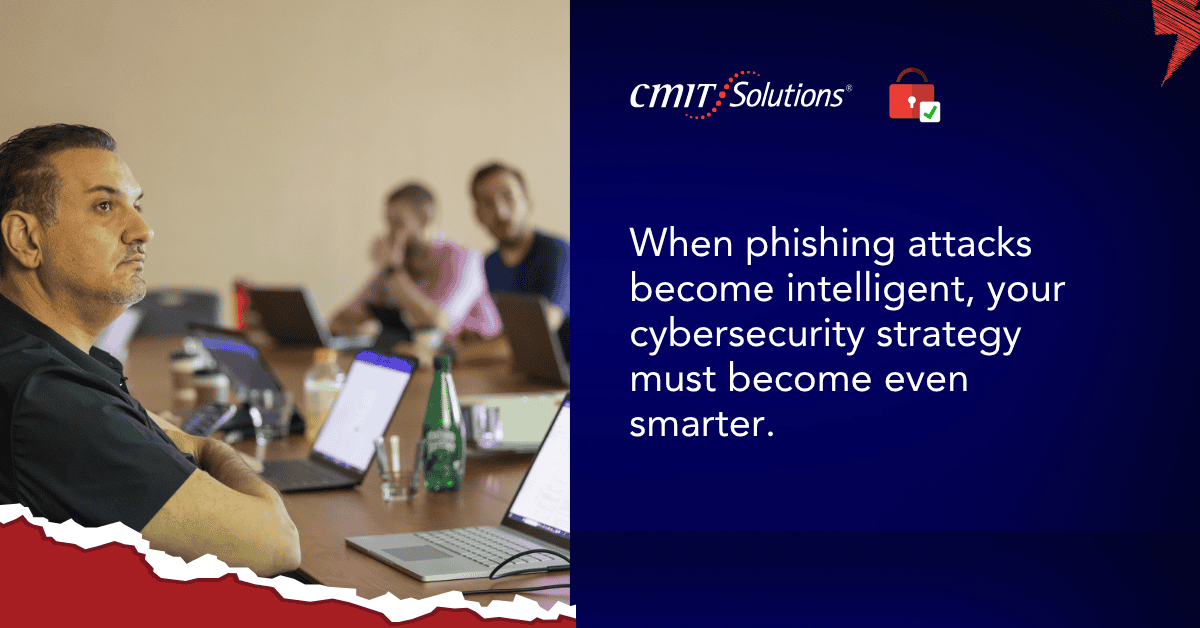
Phishing used to be easy to spot. Broken grammar, generic greetings, obviously fake sender addresses, most employees learned to catch these red flags years ago. That era is quietly ending. Artificial intelligence has given cybercriminals the ability to write flawless emails, clone voices, mimic writing styles, and personalize attacks at a scale that was never possible before.
Today’s phishing emails don’t just avoid typos. They reference real projects, use the correct names of coworkers and vendors, match a company’s tone of voice, and arrive at exactly the right moment, right after a wire transfer request, right before a payroll run, right when someone is traveling and harder to reach for verification. AI hasn’t just made phishing more convincing. It’s made it faster, cheaper, and easier to launch at scale.
Businesses working with CMIT Solutions of Long Beach are seeing this shift firsthand, as AI generated phishing attempts increasingly slip past defenses that worked reliably just a couple of years ago. This article breaks down exactly how AI is changing phishing, why older security habits fall short, and what businesses need in place to stay protected.
How AI Has Changed the Phishing Playbook
Traditional phishing relied on volume. Attackers sent thousands of generic emails hoping a small percentage of recipients would click a malicious link or hand over credentials. AI has flipped this model. Instead of relying on volume alone, attackers now use AI to make every single message more convincing, more personalized, and more likely to succeed.
Ways AI is reshaping phishing attacks include:
- Generating grammatically flawless emails in any language or tone
- Scraping public data from LinkedIn, company websites, and social media to personalize messages
- Mimicking the writing style of executives or coworkers based on publicly available content
- Creating convincing fake websites and login pages in minutes instead of days
- Automating entire phishing campaigns that adjust based on recipient behavior
This shift explains why so many businesses are rethinking their approach to security altogether. A closer look at modern hacking tactics shows just how much more sophisticated cybercriminal tools have become, and why defenses built for older, less advanced attacks are no longer enough.
Why Traditional Email Filters Are Falling Behind
Most businesses still rely heavily on spam filters and basic email security tools that were designed to catch obvious red flags: suspicious links, known malicious domains, or poor formatting. AI generated phishing emails are specifically designed to avoid these triggers.
Traditional filters struggle against AI phishing because these messages often:
- Contain no spelling or grammar errors that older filters were trained to detect
- Use newly registered domains that haven’t yet been flagged as malicious
- Avoid obvious red flag phrases commonly used in older phishing templates
- Reference real, verifiable details about the company or individual being targeted
- Arrive from spoofed addresses that closely mimic legitimate contacts
This is why so many companies are seeing an uptick in successful phishing attempts despite having some form of email security already in place. A broader look at current IT challenges facing growing businesses shows that outdated security tools are consistently one of the biggest gaps companies don’t realize they have until an incident occurs.
Business Email Compromise Gets a Dangerous Upgrade
Business email compromise, where an attacker impersonates an executive or vendor to request a fraudulent payment, has always been a costly threat. AI has made these attacks significantly more convincing by allowing criminals to study a company’s actual communication style before ever sending a message.
AI enhanced business email compromise tactics often involve:
- Analyzing publicly available emails or press releases to mimic an executive’s tone
- Timing requests around real business events, like closings, mergers, or travel
- Creating fake but highly convincing invoice or contract documents
- Using AI chat tools to respond convincingly if a target replies with questions
- Targeting finance and accounting staff specifically due to payment authority
Finance teams have become a particularly attractive target as AI tools make these scams more convincing. Insight into AI productivity tools adopted by finance departments shows how the same AI capabilities driving legitimate productivity gains are also being studied and exploited by attackers targeting those same teams.
Ransomware often follows a successful phishing attempt, turning a single compromised account into a company wide crisis. A look at targeted ransomware attacks affecting accounting and finance focused businesses shows how quickly a convincing phishing email can escalate into a full blown data and financial loss event.
Deepfake Voice and Video Phishing Is No Longer Science Fiction
One of the most alarming developments in AI powered phishing is the use of deepfake audio and video. Attackers can now clone a person’s voice from just a few seconds of publicly available audio, then use that cloned voice to make convincing phone calls requesting urgent payments or sensitive information.
Deepfake enabled attacks are being used to:
- Impersonate executives requesting emergency wire transfers over the phone
- Create fake video calls that appear to feature real company leadership
- Bypass voice based identity verification used by some financial institutions
- Add credibility to email based scams by following up with a convincing phone call
- Target employees who may not question a request from a familiar sounding voice
This kind of attack highlights why identity verification can no longer rely on voice or appearance alone. Businesses need stronger, technology based verification methods, something explored in more detail in discussions around identity verification controls that go beyond simply recognizing a familiar voice or face.
The Real Cost of a Successful AI Phishing Attack
The financial impact of a successful phishing attack has always been significant, but AI driven attacks tend to be more convincing, which often means larger financial losses and longer detection times before anyone realizes something is wrong.
Costs associated with successful phishing attacks typically include:
- Direct financial losses from fraudulent wire transfers or payments
- Incident response and forensic investigation expenses
- Legal costs tied to data breach notification requirements
- Reputational damage affecting client and vendor trust
- Lost productivity while systems are reviewed and secured
A detailed breakdown of true breach costs shows just how expensive these incidents become once every associated cost is factored in, reinforcing why prevention is almost always cheaper than recovery.
Building a Layered Defense Against AI Powered Phishing
No single tool or policy can fully protect a business against increasingly sophisticated phishing attacks. Effective protection requires multiple layers working together, so that if one defense is bypassed, others are still in place to catch the threat.
A strong layered defense typically includes:
- Advanced email security tools that use behavioral analysis, not just keyword filtering
- Multi factor authentication on every account, especially those with financial access
- Endpoint protection across all devices used to access company email and systems
- Network segmentation to limit how far an attacker can move after gaining access
- Continuous monitoring to catch unusual login activity or behavior in real time
Layered network protections remain foundational to this approach. A closer review of layered network defenses explains how firewalls, segmentation, and access controls work together to contain threats that manage to slip past initial email defenses.
Endpoint security plays an equally important role, especially as employees access email from multiple devices. A look at secure endpoint devices strategies shows how centralized device monitoring helps catch compromised accounts before an attacker can do serious damage.
Fighting AI With AI: How Defensive Tools Are Evolving
While attackers are using AI to craft more convincing phishing attempts, defenders are using AI just as aggressively to catch them. Modern security platforms increasingly rely on machine learning to detect subtle anomalies that traditional rule based systems would miss entirely.
AI powered defensive tools now commonly provide:
- Behavioral analysis that flags unusual login times, locations, or devices
- Natural language processing that detects manipulation tactics in email content
- Real time threat intelligence updated continuously across global attack data
- Automated isolation of compromised accounts before damage spreads
- Predictive alerts that catch early signs of a targeted attack campaign
This arms race between offensive and defensive AI is reshaping the entire cybersecurity landscape, and staying ahead requires the kind of layered stopping cyberattacks early approach that pairs defensive AI tools with practical, day to day prevention steps.
Predictive monitoring in particular has become a critical part of catching these threats early. Insight into predictive threat monitoring approaches shows how continuous system monitoring helps identify unusual activity long before it turns into a costly incident.
Employee Training Still Matters, But It Has to Evolve
Technology alone can’t stop every phishing attempt, especially as AI makes these attacks more convincing. Employee awareness remains one of the most effective defenses, but training programs need to evolve alongside the threats themselves.
Modern phishing awareness training should include:
- Realistic, AI generated phishing simulations rather than outdated templates
- Specific guidance on verifying unusual payment or data requests
- Clear escalation procedures when something feels off, even without obvious red flags
- Regular refreshers rather than annual, one time training sessions
- Department specific training, especially for finance and executive assistants
Basic security habits remain foundational even as threats become more advanced. A review of basic security tips every business should follow shows how strong fundamentals still make a measurable difference, even against increasingly sophisticated AI driven attacks.
Reducing alert fatigue among IT and security teams also matters here. A look at streamlined security operations explains how simplifying security processes helps teams stay focused on real threats instead of drowning in low priority alerts.

Identity and Access Management as a Core Defense
Even the most convincing phishing email becomes far less dangerous if strong identity and access controls are in place. Limiting what a compromised account can actually access reduces the potential damage of a successful attack significantly.
Strong identity based defenses include:
- Role based access limiting employees to only the systems they actually need
- Conditional access policies restricting logins from unfamiliar locations or devices
- Session monitoring that flags unusual account behavior after login
- Regular access reviews to remove outdated permissions
- Immediate account lockout procedures when compromise is suspected
This kind of identity focused approach is becoming the new standard for modern security, especially as more businesses adopt autonomous AI systems that make decisions and take action with limited human oversight, making strong identity controls even more essential.
Businesses managing hybrid or remote teams face additional complexity here. A review of unified secure access frameworks shows how consolidating network and identity security helps protect distributed teams from phishing attempts targeting remote employees specifically.
Incident Response: What Happens After a Click
Even with strong defenses, no business is completely immune to a successful phishing attempt. Having a clear incident response plan in place determines whether a single compromised account becomes a contained issue or a company wide crisis.
An effective phishing incident response plan should include:
- Immediate account isolation and password resets upon suspected compromise
- Clear internal communication procedures to alert relevant teams quickly
- Forensic review to determine what data or systems may have been accessed
- Coordination with vendors, clients, or partners if their data may be affected
- Post incident review to close the gap that allowed the attack to succeed
Resilience planning plays a major role in how quickly a business can recover from these incidents. A look at resilient security strategy approaches explains why recovery speed matters just as much as prevention when it comes to minimizing damage from a successful attack.
Many businesses discover during incident response that their existing provider simply isn’t equipped to handle a fast moving threat like this. A look at why so many companies are switching managed providers shows that stronger incident response capability is often a major factor driving the decision to change IT partners.
Backup and Recovery: The Safety Net Behind Every Defense
If a phishing attack leads to ransomware or data loss, reliable backups often make the difference between a minor disruption and a business ending event. Backup and recovery planning should be treated as a core part of any phishing defense strategy, not a separate consideration.
Key backup practices that support phishing resilience include:
- Automated, regularly tested backups stored separately from the primary network
- Immutable backup copies that can’t be altered or deleted by an attacker
- Clear recovery time objectives to minimize downtime after an incident
- Backup coverage for cloud based email and collaboration platforms
- Regular disaster recovery drills to confirm systems can actually be restored
A closer look at reliable backup systems built for growing businesses explains why backup strategy needs to account for scenarios where an attacker has already gained access to email or network systems before the compromise is discovered.
Compliance Implications of a Phishing Related Breach
For many businesses, a successful phishing attack isn’t just a security incident, it can also trigger compliance and legal obligations depending on what data was exposed. Understanding these requirements ahead of time helps businesses respond faster and more effectively when an incident occurs.
Compliance considerations tied to phishing incidents include:
- Data breach notification requirements that vary by industry and location
- Documentation requirements proving reasonable security measures were in place
- Client and vendor contractual obligations around data protection
- Industry specific regulations governing financial or healthcare data
- Insurance requirements that may affect coverage after an incident
A detailed look at the regulatory compliance planning required for growing businesses shows why compliance planning needs to happen well before an incident, not scrambled together afterward under pressure.
Why Cloud Security Plays a Bigger Role Than Most Businesses Realize
As more business communication and data storage moves to the cloud, phishing attacks increasingly target cloud based accounts directly, aiming to gain access to email, file storage, and collaboration tools rather than installing traditional malware.
Cloud security considerations relevant to phishing defense include:
- Strong authentication requirements across all cloud based platforms
- Monitoring for unusual file access or sharing activity
- Secure configuration of cloud based email and storage systems
- Regular review of third party app permissions connected to cloud accounts
- Backup coverage extended to cloud native data and communications
A broader look at cloud based operations shows how much business activity now happens in cloud environments, reinforcing why cloud specific security measures have become just as important as traditional network protections.
Businesses spreading operations across multiple platforms are also rethinking their broader cloud strategy. A review of diversified cloud infrastructure approaches explains how distributing systems across multiple environments can reduce the impact of a single compromised account or platform.
Firms going through cloud transitions have found real security benefits along the way. A look at seamless cloud migration experiences shows how modernized cloud environments often come with stronger built in security controls than older, on premises systems.
How Managed IT Providers Help Businesses Stay Ahead
Keeping up with rapidly evolving phishing tactics requires constant attention, something that’s difficult for internal teams already managing daily operations and support requests. This is exactly why more businesses are turning to managed IT providers for ongoing phishing defense.
A strong managed IT partnership typically provides:
- Continuous monitoring for phishing attempts and suspicious account activity
- Regular updates to email security tools as new threats emerge
- Ongoing employee training and simulated phishing exercises
- Rapid incident response when a phishing attempt succeeds
- Strategic guidance on emerging AI driven threats specific to the business’s industry
The shift toward proactive, ongoing protection reflects a broader trend across the industry. A closer look at proactive support model approaches shows why waiting for an attack to happen before responding has become far too costly a strategy for most businesses.
New categories of AI focused providers are also emerging to address these exact challenges. A look at next generation IT partners reshaping the managed services industry explains how these providers combine traditional security expertise with AI specific threat detection capabilities.
Automation is also helping providers respond faster to emerging threats. A review of faster help desk improvements shows how automated ticketing and response systems help IT teams act quickly when a suspicious email or login attempt is reported.
Practical Steps Businesses Can Take Right Now
While comprehensive protection requires ongoing investment and expertise, there are practical steps every business can start implementing immediately to reduce phishing risk.
Immediate steps businesses should consider include:
- Enabling multi factor authentication across every business account
- Reviewing and updating email security settings and filtering rules
- Establishing a clear, simple process for reporting suspicious emails
- Verifying payment or data requests through a secondary communication channel
- Scheduling regular phishing simulation training for all employees
These steps often pair well with broader IT modernization efforts already underway at many businesses. A look at smarter workflow tools shows how upgrading outdated systems tends to improve both productivity and security at the same time, rather than requiring a tradeoff between the two.
Recognizing early warning signs also matters. A closer look at outdated IT signs that indicate a business needs stronger support highlights many of the same gaps that leave companies vulnerable to increasingly convincing phishing attempts.
Why Investing in Protection Now Is More Affordable Than Recovering Later
Some businesses hesitate to invest in stronger phishing defenses because of perceived cost, but the math consistently favors prevention over recovery. A single successful attack often costs far more than years of proactive security investment combined.
A look at why cost effective IT partnerships make sense for growing businesses explains how outsourcing security expertise is often more affordable than either absorbing the cost of a breach or trying to build equivalent protection with an internal team alone.
Engineering and professional service firms have found similar value in proactive protection paired with better collaboration tools. A look at collaborative cloud platforms shows how secure, well managed systems support both productivity and protection at the same time.
Broader efficiency gains from AI adoption also matter here. A review of AI driven efficiency improvements shows that the same technology reshaping phishing threats is also helping businesses operate more efficiently and securely when applied on the defensive side.
Growing adoption of AI enabled managed services reflects this shift as well. A look at AI enabled IT adoption trends shows businesses increasingly expect their IT partners to bring AI powered defense capabilities to the table, not just traditional security tools.
Why Businesses Choose CMIT Solutions of Long Beach for Phishing Defense
Staying ahead of AI powered phishing requires more than a single security tool. It requires continuous monitoring, regularly updated defenses, employee training that evolves with the threat landscape, and a response plan ready to act the moment something goes wrong.
CMIT Solutions of Long Beach works with businesses to build exactly this kind of layered protection, combining advanced email security, identity management, endpoint protection, and ongoing employee training into a single, coordinated defense strategy. The goal isn’t just to block known threats. It’s to stay ahead of the increasingly sophisticated tactics attackers are using right now.
Businesses that take this proactive approach consistently report fewer successful phishing attempts, faster detection when something does slip through, and far greater confidence in their overall security posture.
Conclusion
AI has fundamentally changed what phishing looks like, and businesses that rely on outdated defenses are increasingly exposed to attacks that are harder to detect and more costly when they succeed. Flawless writing, personalized details, and even cloned voices are now tools available to attackers who once relied on obvious, easy to spot mistakes.
Staying protected requires a layered approach: strong email security, identity based access controls, ongoing employee training, and a clear incident response plan, all working together rather than relying on any single defense. Businesses that invest in this kind of protection now are far better positioned to avoid the costly fallout of a successful attack later.
If you want a clear picture of how prepared your business actually is against today’s AI powered phishing threats, it’s worth taking the time to schedule a consultation with a team that can review your current defenses and close the gaps before an attacker finds them first.
Frequently Asked Questions