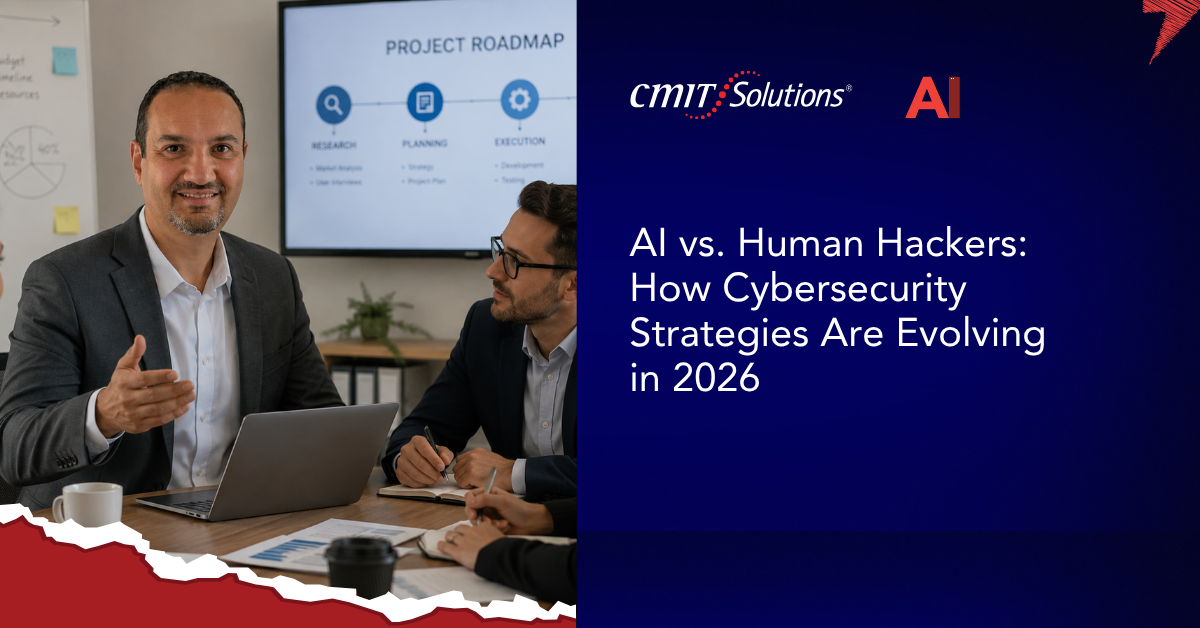
Cybersecurity in 2026 looks very different from what businesses faced just a few years ago. Cyberattacks are no longer limited to isolated phishing emails or basic malware campaigns. Today’s threat landscape is faster, more automated, and significantly more sophisticated.
One of the biggest changes shaping modern cybersecurity is the rise of artificial intelligence.
AI is now being used on both sides of the cybersecurity battle. Businesses are adopting AI-powered security tools to improve threat detection and response times, while cybercriminals are also leveraging AI to launch more advanced and targeted attacks.
This growing conflict between AI-driven defense systems and increasingly intelligent cyber threats is forcing businesses to rethink how they approach cybersecurity.
For organizations across every industry, traditional security models are no longer enough. Businesses now need adaptive, proactive, and intelligent cybersecurity strategies capable of evolving alongside modern threats.
Cyber Threats Are Becoming Faster and Smarter
Cybercriminals are no longer relying solely on manual attacks. Artificial intelligence has dramatically increased the speed and scale at which attacks can be launched.
In the past, hackers often spent weeks or months researching targets and identifying vulnerabilities. Today, AI-powered tools can automate large portions of that process within minutes.
Modern cyberattacks can now:
- Scan networks automatically for weaknesses
- Generate highly convincing phishing emails
- Mimic writing styles and communication patterns
- Automate credential-stuffing attacks
- Analyze stolen data faster
- Evade traditional security filters
This evolution has made cyber threats more difficult to detect and stop using conventional cybersecurity methods.
Businesses are facing attacks that are not only more sophisticated but also more frequent and harder to predict. Companies improving cyber readiness are also exploring AI-driven threats and modern cyber risks.
AI Is Changing the Way Phishing Attacks Work
Phishing remains one of the most common causes of cybersecurity breaches, but the nature of phishing attacks has changed dramatically in 2026.
Traditional phishing emails were often easy to identify because of poor grammar, suspicious links, or generic messaging. AI-generated phishing attacks are far more convincing.
Personalized Phishing Emails
Attackers analyze public information, social media activity, and company websites to create highly targeted messages that appear legitimate.
Deepfake Voice and Video Scams
AI-generated audio and video are being used to impersonate executives, vendors, or trusted contacts.
Automated Social Engineering Campaigns
AI tools can simulate natural conversations and manipulate users into revealing sensitive information.
These attacks are designed to bypass human suspicion and traditional email filters, making employee awareness and advanced threat detection more important than ever.
Businesses strengthening phishing protection are also reviewing security awareness training and email security strategies.
Businesses Are Fighting Back With AI-Powered Cybersecurity
While cybercriminals are using AI offensively, businesses are also adopting AI-powered cybersecurity tools to strengthen their defenses.
Traditional security systems often struggle to keep up with the speed and complexity of modern attacks. AI-driven security platforms help businesses identify threats faster and respond more effectively.
Modern cybersecurity systems can now analyze massive amounts of data in real time to detect suspicious activity before serious damage occurs.
AI-powered cybersecurity tools are helping businesses:
- Identify unusual network behavior
- Detect malware faster
- Monitor endpoint activity continuously
- Automate incident response
- Predict potential vulnerabilities
- Reduce response times during attacks
Instead of relying entirely on manual monitoring, businesses are using intelligent systems to improve visibility and strengthen threat detection across their environments with advanced managed cybersecurity services.
Businesses adopting AI-powered protection are also exploring AI security solutions and threat protection platforms.
Real-Time Threat Detection Is Becoming Essential
Speed has become one of the most important factors in cybersecurity.
The faster a business can detect and contain a threat, the lower the potential damage.
AI-powered monitoring systems continuously analyze network traffic, login behavior, cloud activity, and endpoint data to identify anomalies that may indicate cyberattacks.
This real-time visibility allows businesses to respond much more quickly than traditional security models.
For example, AI-driven systems can automatically:
- Block suspicious login attempts
- Isolate compromised devices
- Stop ransomware activity
- Detect unauthorized access
- Alert IT teams to abnormal behavior
This level of automation is becoming critical as cyberattacks continue to increase in speed and sophistication through proactive network monitoring.
Businesses improving threat visibility are also reviewing MDR and EDR tools and predictive cybersecurity.
Human Hackers Are Still a Major Threat
Despite the rise of AI-powered attacks, human hackers remain one of the biggest cybersecurity risks businesses face.
AI tools may automate parts of cyberattacks, but skilled attackers still play a major role in planning, adapting, and exploiting vulnerabilities creatively.
Social Engineering
Manipulating employees into revealing passwords, financial information, or sensitive data.
Business Email Compromise
Impersonating executives or vendors to trick employees into transferring money or sharing confidential information.
Exploiting Human Error
Taking advantage of weak passwords, poor security habits, and unpatched systems.
Targeted Attacks
Conducting highly customized attacks against specific organizations or industries.
This is why cybersecurity cannot rely entirely on automation. Businesses still need strong security policies, employee training, and human oversight to reduce risks effectively.
Businesses strengthening human-focused security are also reading about social engineering risks and insider threats.

Endpoint Security Has Become More Important Than Ever
As hybrid work environments continue to expand, endpoint devices remain one of the most common entry points for cyberattacks.
Employees now access business systems from laptops, smartphones, tablets, and remote networks outside traditional office environments.
Every connected device creates a potential security risk if not properly managed.
Businesses are strengthening endpoint security through:
- Real-time device monitoring
- Endpoint detection and response (EDR)
- Automated patch management
- Multi-factor authentication
- Remote device management
- Zero Trust security frameworks
AI-powered endpoint protection systems can identify suspicious activity quickly and help contain threats before they spread across business networks.
For businesses supporting remote and hybrid workforces, endpoint security has become a major priority in 2026 with advanced IT support services.
Businesses modernizing endpoint protection are also exploring remote workforce security and device management.
Zero Trust Security Is Replacing Traditional Security Models
One of the biggest shifts in modern cybersecurity strategy is the move toward Zero Trust security.
Traditional security models assumed that users inside the corporate network could generally be trusted. That approach no longer works in cloud-based and remote work environments.
Zero Trust follows a different principle:
Never trust. Always verify.
This means every user, device, and access request must be continuously validated regardless of location.
Businesses are using Zero Trust strategies to:
- Restrict unnecessary access
- Verify user identities continuously
- Monitor endpoint activity
- Protect cloud applications
- Reduce lateral movement during attacks
AI-powered security tools are helping businesses implement Zero Trust models more effectively by automating risk analysis and access monitoring through advanced cloud security services.
Businesses implementing Zero Trust are also reviewing identity management and secure authentication.
AI Is Also Helping Businesses Predict Cyber Risks
One of the most powerful advantages of AI-driven cybersecurity is predictive analysis.
Instead of reacting only after attacks occur, businesses can now identify patterns that may indicate future vulnerabilities or threats.
Predictive cybersecurity tools help organizations:
- Identify weak points in infrastructure
- Forecast emerging threat trends
- Prioritize security risks
- Improve patch management strategies
- Strengthen overall security planning
This proactive approach helps businesses stay ahead of evolving cyber threats rather than constantly reacting to incidents after they occur with strategic IT guidance.
Businesses planning long-term security strategies are also exploring future-ready cybersecurity and business resilience.
Cybersecurity Strategies Are Becoming More Proactive
The biggest change happening in 2026 is the shift from reactive cybersecurity to proactive cyber resilience.
Businesses now understand that cyberattacks are not a matter of “if” but “when.”
Instead of relying only on prevention, organizations are focusing on:
- Continuous monitoring
- Threat detection
- Rapid incident response
- Data backup and recovery
- Business continuity planning
- Security automation
Cyber resilience strategies help businesses maintain operations even during cyber incidents while minimizing downtime and financial losses through reliable data backup solutions.
Businesses improving cyber resilience are also reviewing ransomware recovery and business continuity planning.

Why Managed IT Services Are Becoming Essential
Modern cybersecurity environments are becoming too complex for many businesses to manage internally.
AI-powered attacks, cloud security, endpoint management, compliance requirements, and remote workforce protection require specialized expertise and continuous oversight.
This is why many businesses are partnering with managed IT providers for cybersecurity support.
Managed IT services help businesses:
- Monitor systems 24/7
- Detect threats proactively
- Manage endpoint security
- Implement Zero Trust frameworks
- Maintain compliance
- Respond quickly to cyber incidents
For SMBs, working with experienced IT professionals helps strengthen security while reducing operational complexity through reliable managed technology services.
Businesses evaluating IT partnerships are also exploring proactive IT support and technology management.
The Future of Cybersecurity in the AI Era
Artificial intelligence will continue reshaping cybersecurity over the next several years.
As attackers become more sophisticated, businesses will need smarter, faster, and more adaptive security strategies to remain protected.
Future cybersecurity trends will likely include:
- AI-driven threat intelligence
- Automated incident response
- Advanced behavioral analytics
- Self-healing security systems
- Predictive cybersecurity platforms
- Stronger identity verification technologies
Businesses that modernize their cybersecurity strategies now will be better prepared to adapt to the rapidly evolving digital threat landscape.
Organizations preparing for future threats are also reading about AI-powered security innovation and advanced cybersecurity planning.
Conclusion
The cybersecurity landscape in 2026 is being shaped by a growing battle between AI-powered defense systems and increasingly advanced cyber threats.
While artificial intelligence is helping businesses improve threat detection, automate security operations, and strengthen cyber resilience, attackers are also using AI to launch more sophisticated and targeted attacks.
This evolving environment requires businesses to move beyond traditional security models and adopt proactive, intelligent cybersecurity strategies designed for modern digital operations.
CMIT Solutions of Long Beach helps businesses stay protected with advanced cybersecurity solutions, proactive monitoring, endpoint security management, and managed IT services tailored to today’s evolving threat landscape.
From AI-powered threat detection to Zero Trust security frameworks and remote workforce protection, CMIT Solutions helps businesses build stronger cybersecurity strategies that support long-term operational stability and business growth. To strengthen your business cybersecurity strategy, contact our team today.