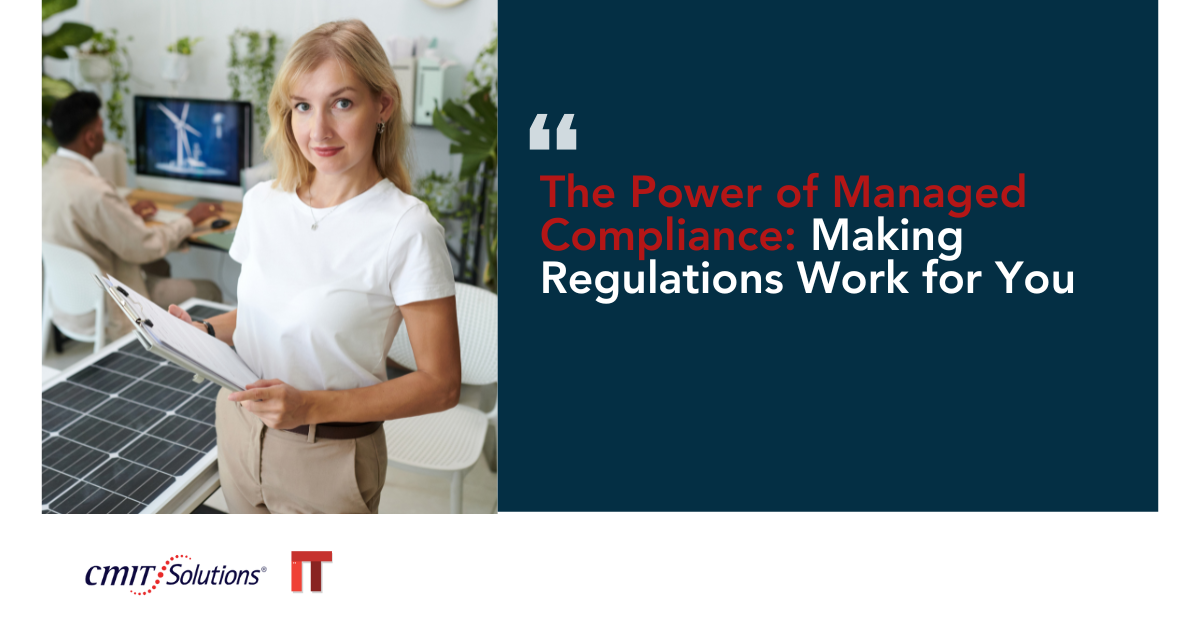
For most businesses, compliance feels like a burden, a checklist of rules and audits to satisfy regulators. But what if compliance could be your competitive edge instead of your constraint? Managed compliance transforms this mandatory responsibility into a strategic advantage, helping businesses build trust, strengthen cybersecurity, and streamline operations.
At CMIT Solutions of Long Beach, compliance isn’t just about following regulations, it’s about creating a resilient IT framework that protects your business while supporting long-term growth.
What Is Managed Compliance?
Managed compliance is the proactive, technology-driven management of your company’s security, data protection, and privacy obligations. Instead of scrambling to meet regulations during audits, managed compliance keeps you aligned year-round through automated monitoring, regular reporting, and expert oversight.
Key aspects include:
- Continuous monitoring of data and systems
- Automated documentation and reporting
- Policy enforcement across endpoints and cloud systems
- Real-time visibility into compliance status
As CMIT explains in its analysis of compliance audits, proper oversight transforms audits from stressful events into seamless confirmations of good practice.

Why Compliance Matters More Than Ever
Regulatory compliance is no longer optional; it’s a business survival requirement. Frameworks like HIPAA, GDPR, SOC 2, and CCPA govern how organizations collect, store, and use data. Failure to comply can result in heavy fines, operational shutdowns, and loss of customer trust.
The modern compliance landscape covers:
- Data privacy and consumer rights
- Industry-specific standards (healthcare, finance, education)
- Cybersecurity controls for small and midsized businesses
- Vendor and third-party risk management
CMIT Solutions’ work on cybersecurity compliance shows that businesses that treat compliance as strategy not paperwork gain credibility and confidence from clients.
The Hidden Benefits of Managed Compliance
Many companies approach compliance reactively — addressing issues only when required. A managed approach flips this mindset by integrating compliance into daily operations, making it easier, faster, and more effective.
Top benefits include:
- Operational efficiency: Automation removes manual reporting burdens.
- Risk reduction: Real-time monitoring identifies potential violations before they escalate.
- Customer trust: Transparent practices strengthen relationships.
- Competitive differentiation: Certified compliance gives your business an edge in procurement and partnerships.
This proactive approach aligns with CMIT’s philosophy in proactive IT preventing problems before they happen instead of reacting afterward.
Turning Compliance Into a Strategic Asset
When handled strategically, compliance becomes more than an obligation it becomes an advantage. It enhances your reputation, streamlines decision-making, and supports digital transformation.
Compliance can empower your business to:
- Improve internal accountability and data hygiene
- Strengthen vendor relationships through documented controls
- Unlock certifications that open new market opportunities
- Enhance resilience against cyber incidents and data breaches
CMIT’s driving growth perspective shows that compliance-aligned processes create operational confidence and scalability.
Compliance and Cybersecurity: Two Sides of the Same Coin
You can’t have effective compliance without robust cybersecurity and vice versa. Compliance frameworks like HIPAA and PCI-DSS are built on cybersecurity principles: data encryption, access control, and monitoring.
Core shared elements include:
- Risk assessments and vulnerability management
- Endpoint protection and secure network segmentation
- Access control and authentication policies
- Incident response planning and testing
CMIT’s expertise in AI security highlights how intelligent systems can help meet compliance demands by automating security checks and anomaly detection.
Compliance Automation: Simplifying the Complex
One of the most transformative aspects of managed compliance is automation. Instead of relying on spreadsheets or manual tracking, automated tools provide continuous oversight across systems, users, and data flows.
Automation delivers:
- Real-time policy enforcement
- Instant alerts on noncompliance
- Centralized reporting dashboards
- Auto-generated audit documentation
This efficiency mirrors the advancements covered in CMIT’s intelligent automation insights, where automation streamlines complex tasks without removing human oversight.
Industry-Specific Compliance Management
Different sectors face unique regulations and noncompliance in any can result in serious repercussions.
For example:
- Healthcare: HIPAA requires strict control over electronic protected health information (ePHI).
- Finance: FINRA and SOX compliance enforce financial integrity and transparency.
- Education: FERPA ensures student data privacy.
- Retail and e-commerce: PCI-DSS mandates secure payment handling.
CMIT’s focus on HIPAA and beyond demonstrates how customized compliance programs support industry-specific needs without overcomplicating operations.
How Managed Compliance Reduces Business Risk
Without consistent compliance, organizations face unpredictable costs and disruptions. Managed compliance reduces uncertainty through proactive monitoring and corrective action.
Risk mitigation strategies include:
- Conducting regular risk assessments
- Maintaining continuous visibility into system health
- Managing user permissions and data access levels
- Documenting every control action for audit-readiness
This aligns with CMIT’s expertise in zero trust adoption, where risk mitigation begins by assuming no access is inherently safe until verified.
Empowering Employees Through Compliance Awareness
Human error is a major compliance risk. A robust compliance program integrates ongoing training and awareness so employees understand their roles in maintaining security and privacy.
Effective compliance awareness training includes:
- Regular refresher courses on policies and procedures
- Role-based training for handling sensitive information
- Simulated exercises for responding to incidents
- Ongoing reminders about new regulations or company updates
This approach complements CMIT’s security awareness initiatives, which ensure employees act as proactive defenders rather than potential liabilities.

Managed Compliance and Cloud Environments
As more organizations migrate to cloud platforms, compliance management becomes more complex. Data can move between multiple providers, jurisdictions, and endpoints. Managed compliance offers centralized oversight for these distributed environments.
Cloud compliance strategies include:
- Multi-cloud policy enforcement
- Encryption and key management
- Data residency and sovereignty controls
- Vendor compliance verification
CMIT’s coverage of multi-cloud management shows how centralized monitoring ensures secure and compliant cloud operations without sacrificing flexibility.
How MSPs Simplify Compliance for SMBs
For small and midsized businesses, keeping up with evolving regulations is nearly impossible without expert help. A Managed Service Provider (MSP) like CMIT Solutions of Long Beach simplifies this process with end-to-end support.
An MSP provides:
- Continuous compliance monitoring and alerts
- Policy management tailored to your industry
- Secure cloud and endpoint management
- Documentation and audit readiness assistance
Through integrated monitoring and proactive support, CMIT’s help desk and IT governance solutions make compliance seamless and scalable.
Building Trust Through Transparency
Compliance builds credibility with clients, vendors, and regulators. By maintaining transparency showing where data lives, how it’s secured, and who accesses it businesses demonstrate professionalism and accountability.
Transparency advantages:
- Simplifies vendor onboarding
- Strengthens client relationships
- Enhances reputation for data integrity
- Supports long-term brand growth
This mirrors CMIT’s stance in cybersecurity without compromise, where transparency and proactive defense go hand in hand.
Compliance as a Growth Enabler
When managed effectively, compliance doesn’t slow growth; it enables it. Businesses that maintain compliance can expand confidently into new markets, industries, or partnerships without the fear of regulatory setbacks.
Growth outcomes include:
- Faster vendor approvals
- Easier mergers and acquisitions due diligence
- Streamlined customer onboarding
- Enhanced ability to attract investors
In CMIT’s article on driving growth, technology-enabled compliance is identified as one of the key accelerators of business innovation.
Future of Managed Compliance: Automation and Intelligence
The next generation of compliance will be powered by artificial intelligence and predictive analytics. These systems will continuously scan for compliance drift, detect anomalies, and recommend corrective actions automatically.
Emerging trends include:
- AI-assisted compliance mapping
- Continuous validation and auditing
- Predictive alerts for policy violations
- Real-time visibility through data dashboards
These innovations reflect the progress CMIT outlined in AI innovation, where automation reduces human workload while enhancing accuracy.
Conclusion: Compliance as a Catalyst for Confidence
Compliance shouldn’t feel like an obstacle, it’s a roadmap to operational excellence. Managed compliance allows businesses to simplify complex regulations, reduce risk, and build a foundation of trust with customers and partners.
By partnering with CMIT Solutions of Long Beach, companies gain access to automated compliance management, expert advisory services, and end-to-end monitoring. When technology and governance align, regulations stop being a burden and start becoming a powerful business advantage. Managed compliance isn’t just about checking boxes, it’s about turning security, trust, and accountability into your biggest strengths.